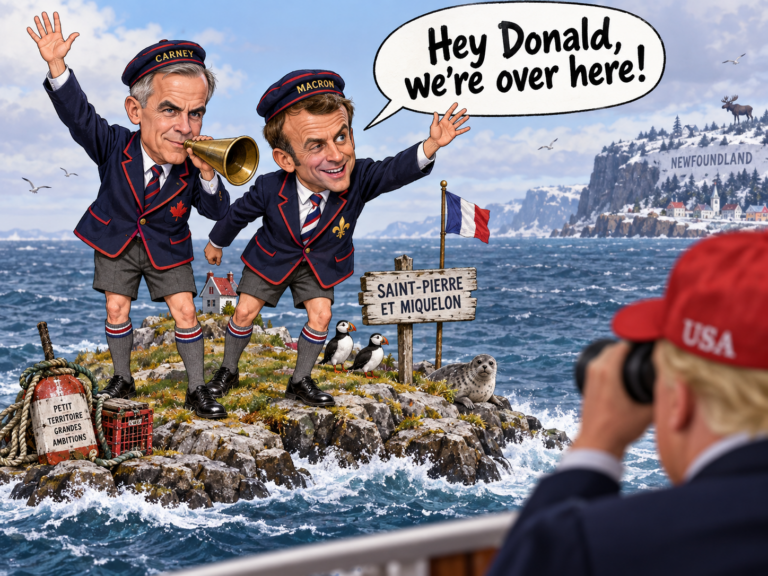
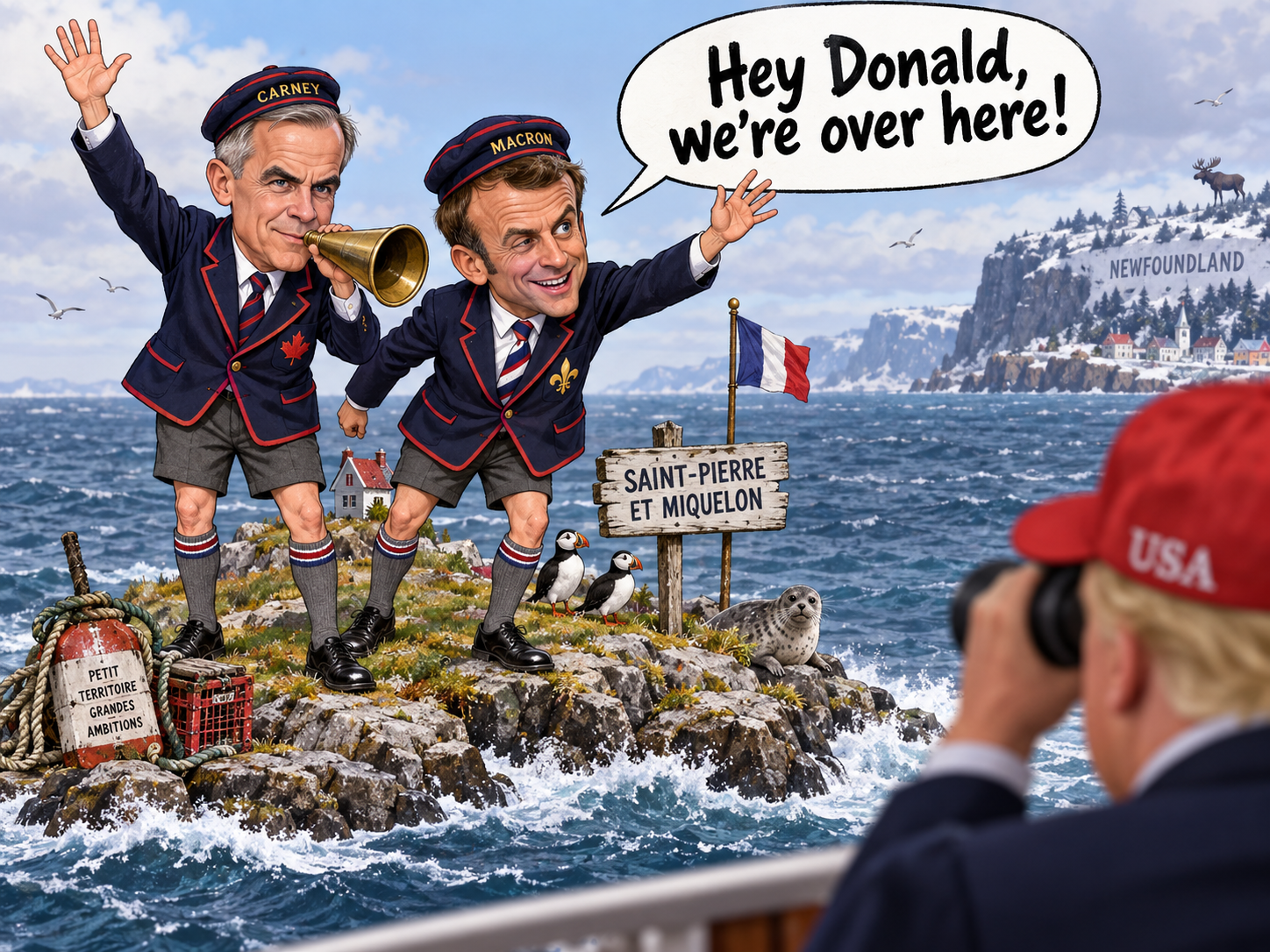
Carney and Macron, portrayed as schoolboys, call attention to Saint-Pierre and Miquelon in this satirical image about the tiny French territory off Newfoundland.
By Hans Wilder | Watertown Post
Canadian Prime Minister Mark Carney and French President Emmanuel Macron traveled to tiny Saint-Pierre and Miquelon on Sunday and somehow managed to turn one of the most easily overlooked pieces of North America into an international geopolitical story.
From where we sit at the Watertown Post, the whole thing looks a little like two kids standing in the back of the classroom with both hands waving over their heads: “Hey Donald Trump, we’re over here!”
Saint-Pierre and Miquelon sits just off Newfoundland and remains sovereign French territory, the last territorial remnant of France’s former North American empire. Carney and Macron did not simply meet there for coffee and croissants. Their talks included closer cooperation between Canada and France involving defense ministries, space agencies, launch systems, ground-reception facilities, energy and broader strategic ties.
Macron had also said before the meeting that he intended to discuss increased Canadian oil and liquefied natural gas trade with France.
So congratulations, gentlemen. Everybody is looking at the islands now.
For generations, Saint-Pierre and Miquelon existed as a strange little historical leftover that most Americans probably never thought about. France owned it, Canada lived next door, and everybody went about their business. Then Carney and Macron arrived with cameras, defense discussions, space cooperation and a message about stronger Canadian-European ties.
If the objective was to remind Washington that a European power still owns strategically located territory sitting directly off the North American coast, mission accomplished.
The Watertown Post position is straightforward. Europe is Europe. North America is North America. European governments are welcome as allies, trading partners and friends, but the United States has every reason to take a hard look at foreign strategic infrastructure operating on this continent, especially as the Arctic and North Atlantic become increasingly important.
That does not mean pretending history does not exist. Saint-Pierre and Miquelon is presently French territory. But treaties and arrangements made in another century do not prevent Americans from asking whether those arrangements continue to make strategic sense in the world of 2026.
Look at the map.
The islands sit beside Newfoundland near the approaches to the North Atlantic and an increasingly important Arctic region. Add maritime surveillance, satellite infrastructure, shipping, communications, energy security and the growing strategic importance of Greenland, and suddenly those little French islands do not look quite so insignificant.
That is why Sunday’s meeting was almost comical.
Carney and Macron could have met in Paris. They could have met in Ottawa. They could have met in Montreal. Instead, they deliberately traveled to France’s last territorial foothold in North America and discussed defense, space, energy and deeper cooperation between Canada and Europe. Reuters reported that the location itself carried symbolism amid worsening tensions between Washington, Ottawa and European governments.
If you wanted to get Donald Trump and American strategic planners staring at Saint-Pierre and Miquelon on a map, it would be difficult to design a better publicity campaign.
The broader question should now be openly discussed: does it serve American strategic interests to have a European sovereign outpost sitting in such a geographically important part of North America?
The Watertown Post believes that question deserves a serious answer.
A future American administration could pursue negotiations over access, basing arrangements or some broader North American security agreement involving the islands. Any actual change in sovereignty would require diplomacy and agreement among the governments and people involved. But there is nothing unusual about the United States examining strategically important territory near its own continental approaches.
That is especially true as Washington pays greater attention to the Arctic, Greenland and the northern defense of North America.
Carney and Macron apparently wanted Sunday’s meeting to demonstrate Canadian-French cooperation and emphasize Canada’s expanding relationship with Europe.
They succeeded.
They also managed to remind millions of Americans that France still owns a little piece of North America.
And perhaps the funniest part is that they did it themselves.
No American advertising campaign was necessary. No Pentagon briefing was required. No history lesson was needed.
Carney and Macron simply stood on Saint-Pierre and Miquelon, waved their hands in the air and effectively announced:
“Hey Donald. We’re over here.”
Now everybody knows exactly where to look.
About the Author