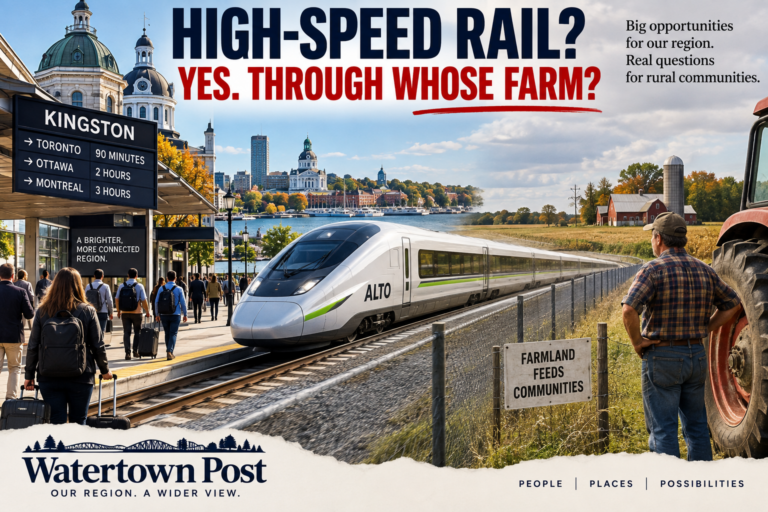
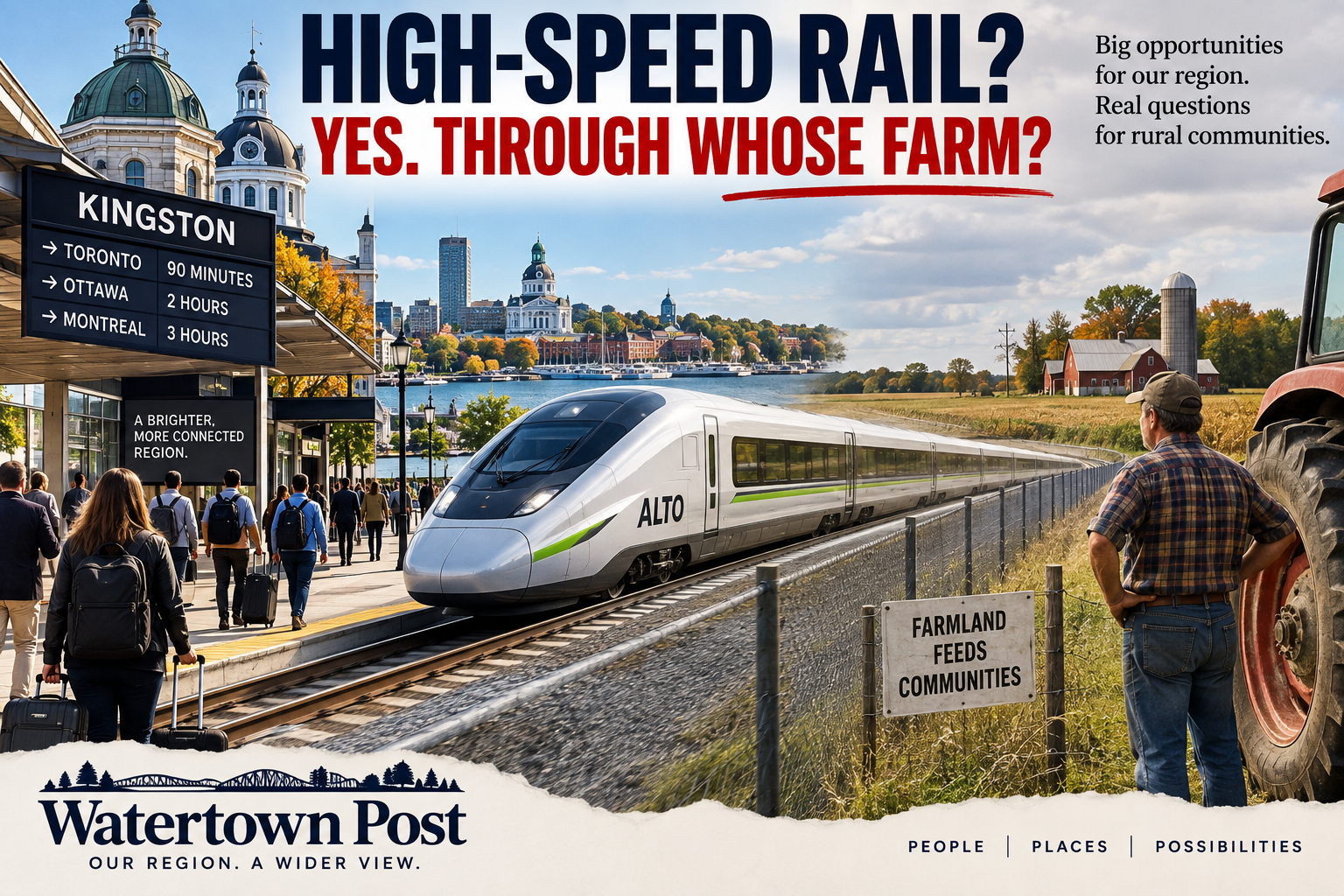
A Kingston Alto station could put Toronto roughly 90 minutes away, but the proposed high-speed rail network is raising concerns among farmers and rural landowners over where the new tracks will run.
By Hans Wilder | Watertown Post
WATERTOWN, N.Y. — Let’s start with the part of Canada’s proposed Alto high-speed railway that sounds pretty darn good from Northern New York.
Imagine crossing the border, driving up to Kingston, parking the car and climbing aboard a genuine high-speed train. About 90 minutes later, you’re in Toronto. Head east and the same network would connect you with Ottawa, Montreal and eventually Quebec City. Trains are expected to travel at speeds approaching or exceeding 300 kilometers per hour. For Watertown and the Thousand Islands region, having that kind of transportation system sitting just across the border would be a remarkable convenience.
We like big infrastructure projects around here. We certainly like the idea of Kingston becoming an even bigger transportation hub for this entire cross-border region.
BUT, here’s the skinny.
That train has to go somewhere.
And unlike the existing VIA Rail system, Alto isn’t simply a matter of putting faster trains on the tracks already running through Kingston. True high-speed rail requires long, relatively straight sections, broad curves, no ordinary level crossings and a protected right-of-way. Alto says its trains could travel at around 300 to 320 km/h. The eventual right-of-way is expected to average roughly 60 metres wide.
That means land.
Lots of it.
And suddenly the shiny train that gets somebody from Kingston to Toronto in about 90 minutes looks considerably different to the farmer whose family property might have a high-speed railway running through it.
That concern boiled over Saturday, September 19, in Rigaud, Quebec, where farmers and landowners brought out their tractors to protest Alto. Rebel News reporter Alexandra Lavoie was there as property owners raised concerns about expropriation, farms being divided and roads potentially being cut off by the future railway corridor. Some protesters said their biggest fear wasn’t the train itself. It was what could happen to the land beneath it.
And those concerns aren’t limited to Quebec.
They matter tremendously around Kingston because Ottawa is now examining a southern route between Peterborough and Ottawa that could include Kingston as an Alto station. That possibility became much more concrete in June when Transport Minister Steven MacKinnon directed Alto to develop a plan assessing the southern option with a potential Kingston stop. Alto estimates that such a station could put Kingston approximately 90 minutes from Toronto.
Here’s where things get particularly interesting.
Kingston Mayor Bryan Paterson, South Frontenac Mayor Ron Vandewal and Save South Frontenac have jointly said that if this massive railway is going to be built, put it along the Highway 401 corridor and give Kingston a station.
That sounds remarkably sensible.
Their concern is that carving an entirely new transportation corridor through South Frontenac could fragment farms, wetlands and rural communities. Their preferred alternative is to concentrate the railway as much as practical alongside infrastructure that already exists.
Unfortunately, physics gets a vote too.
Alto says it cannot simply follow every twist and turn of Highway 401 because a train moving around 300 km/h requires much gentler curves than a highway. So even if planners attempt to use the 401 corridor wherever practical, there will likely be places where the railroad has to depart from it.
And that’s where somebody’s farm, woodlot or backyard can enter the equation.
To be fair, Alto says the giant corridor appearing on planning maps right now is not the final railway route. The current study corridor is approximately 10 kilometres wide. Eventually planners expect to narrow that down to an actual right-of-way roughly 60 metres wide. Alto says it intends to minimize farmland fragmentation, use existing infrastructure and property lines where possible, provide crossings where necessary and prioritize negotiated purchases rather than expropriation.
That’s an important distinction. Nobody should look at the present Alto map and assume every farm inside that broad band is about to disappear.
But farmers aren’t crazy for paying attention now, either.
Once engineers settle on those long straight stretches necessary for 300-km/h trains, the abstract line on a planning map becomes somebody’s actual property. A high-speed railway can divide a farm, change access to fields and require bridges, tunnels or considerably different routes for agricultural equipment. Alto itself acknowledges those concerns and says farmers and landowners have raised questions about property acquisition, farmland, agricultural operations and access.
The project isn’t cheap, either. Current preliminary estimates put Alto at roughly $60 billion to $90 billion, although that is not a final construction budget. The complete Toronto-to-Quebec City network would stretch roughly 1,000 kilometres. Alto says the first construction segment, between Montreal and Ottawa, is expected to begin around 2029 or 2030, with the full system taking roughly 12 years to complete.
For Northern New York, however, there is another side to this story that deserves some attention.
If Kingston gets an Alto station, Watertown could find itself sitting just across the international border from one of the most advanced passenger rail systems in North America while having no intercity passenger railroad of its own.
Think about that for a minute.
A Watertown resident could potentially drive north across the Thousand Islands Bridge, board a 300-km/h train in Kingston and reach Toronto in roughly 90 minutes. Meanwhile, getting from Watertown south to Syracuse without a car remains another matter entirely.
Maybe that ought to restart our own conversation about regional rail on this side of the border.
The Watertown Post has previously proposed restoring passenger rail between Syracuse, Watertown and Fort Drum, including connections serving the enormous Micron development in Central New York. A future Kingston high-speed station would make that discussion even more interesting. Suddenly we’re not merely talking about getting Watertown residents to Syracuse. We’re talking about a Northern New York region potentially sitting between major transportation investments on both sides of the border.
That could be a tremendous opportunity.
But what is happening in Rigaud is also a reminder that infrastructure has consequences. It’s easy to love a high-speed railroad when you’re the guy sitting comfortably in the seat watching the countryside fly past at 300 kilometres per hour. It’s considerably different when that countryside belongs to you.
So yes, give us that Kingston station.
Being able to cross the border, hop aboard and get to Toronto in about 90 minutes sounds fantastic.
But let’s also listen to the farmers and property owners who may be asked to make that convenience possible. The smartest version of Alto would give Kingston and Eastern Ontario the economic benefits of high-speed rail while using existing transportation corridors wherever technically possible and taking as little productive farmland and private property as reasonably achievable.
That’s the skinny.
The train sounds great.
Just make damn sure you know whose backyard you’re running it through.
About the Author