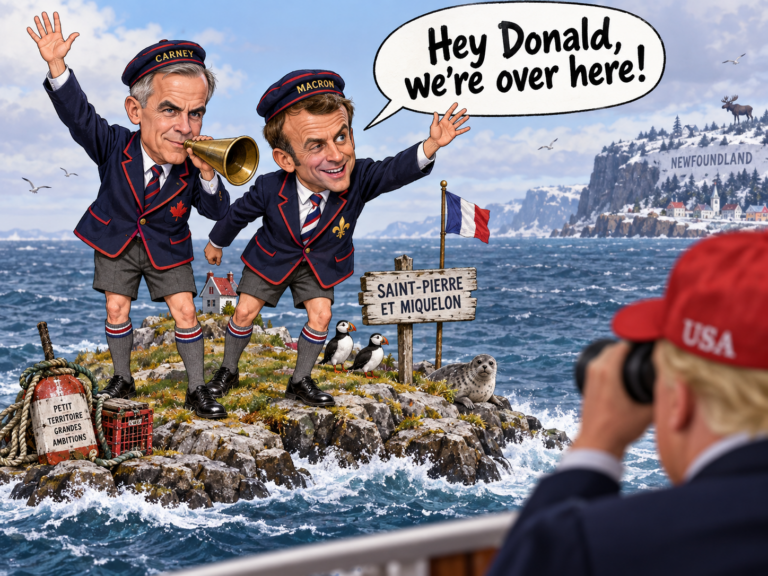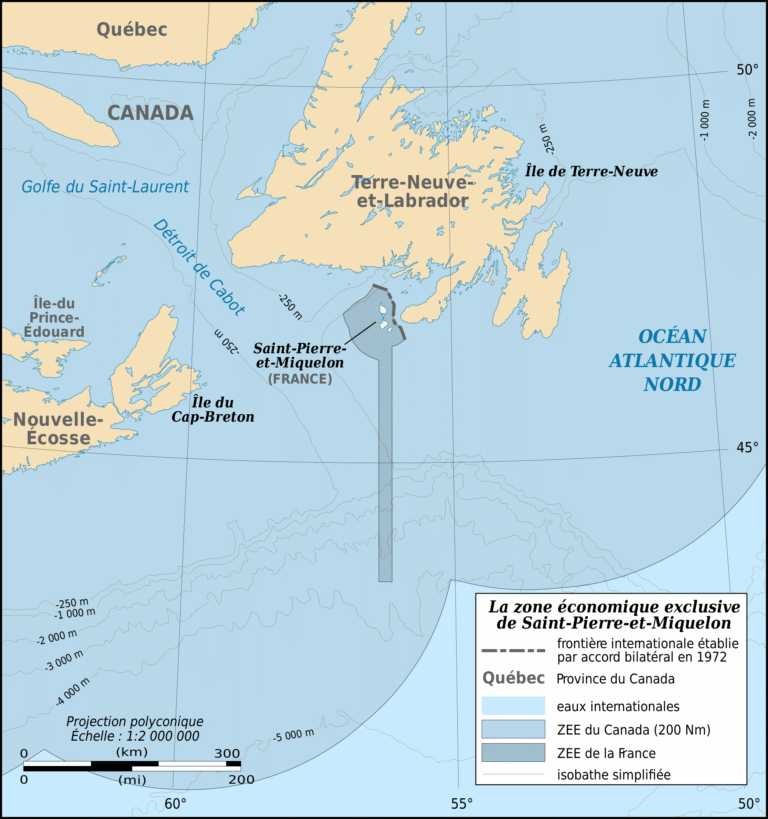
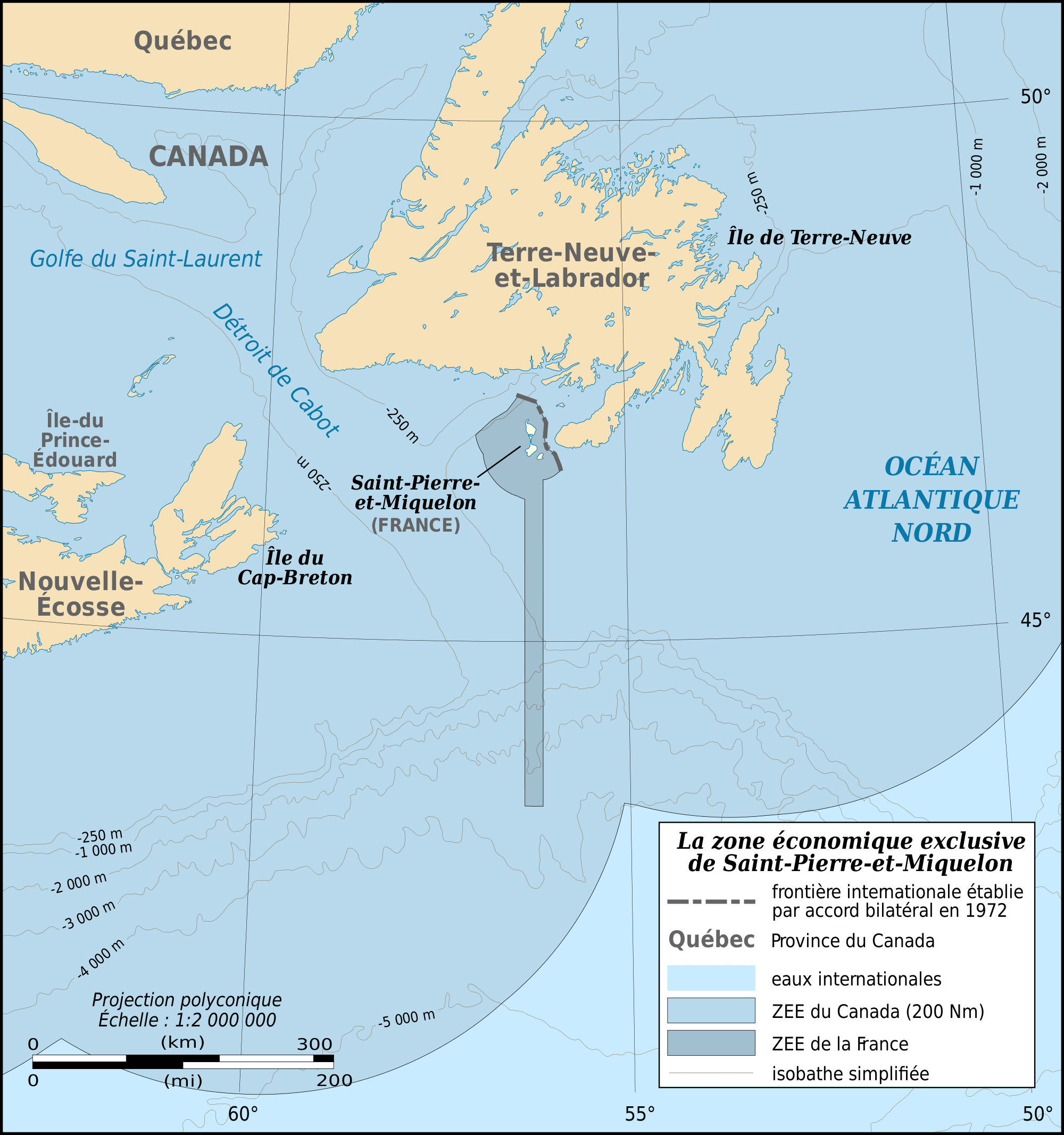
France’s Saint-Pierre and Miquelon sits just off Newfoundland, giving France a continuing territorial and fishing presence in North American waters.
By Hans Wilder | Watertown Post
There are two little islands sitting just off the coast of Newfoundland that most Americans probably couldn’t find on a map.
They belong to France.
Saint-Pierre and Miquelon are the surviving remnants of what was once an enormous French colonial empire in North America. France lost Canada more than 260 years ago, yet these islands remained French. Today they give a European country territory, maritime rights and a continuing role in fisheries immediately off the North American coast.
And if you want to understand why that matters, look at what happened to the cod.
For centuries, the waters surrounding Newfoundland and the Gulf of St. Lawrence supported one of the greatest fisheries on Earth. Then industrial fishing arrived on an enormous scale.
Canada’s own fisheries records show that the 3Ps cod stock south of Newfoundland was heavily exploited by fishing fleets during the twentieth century. The collapse cannot honestly be blamed solely on France. Canadian vessels and fleets from several other countries also participated, and fisheries management and changing environmental conditions were important factors.
But France was very much part of the fishing pressure.
France’s presence at Saint-Pierre and Miquelon gave it a permanent position beside some of North America’s richest traditional fishing grounds. The 3Ps cod stock actually crosses the maritime boundary surrounding the French islands. Canada and France therefore jointly manage that stock today, with Canada receiving 84.4 percent of the allowable catch and France receiving 15.6 percent.
Think about that for a moment.
More than two centuries after the great colonial struggle between Britain and France for control of North America ended, a European nation still receives more than 15 percent of the allowable catch from an important cod stock immediately south of Newfoundland.
But it gets even stranger.
France’s Fishing Rights Reach Into the Gulf of St. Lawrence
Saint-Pierre and Miquelon doesn’t merely give France fishing rights around the islands themselves.
Under the 1972 Agreement between Canada and France, Canada allocates 2.6 percent of the total allowable catch of the 3Pn4RS cod stock to Saint-Pierre and Miquelon. That stock extends into the Gulf of St. Lawrence.
That means France continues to possess fishing rights involving a resource managed by Canada well beyond the immediate waters surrounding its little island territory. Fisheries and Oceans Canada explicitly says that the allocation exists because of the 1972 Canada-France fishing agreement.
Older Canadian government documentation was even more striking. It described France as the only foreign nation continuing to possess cod-fishing rights in the Gulf of St. Lawrence under that agreement.
This isn’t ancient history buried in some dusty treaty book.
The Canadian government still lists that 2.6 percent allocation today.
Then Came the Cod Disaster
The consequences of overfishing throughout the northwest Atlantic were catastrophic.
Cod stocks collapsed, moratoriums were imposed and generations of fishing communities suddenly found that a resource people once considered virtually inexhaustible wasn’t inexhaustible at all.
France wasn’t solely responsible. That needs to be stated clearly.
Canada bears responsibility for its own management decisions, and Spanish, Portuguese and other international fleets historically operated throughout the northwest Atlantic as well. The famous northern cod collapse was also a different stock from the 3Ps stock surrounding Saint-Pierre and Miquelon.
But France was part of the larger industrial fishing era that put extraordinary pressure on North Atlantic cod.
Canadian fisheries records show that before jurisdiction was extended in 1977, Canadian, Spanish, Portuguese and French fleets all fished the 3Pn4RS stock. After 1977, Canada, France and Saint-Pierre and Miquelon remained involved.
The 3Ps stock suffered badly as well. Canadian scientific records describe it as heavily exploited, with abundance falling to record-low levels in 1994 after a moratorium had already been imposed in 1993.
And France’s involvement did not disappear with the crisis.
Canada and France still negotiate management of the transboundary 3Ps stock. In fact, Canadian government briefing documents show that when Canada sought no directed 3Ps cod fishery for the 2021-22 season because the stock remained in the critical zone, France strongly opposed the proposal. The two governments ultimately agreed instead to a 50 percent reduction in the total allowable catch and began developing a rebuilding plan.
That is precisely why Saint-Pierre and Miquelon matters.
This Is About More Than Two Tiny Islands
France is an American ally. This isn’t an argument against French people, French culture or cooperation between France and the United States.
It is a question of geography, resources and sovereignty.
Why should European colonial possessions continue determining who controls resources around North America in the 21st century?
The people of Newfoundland lived through the economic devastation of the cod collapse. North American fishing communities depend upon these resources. North American governments ultimately have to deal with the economic and environmental consequences when those resources are depleted.
Yet France maintains a territorial foothold immediately beside Newfoundland and fishing rights established through agreements descended from a colonial arrangement stretching back centuries.
That deserves another look.
North American Waters, North American Responsibility
The United States and Canada disagree about plenty. We have fought wars, trade battles and more than a few arguments over fish.
But there is a larger principle here.
The natural resources surrounding North America should primarily be managed for the long-term benefit of the people living on this continent.
Saint-Pierre and Miquelon should therefore be part of a broader modern discussion about the remaining European territories in North America and what their future should be. Any change in sovereignty would necessarily involve international law, France, Canada and, critically, the democratic wishes of the people who actually live on the islands.
But there is nothing unreasonable about questioning an arrangement simply because it has existed for centuries.
The cod collapse demonstrated exactly what happens when nations treat a seemingly limitless natural resource as something that will always be there.
It wasn’t limitless.
Today France still receives 15.6 percent of the 3Ps cod allocation and Saint-Pierre and Miquelon still receives 2.6 percent of Canada’s 3Pn4RS cod TAC under an agreement signed more than half a century ago.
Those aren’t historical footnotes. Those are current fishing arrangements.
Saint-Pierre and Miquelon may look like two insignificant dots on the map.
When those dots carry territory, maritime jurisdiction and access to North America’s natural resources, however, they aren’t insignificant at all.
The cod learned that lesson the hard way.
About the Author