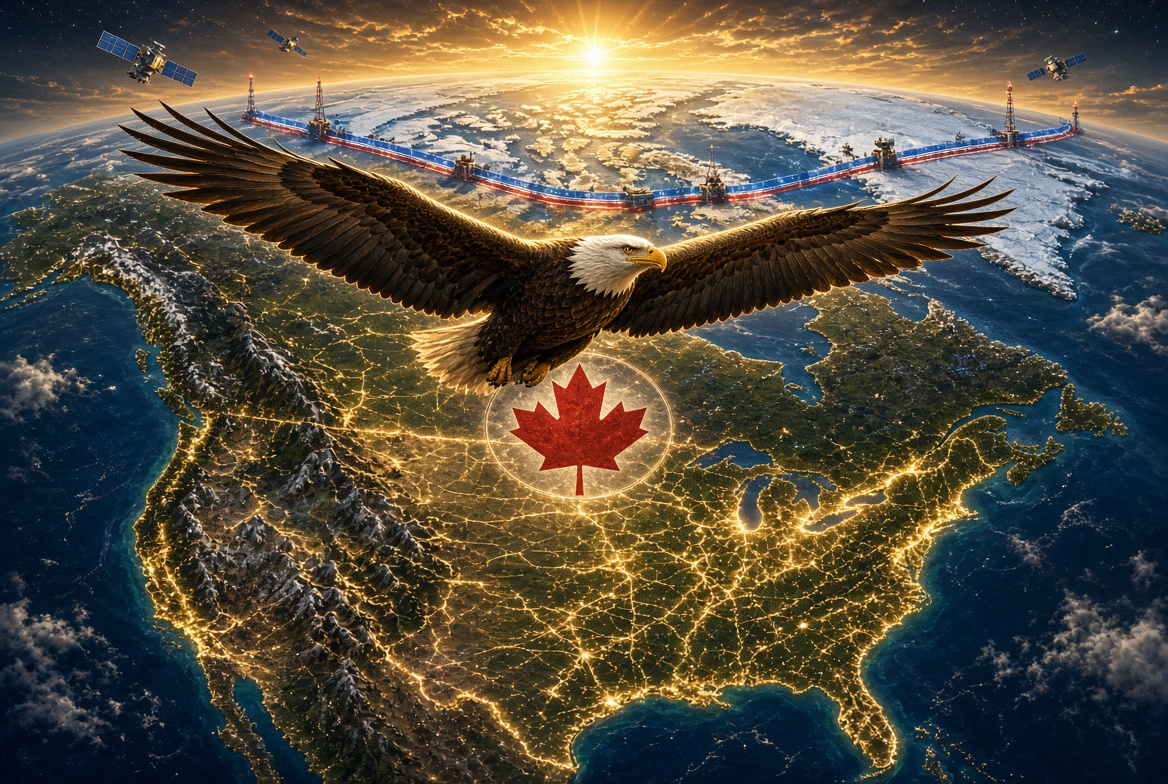
A dramatic orbital view of North America glowing at sunrise, with a soaring bald eagle, Arctic infrastructure, satellites, and a maple leaf symbol over Canada.
By Hans Wilder | Watertown Post
North America stands at a strategic crossroads that would have sounded almost unimaginable only a few years ago. Canada is locked in a worsening trade dispute with the United States while simultaneously pursuing dramatically deeper ties with Europe, reopening economic doors to China, allowing Chinese electric vehicles into its market, expanding its defense industry, and preparing to manufacture millions of military drones. At the same time, the Arctic is growing more vital to the United States, Russia, and China. President Trump has explicitly revived the Monroe Doctrine and American strategic leadership in the Western Hemisphere, setting the stage for a new American Golden Age of strength, prosperity, and continental security.
Taken together, these developments force a blunt conclusion: Canada’s trajectory under Prime Minister Mark Carney threatens the integrated North American system that has underpinned U.S. security and prosperity for generations. Carney is a classic globalist—a former central banker and elite insider who talks like a progressive while operating in the world of billionaire networks that push transnational agendas over national sovereignty. These are the billionaire globalists who lecture about equity and climate while consolidating power and opening doors to Beijing. The time for polite diplomacy is ending. The United States, under Trump’s leadership, must act decisively to secure its northern flank—through full strategic integration that effectively brings Canada under firm American control—before the window closes and the Golden Age is delayed.
The most alarming development came Sunday, September 13, when the Wall Street Journal reported that Carney has been exploring the unprecedented idea of Canada becoming some form of “associate member” of the European Union. Reuters confirmed discussions covering freer movement of goods, services, and workers, plus cooperation on defense, artificial intelligence, energy, critical minerals, and major infrastructure. This is not a routine trade deal. It reaches into labor mobility, defense procurement, technology rules, strategic resources, and infrastructure. Visa-free mobility and deep participation in Europe’s single market would reorient Canada toward a transatlantic system while it still shares roughly 5,500 miles of border with the United States. This is pure globalist engineering: dilute national control, expand elite-managed mobility, and weaken the continental core that Trump is determined to strengthen.
The United States and Canada have spent generations building an unusually integrated continental system: automotive components crossing the border repeatedly, shared electrical grids, pipelines, railroads, agriculture, routine cross-border travel, and joint defense of North American airspace through NORAD. Free mobility with Europe would not instantly grant Europeans entry to the United States, but it would erode the assumptions underlying that open northern relationship. How deeply can Canada integrate with a separate economic and labor bloc before Washington must treat the border as a genuine strategic vulnerability rather than a shared convenience? Trump’s America First approach rejects that vulnerability. A Golden Age requires secure borders, controlled supply chains, and American leadership—not Carney’s globalist experiments.
The commercial stakes are higher still. If Canada adopts European regulatory standards, defense systems, technology rules, industrial subsidies, or supply-chain requirements while remaining inside USMCA, Canadian firms would straddle two large but incompatible systems. Rules of origin, standards, procurement, and preferential treatment for goods entering the United States would become constant flashpoints. Canada cannot keep one foot in the North American marketplace and another in the European one without forcing the United States to rewrite the terms of access. Trump has already shown he will not tolerate one-sided deals. Securing Canada means locking in continental rules that prioritize American workers, American energy, and American security.
Then there is China. Canada has already broken with Washington’s approach to Chinese electric vehicles. Beginning March 1, Ottawa replaced its previous 100 percent surtax with a quota allowing 49,000 Chinese EVs annually at the normal 6.1 percent tariff, with the quota set to rise 6.5 percent each year. Officials frame this as diversification. Modern EVs are rolling computer networks packed with cameras, microphones, communications gear, navigation systems, software, and data-processing capability. Washington correctly treats connected vehicles and their supply chains as both economic and national-security issues. If Chinese manufacturers establish factories or joint ventures in Canada, the United States will face immediate questions: When does a Chinese product made in Canada become “Canadian” enough for North American privileges? Where do the batteries, processors, and software originate? Who controls the data? How much Chinese state-backed investment should be tolerated inside a supply chain that currently moves freely into the United States? Carney’s willingness to open the door to Beijing while preaching progressive values is the hallmark of the billionaire globalist class—profit and ideology over national interest.
Canada’s drone initiative compounds the problem. Carney announced plans to develop capacity to manufacture millions of drones within two years, with roughly one-third destined for Ukraine. That scale could make Canada a major unmanned-systems producer. There is nothing inherently hostile about a NATO ally building drones, but military-grade production immediately north of the U.S. border makes control of the supply chain non-negotiable. Processors, communications equipment, cameras, batteries, AI systems, and electronics cannot be treated as ordinary consumer goods. The United States has a legitimate security interest in ensuring that sophisticated military technology produced on its northern border does not depend on Chinese components or other vulnerable foreign sources. Trump’s Golden Age vision includes American dominance in advanced manufacturing and defense technology—not outsourcing strategic capacity to a Canada drifting under globalist influence.
Hovering over everything is the Arctic. The region is rapidly becoming an economic and strategic frontier involving shipping routes, resources, surveillance, missiles, submarines, satellites, and northern access. Russia already fields major Arctic capabilities. China has deliberately sought a larger role despite not being an Arctic nation. Canada controls a vast share of the North American Arctic. That reality makes Canadian foreign-policy choices far more consequential to Washington than ordinary disagreements with a friendly neighbor. Trump has made clear that the Western Hemisphere will not be shaped by outside powers. The Monroe Doctrine, reinforced by the Trump Corollary announced in December 2025, declares that foreign countries and international institutions will not determine the future of this hemisphere. American leadership is non-negotiable.
Place Carney’s European initiative inside that framework. Canada is pursuing an unprecedented relationship with the EU covering worker mobility, strategic industries, defense, AI, energy, and infrastructure. It is simultaneously trying to reduce economic reliance on the United States and reopening significant engagement with China. This is the globalist playbook: weaken the American-led continental system, expand transnational institutions, and create room for Beijing. Meanwhile Trump is prioritizing continental supply chains, Arctic security, American energy dominance, and limiting strategic dependence on foreign powers. These strategies are moving in opposite directions. One path leads to a Golden Age of American strength. The other leads to fragmentation.
The fundamental issue is no longer one tariff dispute or a handful of Chinese cars. It is whether North America continues as an integrated strategic region under American leadership or becomes the meeting point of three competing systems: the United States, Europe, and China. Geography is stubborn. Detroit is still next to Windsor. New York is still next to Ontario and Quebec. Montana still borders Alberta and Saskatchewan. Washington State still borders British Columbia. The Great Lakes remain shared. Canada’s major pipelines do not terminate in Paris because politicians sign papers in Brussels.
A true continental framework under Trump’s leadership must go further than past talk of integration. Preferential access to the extraordinarily integrated North American economic system should come with common strategic standards on foreign investment, Chinese state-supported industries, connected vehicles, telecommunications, drones, AI infrastructure, semiconductors, batteries, and critical minerals. NORAD should expand into a true twenty-first-century continental defense system covering Arctic surveillance, drones, satellites, missile detection, maritime domain awareness, and protection of critical infrastructure. Legitimate commerce inside North America becomes easier. The external economic and security perimeter becomes harder. That is how you build a Golden Age.
Canada understandably seeks additional markets. Europeans remain American allies. Trade diversification can strengthen a country. Those facts do not erase the contradiction created by Carney’s globalist agenda. Canada cannot realistically become deeply integrated into European strategic supply chains, invite greater Chinese participation in key industries, create broad labor mobility with another economic bloc, and simultaneously expect the privileged economic relationship across the American border to remain unchanged forever.
Washington possesses sovereign choices. The United States can decide what qualifies for preferential market access. It can set rules for sensitive technologies, connected vehicles on American roads, foreign technology in critical infrastructure, and tougher rules of origin under USMCA. Trump has already demonstrated he will use every tool available to protect American interests. The preferred outcome is decisive integration—securing the northern border, the Arctic, the supply chains, and the strategic industries so that North America functions as a coherent continental power rather than a vulnerable patchwork.
North America possesses extraordinary advantages if coordinated under strong American leadership: energy reserves, agricultural capacity, freshwater, critical minerals, advanced technology, manufacturing expertise, financial markets, and access to the Atlantic, Pacific, and Arctic. Artificial intelligence is transforming the economy. Autonomous systems are transforming warfare. Electric vehicles increasingly resemble computers on wheels. Semiconductors and critical minerals have become instruments of national power. Arctic shipping and defense grow more important every year. Institutions built for twentieth-century assumptions cannot manage twenty-first-century strategic competition indefinitely.
Canada is not an enemy of the United States. Precisely the opposite: Canada is too important to North American security and prosperity to be left drifting under globalist leadership of the Carney variety—elite billionaires who advance transnational agendas while ordinary citizens pay the price. Carney’s European proposal may ultimately go nowhere. Europe may decide a new associate-membership category is impractical. Canadians may reject the compromises. But the proposal has already forced the question into the open.
If Canada under Carney believes its future involves substantially deeper economic, labor, and strategic integration with Europe while expanding relationships with China, then the United States under Trump must decide what kind of northern relationship it will accept. The advantages of the existing continental system remain greater than the alternatives. The answer is not less North American integration. It is considerably more—secured now, under American leadership, before external powers and divergent policies make the cost of restoration far higher.
The borders between the countries do not have to vanish for North America to act strategically as a continent. But the time for pretending these questions can be postponed is over. President Trump’s vision of a Golden Age demands locked-in continental control of the northern approaches, the Arctic domain, and critical supply chains without further delay. Secure Canada. Secure the future. Build the Golden Age.
About the Author