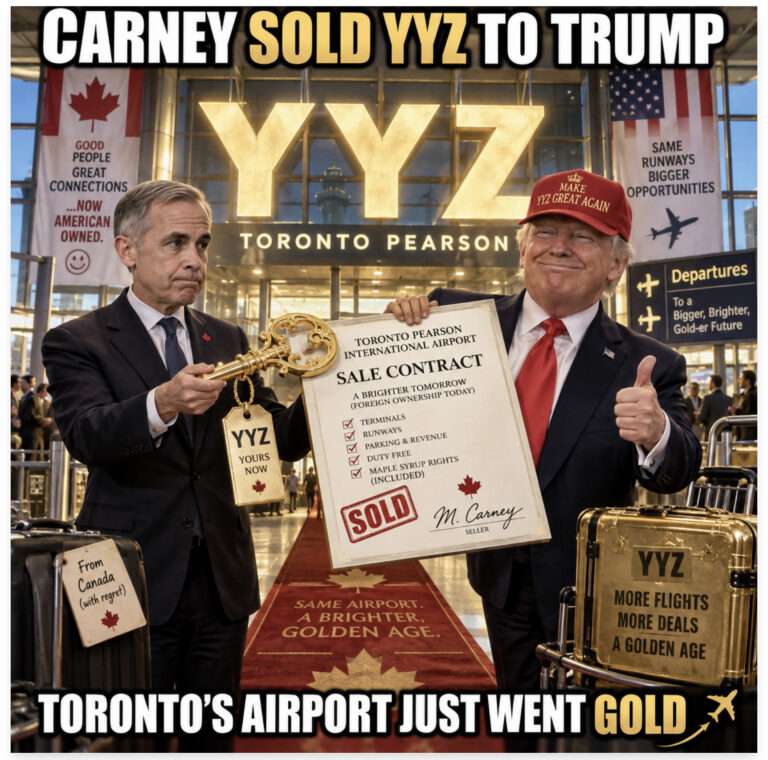
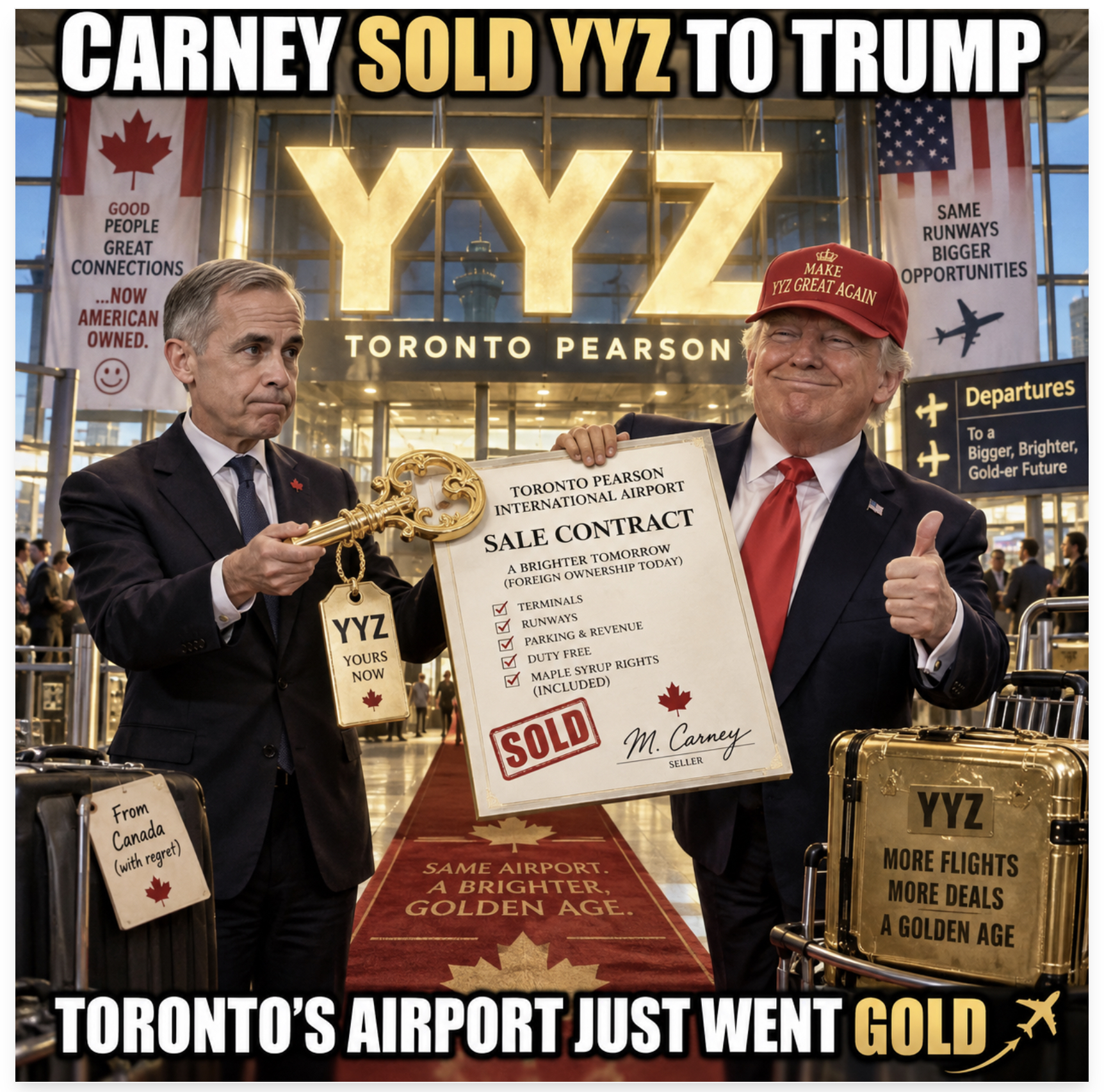
Funny Meme of Toronto Pearson International Airport YYZ going TRUMP.
By Hans Wilder | Watertown Post
Canada is moving toward opening some of its largest airports to private investment through long-term operating concessions, including Toronto Pearson, Montreal Trudeau, Calgary and Vancouver. The government would still retain ownership of the underlying airport assets, but private operators could gain enormous influence over how those airports are run, financed and developed.
That naturally raises a question that Canadians may not have thought all the way through yet: If you are inviting private capital into some of the most important transportation infrastructure in the country, what exactly prevents American investors from showing up with a very large checkbook?
Or, for that matter, Donald Trump personally?
The image almost writes itself. Mark Carney announces that Pearson is open to private investment, Trump walks into the room, looks at YYZ and says, “How much?” A few signatures later, Terminal 1 becomes Terminal 47, the Maple Leaf Lounge turns into the Golden Age Lounge, and half of Toronto spends the next six months in emotional recovery.
It is funny, but underneath the joke is a serious question about foreign ownership, infrastructure and sovereignty.
Carney has been aggressively pitching Canada to global investors and has made no secret of his desire to attract massive amounts of foreign capital. That sounds good when the money is coming from friendly pension funds, infrastructure companies and institutional investors. It becomes a more interesting discussion when the investor is American, politically connected, backed by sovereign capital or simply richer than anyone else in the room.
Canada does have mechanisms to review and block foreign investment. The Investment Canada Act gives Ottawa broad authority to examine transactions that raise national-security concerns, particularly when critical infrastructure is involved. The government can impose conditions, reject deals or force divestment if it believes an investment creates an unacceptable risk.
That means Canada could certainly tell an American buyer no.
But that is not the same as saying an American buyer could never make the offer.
American pension funds have money. American infrastructure firms have money. American private-equity groups have a lot of money. American corporations already operate across the Canadian economy, and U.S. capital is deeply intertwined with Canadian business.
So if Canada opens Pearson, Vancouver, Montreal and Calgary to more private participation, it should not be surprising if American money arrives at the table.
The United States government itself attempting to gain control of Pearson would be a different matter entirely. Any deal involving Washington would trigger extraordinary political and national-security scrutiny in Ottawa, and a foreign-government-linked buyer would face much tougher examination than an ordinary private company.
Still, the thought experiment exposes something important.
Canada is simultaneously trying to reduce its economic dependence on the United States while asking the rest of the world to invest more heavily in Canadian infrastructure. Those two goals may eventually collide. You cannot spend years telling investors that Canada is open for business and then act shocked when somebody from south of the border asks what is actually for sale.
The Trump version is obviously the most entertaining scenario. A sitting U.S. president personally buying an interest in Canada’s largest airport would create an avalanche of conflict-of-interest, diplomatic and national-security questions. It would also create enough Canadian social-media outrage to keep the country’s entire telecommunications system busy for a week.
But the serious issue remains: Who exactly would Canada allow to operate these airports?
Would American companies be acceptable? European companies? Middle Eastern sovereign wealth funds? Chinese investors? Would Canada draw different lines depending on the nationality of the bidder? Would the highest bidder matter more than national strategy? These are not trivial questions when the assets involved are airports that serve millions of passengers and play major roles in trade, transportation and national security.
From Northern New York, Pearson is not some distant foreign airport that exists only on a map. YYZ is right across the lake and down the road. It is part of the same regional economic system we live in every day.
So if Mark Carney wants to invite the world’s money into Canadian airports, Americans should probably pay attention.
And Canadians should probably ask one more question before they hang out the FOR SALE sign:
What happens when the highest bidder speaks with an American accent?
Because if somebody from the United States eventually walks into the room and asks, “How much for Pearson?” Canada cannot say nobody saw it coming.
About the Author