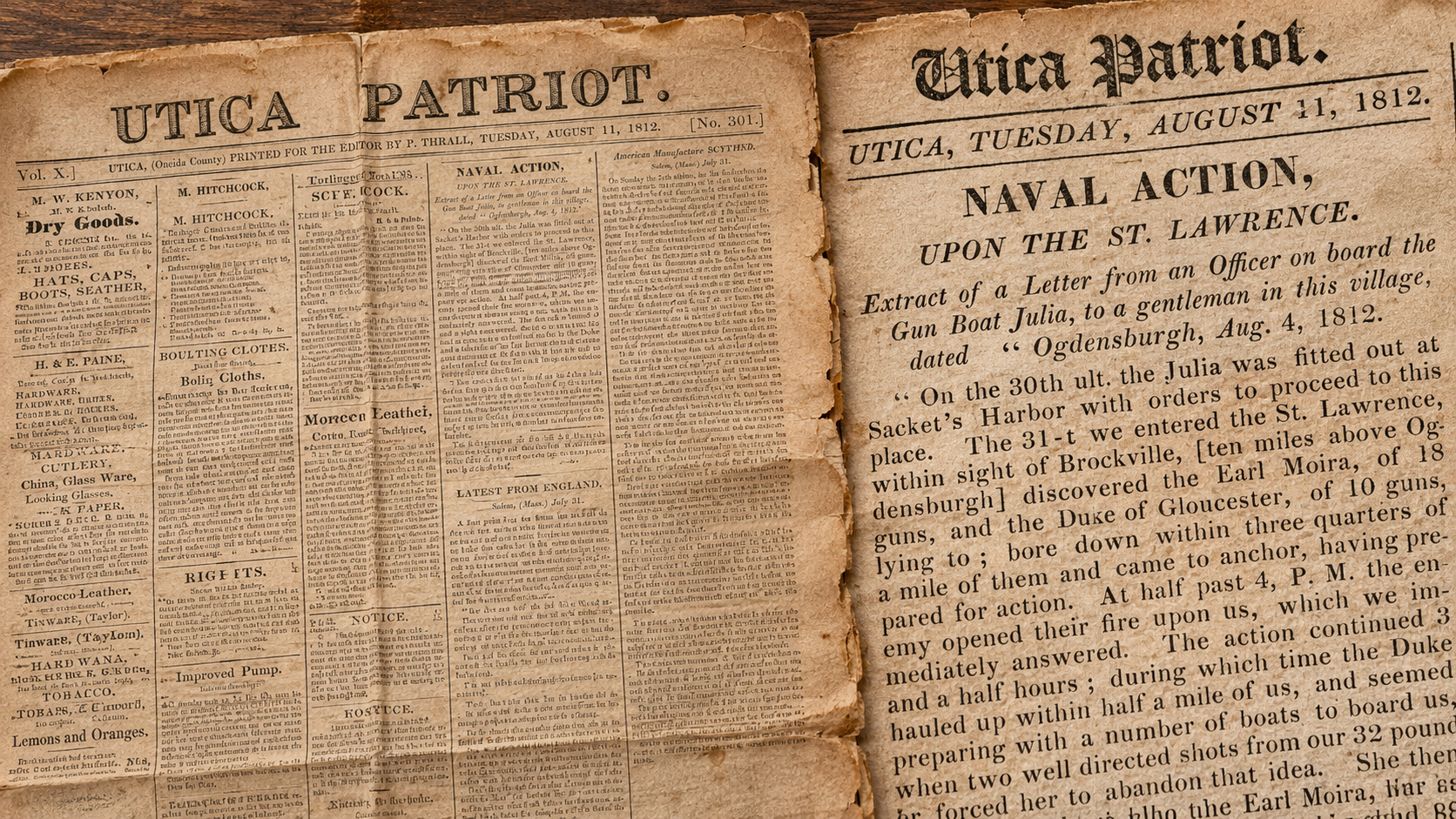
History as breaking news: the August 11, 1812 Utica Patriot reports naval action involving the gunboat Julia, fitted out at Sackets Harbor. AI-assisted composite assembled from photographs of the original newspaper.
An original August 11, 1812 edition of the Utica Patriot reports a naval fight launched from Sackets Harbor. More than two centuries later, Canada is again reassessing its strategic relationships, this time through a proposed new partnership with the European Union.
By Hans Wilder | Watertown Post
SACKETS HARBOR, N.Y. — More than two centuries before tariffs, European trade agreements, defense partnerships and arguments over the future of the U.S.-Canada relationship, Americans along the northern frontier were watching events on these same waters with considerably more immediate consequences.
An original copy of the Utica Patriot dated August 11, 1812, preserved in my collection and reproduced below, contains a remarkable contemporary account of naval action on the St. Lawrence River during the opening months of the War of 1812.
This was not history when it was printed. It was the news.
The newspaper published a letter dated August 4 from Ogdensburg describing the American gunboat Julia, which had been fitted out at Sackets Harbor and ordered down the St. Lawrence. Within sight of Brockville, the Americans encountered the British vessels Earl Moira, carrying 18 guns, and Duke of Gloucester, carrying 10.
According to the account, Julia closed to within roughly three-quarters of a mile and prepared for battle. At about 4:30 p.m., the British opened fire and the Americans answered.
The fighting continued for approximately three and a half hours.
The newspaper describes the Duke of Gloucester moving to within half a mile and apparently preparing boats for an attempt to board Julia. Two shots from the American vessel’s 32-pounder reportedly caused the British ship to abandon the effort. The British vessels then moved beneath the protection of a shore battery armed with eight long 18-pounders, which also opened fire on the Americans.
At 8 p.m., Julia weighed anchor and headed for Ogdensburg.
Remarkably, the American account reported no men killed or wounded and relatively little damage to the vessel.
In a Nutshell
In a nutshell, this August 11, 1812 edition of the Utica Patriot captures the War of 1812 almost in real time. Its lead naval report recounts how the American gunboat Julia, fitted out at Sackets Harbor, sailed down the St. Lawrence and engaged the British vessels Earl Moira and Duke of Gloucester near Brockville and Ogdensburg. The fight lasted about three and a half hours, with the Julia trading fire not only with the British ships but also with a shore battery armed with long 18-pounders. According to the officer’s letter printed in the paper, the Julia suffered only minor damage and no men were killed or wounded.
The same issue also shows how uncertain and fast-moving the wider war was. It carries reports from Halifax about captured American sailors, British warships and American prizes, an embargo on shipping, and new diplomatic dispatches arriving from England. There was even hope that Britain’s repeal of the Orders in Council, one of the major grievances that had helped push the United States toward war, might lead to reconciliation. Reading it today is essentially reading the news of the War of 1812 while the outcome was still completely unknown.
Two Centuries Later, the Northern Frontier Is Back in the News
The historical timing is difficult to ignore because the relationship across America’s northern border is again undergoing an unusual period of change.
On September 16, European Commission President Ursula von der Leyen proposed opening the door for Canada to become the European Union’s first “associate member.” The proposal does not make Canada the EU’s 28th full member. In fact, associate membership is a new concept that does not presently exist as a formal membership category in EU treaties. The proposal envisions substantially deeper cooperation in areas including defense, energy, artificial intelligence, quantum technology, critical minerals and economic security.
Canadian Prime Minister Mark Carney welcomed the idea during his September 17 address to the European Parliament, saying Canada supports a much deeper relationship with Europe. His government describes the strategy as an effort to diversify Canadian partnerships and increase what it calls strategic autonomy and resilience.
President Donald Trump has responded critically. On September 16, he said a Canadian associate relationship with the EU could be viewed as a “hostile act” depending upon its purpose and warned of possible U.S. trade retaliation. Carney responded the following day that Canada would determine its own international partnerships.
For Northern New York, these questions are considerably less abstract than they may appear from Washington, Ottawa or Brussels.
Stand at Sackets Harbor, Ogdensburg, Clayton or anywhere along the St. Lawrence and Lake Ontario and Canada is not some distant foreign country on a map. It is directly across the water. The two economies, transportation networks, families, tourism industries, military histories and communities have been intertwined for generations.
That is what makes this 1812 newspaper so fascinating today.
The political question in 2026 is obviously not the military question Americans confronted in 1812. But the geography has not moved. Decisions made in Ottawa about Canada’s economic, defense and regulatory alignment can have direct consequences for communities on the American side of the border, just as decisions made in Washington affect Canadians.
Those who advocate greater North American integration or unification see the current Canada-EU debate as evidence that the continent needs a clearer long-term strategic relationship. Opponents argue just as strongly that Canadian sovereignty includes the ability to build partnerships with Europe or other countries independently of Washington. That disagreement is now becoming part of the larger debate over what the U.S.-Canada relationship should look like in the decades ahead.
The Trump administration has framed its broader economic program around strengthening American manufacturing, energy production and strategic independence. Canada, under Carney, is simultaneously looking toward Europe for deeper economic and security integration. Those two strategies are now colliding directly along the world’s longest international border.
And that brings us back to the newspaper.
On August 11, 1812, readers in Utica opened the Patriot and learned that a little American gunboat launched from Sackets Harbor had spent three and a half hours exchanging cannon fire with British forces along the St. Lawrence.
They had no idea how the war would end.
They could not know that more than 214 years later people living along those same waters would still be debating the political, economic and strategic relationship between the nations occupying the northern half of North America.
History rarely repeats itself neatly. But here in Northern New York, it has a peculiar habit of using the same geography.
And sometimes it even leaves us the newspaper.
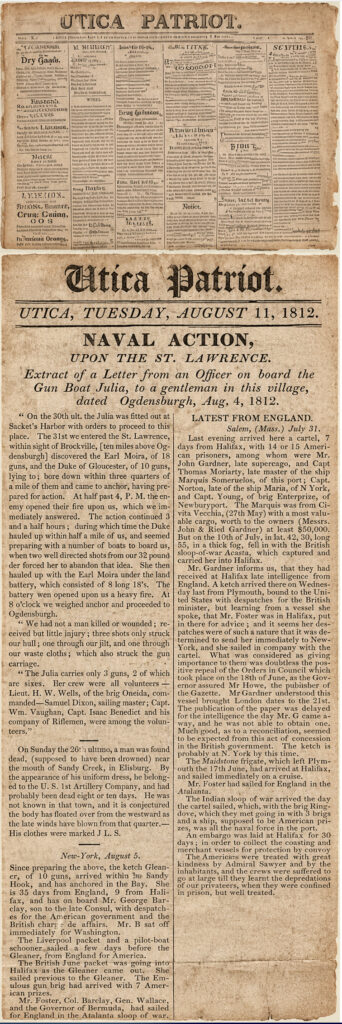
ARCHIVAL NOTE: The long-format image shown here was assembled with artificial intelligence from multiple photographs of the original August 11, 1812 newspaper in order to make the complete report easier to view on a modern screen. It should be treated as a presentation composite rather than a photographic facsimile. The individual photographs of the original newspaper remain the authoritative source for the printed text.
About the Author