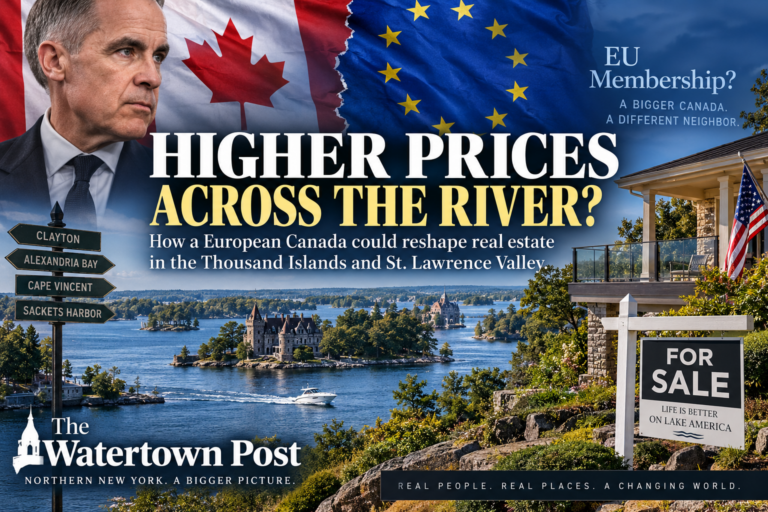

Could Canada’s EU pivot reshape North Country real estate?
By Hans Wilder | Watertown Post
NORTHERN NEW YORK — There are Americans along the south side of the St. Lawrence River and throughout Northern New York cheering Canadian Prime Minister Mark Carney’s push for closer ties with Europe. Before celebrating too loudly, however, people living along this border should think through what a genuine Canadian economic pivot toward Europe could eventually mean here at home.
European Commission President Ursula von der Leyen on Wednesday proposed opening the door for Canada to become the European Union’s first “associate member.” Carney has been pursuing what he calls a “unique alliance” with Europe, although neither Canada nor the EU has defined exactly what associate membership would mean, and full Canadian membership is not currently being proposed.
So let’s take the idea several steps further as a hypothetical.
Suppose Canada eventually develops a relationship with Europe involving much deeper economic integration, regulatory alignment, investment, defense cooperation and movement of capital. What happens to Clayton, Alexandria Bay, Cape Vincent, Sackets Harbor and the American side of the St. Lawrence Valley?
There is a reasonable argument that American real estate along this international boundary could become more valuable. But there is another side of this story that people cheering Carney from Northern New York should consider.
That River Could Become a Much Bigger Border
People around here sometimes forget how unusual our relationship with Canada actually is.
We don’t think twice about somebody from Watertown driving to Kingston for dinner, somebody from Ontario spending the weekend in Clayton, Canadians keeping boats or property on the American side, or families moving back and forth through the Thousand Islands border crossing.
The border can already be inconvenient. Now imagine Canada spending the next decade aligning parts of its economy and regulatory system increasingly with Europe instead of the United States.
That could create consequences nobody is discussing yet.
Automobiles are a good example. Canada and the United States currently have highly similar, although not identical, vehicle safety standards, and decades of integrated automobile manufacturing have made vehicles on both sides broadly compatible. U.S. regulators have specifically noted the extensive similarities between Canadian and American standards.
European vehicles operate under a different regulatory framework.
That does not mean somebody driving a European-specification vehicle in Canada would automatically be prohibited from crossing into New York. Current U.S. regulations generally permit a nonresident to temporarily bring a foreign-registered, nonconforming vehicle into the United States for personal use for as long as one year. Permanently importing and registering such a vehicle is considerably more complicated and can require federal certification, modifications or use of a registered importer.
But that’s exactly the point.
If Canada starts harmonizing significant portions of its economy with Europe rather than the United States, how many little complications begin accumulating?
Cars are only one example.
What happens with vehicle standards, insurance, commercial trucking, agricultural products, professional licenses, digital regulations, banking rules, consumer products, customs declarations, taxes and thousands of other things that currently benefit from two neighboring economies having spent generations building around each other?
Nobody knows, because the EU itself hasn’t even defined what Canadian “associate membership” would mean. Reuters reported Wednesday that the proposed status isn’t established in existing EU treaties and that diplomats themselves are questioning what it would actually entail.
That’s something worth remembering before Americans living five miles from Canada start cheering Canada’s European pivot as though Strasbourg were right around the corner.
It isn’t.
We are.
And That Could Affect Real Estate
This is where the issue becomes very local.
If economic and regulatory differences between Canada and the United States increase while cross-border commerce remains strong, American property close to Canada could become more strategically valuable.
An Ontario business owner dealing extensively with American customers might place greater value on owning property on the U.S. side. Canadians could want American residences or business addresses. Companies serving both markets could value proximity to the border. Investors could begin looking differently at communities that today are considered relatively remote.
And waterfront is finite.
There are only so many islands, only so many deep-water properties and only so many houses overlooking the St. Lawrence River and Lake America.
You can build another subdivision outside Syracuse.
You cannot build another Wellesley Island.
That scarcity matters.
But There Is a Catch
The same geopolitical changes that could increase the strategic value of American property could also hurt it.
If Canada’s European pivot eventually produced substantially more difficult border crossings, additional customs requirements or a prolonged U.S.-Canadian trade confrontation, Canadian tourism and cross-border property ownership could suffer.
Currency matters too. A stronger Canadian dollar makes American property cheaper for Canadian buyers. A weaker Canadian dollar makes it more expensive.
That creates two very different possible futures.
In one, Northern New York becomes increasingly valuable because it is affordable American territory sitting immediately beside a Canada connected more deeply to European capital and commerce.
In the other, the border becomes enough of an economic and regulatory barrier that the easy cross-border lifestyle generations of North Country residents have taken for granted begins disappearing.
Either outcome would affect property values.
Look at the Map Before You Cheer
This is ultimately about geography.
Canada can sign agreements with Brussels. It can increase trade with Europe. It can cooperate with European defense programs and attempt to diversify its economy away from the United States.
But Brussels is approximately 3,500 miles across the Atlantic.
Clayton is across the river.
Alexandria Bay is across the bridge.
Cape Vincent looks directly toward Canada.
Sackets Harbor sits on Lake America just down the shoreline from the international boundary.
That geography doesn’t change because politicians sign agreements.
The people on the American side cheering Carney’s European strategy should therefore understand that they aren’t watching some distant diplomatic experiment. If Canada genuinely begins restructuring its economy and regulations around Europe, some of the first Americans to experience the practical consequences could be those of us living right here along the border.
Nobody can responsibly predict today whether that makes a particular house worth 10 percent more or 10 percent less. There are simply too many variables.
But if the economic systems on opposite sides of the St. Lawrence River begin moving farther apart, the international boundary running through our backyard becomes more important.
And when a boundary becomes more important, property sitting immediately beside it can become more important too.
The Thousand Islands, the St. Lawrence Valley and Lake America aren’t on the edge of this story.
We’re standing right in the middle of it.
About the Author