The Ripple: Special News Analysis Report
By Misté Morales | The Watertown Post | November 17, 2026
There’s a lot going on right now, and I want to set the record straight. North Country residents have been telling me how these outages are showing up in their everyday lives. Microsoft 365 went down. People had trouble getting into their bank accounts and sending money. Passengers trying to get home to Watertown were stuck in Philadelphia. In a community with close ties to Fort Drum, people are asking questions. Does any of this have to do with the wars overseas? Are these technological glitches? And either way, what should we do to prepare? AP on the Microsoft outage · AP on banking delays · 7 News on North Country airports
It started with Microsoft
Anyone who has worked with a new program knows bugs and glitches come with the territory. What struck me about Microsoft’s explanation was how long this particular bug had gone unnoticed. The company traced it to a change it began rolling out in July. “For more than three months, the change was deployed worldwide without impact,” Microsoft wrote in its November 15 preliminary incident report.
That changed on November 12. Teams traffic had shifted onto the part of the network that also handled email. Some of the servers that normally handled that traffic were already out of service. Under the extra load, the overlooked bug surfaced. As servers stopped responding, traffic shifted to the ones still running until those, too, began to fail. People couldn’t open their Outlook mailboxes, messages arrived late, and parts of other Microsoft 365 services stopped working. By Saturday, Microsoft had confirmed full restoration. The company said it found no indication of a cyberattack. Microsoft’s preliminary incident report · AP on the Microsoft outage
What the ground stop meant in Watertown
By Friday afternoon, November 13, another system had failed, and this time the consequences were close to home. Watertown International Airport’s director of aviation, Grant Sussey, told 7 News that passengers bound for Watertown were waiting in Philadelphia. “I’m just thinking about the 49 passengers that are stuck coming in and going out,” he said. In Ogdensburg, the airport manager said no flights had been scheduled to arrive or depart that afternoon. 7 News on North Country airports
The Federal Aviation Administration halted departures after a flood of connection requests overwhelmed parts of its aging network. Investigators focused on a radar site in Texas and a radio communications site in Arkansas. A contractor had installed a new router at the Arkansas site. Some radio frequencies and radar feeds kept working, so controllers could stay in touch with pilots and bring planes already in the air down safely. Air traffic resumed around 8:15 that evening. The FAA disabled the suspect function on more than 60 similar routers and paused further installations. FAA ground stop Q&A · Reuters on the router rollout
The investigation is still open. Transportation Secretary Sean Duffy invited the FBI to help review the equipment failure. On Tuesday, he said intelligence officials had told him a cyberattack had not caused the ground stop. One question investigators still had to answer was how the failure of one piece of equipment could disrupt so much of the country’s air traffic. As cyber threats grow, our air traffic systems need regular security, equipment, and software upgrades. We also need to know how new equipment will behave alongside the old. Reuters on the FBI’s role · Reuters on the ongoing router investigation
What about Fort Drum? Watertown International and Fort Drum’s Wheeler-Sack Army Airfield are separate facilities. As of November 17, I could verify the disruption at Watertown International. I found no public announcement from Fort Drum identifying a change in its operations because of these outages. Readers may also have seen the Army’s plans for a nuclear microreactor to supply power on post. The Army selected Fort Drum for that project in August, months before the ground stop. 7 News on North Country airports · Fort Drum Aviation Division · Army announcement on Fort Drum’s microreactor
New York Senator Kirsten Gillibrand said her office had asked the Department of Transportation for answers on behalf of New Yorkers. Senator Chuck Schumer called for hearings and questioned the administration’s spending priorities. Duffy’s department said existing funds were committed to specific modernization projects and that additional work still needed funding. Locals want answers. American citizens want answers. What citizens need right now are answers and solutions. Gillibrand’s ground stop statement · Schumer’s Senate remarks · Department of Transportation response
Banks are a larger concern at this point
An email can usually wait. Somebody standing at the grocery register or waiting for money a family member just sent may not have that luxury. On Monday, customers at Chase, Bank of America, Wells Fargo, U.S. Bank, Capital One, PNC, and Truist reported trouble. Some Zelle payments were delayed, too. People felt this well beyond Chase. ABC News on bank transaction delays · AP on banking delays
Chase traced the delays to a software bug in its own systems. “Customers still have access to their accounts and funds,” the bank said. Its transactions were processing normally again by Monday evening. Bank of America and Capital One said their own systems had been operating normally. U.S. Bank said customers could still see delays when sending or receiving a Zelle payment involving another institution. Zelle said its network stayed up, and the Federal Reserve’s payment services were operating normally. A transfer involving Chase could be late even if your own bank was working. That’s one ripple we can actually trace. ABC News on bank transaction delays · AP on banking delays
Then on Tuesday, customers ran into trouble with Apple Pay. Apple said an internal update disrupted several services, including Apple Pay and iCloud. By the afternoon, it said many services had recovered and work continued on the others. Apple ruled out a cyberattack. Reuters on Apple’s service update
People want to know their money is safe from hackers and from people who would use AI to get into their accounts. The reporting on Monday’s banking disruption identified delayed transactions and problems accessing accounts. It did not identify money stolen from customer deposits. If you see a withdrawal you didn’t authorize, call the number on your card or statement right away. Federal rules require banks to investigate qualifying electronic transfer errors. Write down when you called and what the bank told you. If a payment delay cost you a fee, the Consumer Financial Protection Bureau recommends asking the bank to reverse it. CFPB on unauthorized transactions · CFPB on bank outages and fees · CFPB on electronic fund transfer protections
Where I stand on the outage clusters
Admittedly, when United Airlines had technical issues on Monday, just days after the FAA ground stop, I had my own suspicions that there was more going on than technical glitches. United said its problem delayed departures. Flights already in the air and United Express flights were unaffected. The airline resolved the problem and said it saw no indication of a cybersecurity cause. Some residents I’ve heard from still find the timing hard to accept as coincidence. I understand why they’re asking what companies might be leaving out. More evidence is needed before these dots can be connected. Reuters on United’s departure delays
In my experience, what happens rarely turns out to be the best-case scenario or the worst. Oftentimes, events fall somewhere in the middle. I believe these outages could be much the same. Do I believe some of them could turn out to involve terrorist attacks? It’s quite possible. That’s my assessment. The current outage clusters are not yet evidence of an attack on the United States. Speaking Tuesday about the disruptions at Microsoft, the FAA, United, and Chase, Homeland Security Secretary Markwayne Mullin said, “I can tell you 98% certainty this isn’t a cyberattack.” He pointed to the strain of running new technology on aging systems. I’ll continue following the investigations for The Watertown Post. Reuters on Mullin’s assessment
President Trump expressed confidence in the safety of air travel and called for improvements to aging infrastructure. Vice President JD Vance was responding to questions about stockpiling supplies and building bunkers when he said, “We do not see some crisis coming down. But you have to be prepared for everything.” AP on Trump’s remarks · CNN on Vance’s interview
Several of the remaining outage reports now have answers. The National Security Agency said scheduled maintenance slowed some internal systems Tuesday while its mission-critical work continued. Marriott told the Associated Press it resolved a sign-in problem on its website and Bonvoy app and found no indication of a cybersecurity cause. Schwab acknowledged a temporary webpage problem, though customers could still reach their accounts by other means. Google said it saw no evidence of a widespread Gmail disruption.
What the FBI and Google actually found
There have been confirmed cyberattacks. On November 13, the FBI warned that attackers around the world were using an AI-powered security-testing tool called ARTEX. In some cases, fewer than three hours passed between choosing a target and gaining high-level access. The FBI Dallas post and the OAN headline circulating Tuesday referred to that advisory. The FBI later clarified an important point about the timing: its Dallas office was sharing a warning issued the previous Friday. The post was not a new alert issued in response to the outages. Original FBI advisory, dated November 13 · FBI clarification on the Dallas post
In October, a group Microsoft identified as aligned with China used stolen credentials from ConnectWise backup applications to attempt sign-ins across more than 2,250 Microsoft 365 customer environments. Most attempts failed, but the attackers gained lasting access at multiple organizations. Those attacks have not yet been connected to the current outages. Microsoft’s investigation of the ConnectWise compromise · Federal assessment of the November outages
On Tuesday, the New York Post ran a headline about Russian AI bots carrying out a fully automated cyberattack. Google’s own November 16 report explains what was new. For the first time, its researchers had seen attackers use AI to find software flaws and break into systems through those flaws without a person directing either step. Researchers found stolen data on a server, along with clues pointing to French media, entertainment, and education websites as targets. They also found comments written in Russian. Google did not identify who operated that system or attribute it to the Russian government. Google Threat Intelligence Group’s original findings
Google’s findings tell us something about how attacks are changing. They don’t tell us why travelers were stuck in Philadelphia or why a Zelle payment arrived late. The FAA is still investigating the equipment involved in the ground stop, with the FBI invited to assist. As of November 17, neither Google nor federal officials had publicly linked the activity Google documented to the U.S. outages. That’s a question I’ll keep following. Google’s report · Reuters on the open FAA investigation
For anyone concerned about their own accounts, turn on two-step login and transaction alerts. Change passwords you’ve reused or believe were exposed. Keep a recent paper statement, dated receipts, and a phone number for each bank in a secure place. Do the same for other accounts you rely on for personal business. If an app goes down, you’ll still have a record of what was in the account, on what date, and whom to call. FTC on protecting your accounts · FDIC banking guidance · FEMA’s emergency financial records checklist
What was reported about Washington
CNN, citing seven U.S. officials, reported intelligence about a possible Iranian plan to use a dirty bomb in Washington, D.C. The officials disagreed over whether Iran could or would carry it out. Iran denied the allegation. Trump said he took it seriously. White House spokesperson Lauren Bis said officials were monitoring potential threats and that “at this time there are no credible threats to the homeland.” What officials were examining was intelligence about a possible plan. No public report I could verify said a device had been found. CNN intelligence reporting · Reuters on the U.S. and Iranian responses
A dirty bomb uses conventional explosives to scatter radioactive material. It cannot cause a nuclear explosion. For people nearby, the greatest immediate danger comes from the blast and flying debris. Radioactive dust can travel farther, and any longer-term health risk depends on the exposure. Officials are assessing the reported threat. No public statement I found tied it to the outage investigations. CDC dirty bomb FAQ · CNN intelligence reporting
What the North Country remembers
I am not claiming that our country, our state, or our communities are under attack. What I am saying is that, regardless of the cause, preparedness matters. I don’t believe we should go blindly into the next month assuming that everything will operate as usual.
I was raised by family members and friends of the family who lived through the Great Depression. One thing they taught us was that whatever crisis comes along, it’s always wise to be prepared. Make common-sense preparations, not panic preparations. That doesn’t mean buying out the shelves of toilet paper and bread. It doesn’t mean emptying the banks. It means a little bit a week. Put a little money aside if you can, and keep some cash in small bills for the things you might need that day. Pick up an extra can or two of something your family actually enjoys eating. Ready.gov financial preparedness
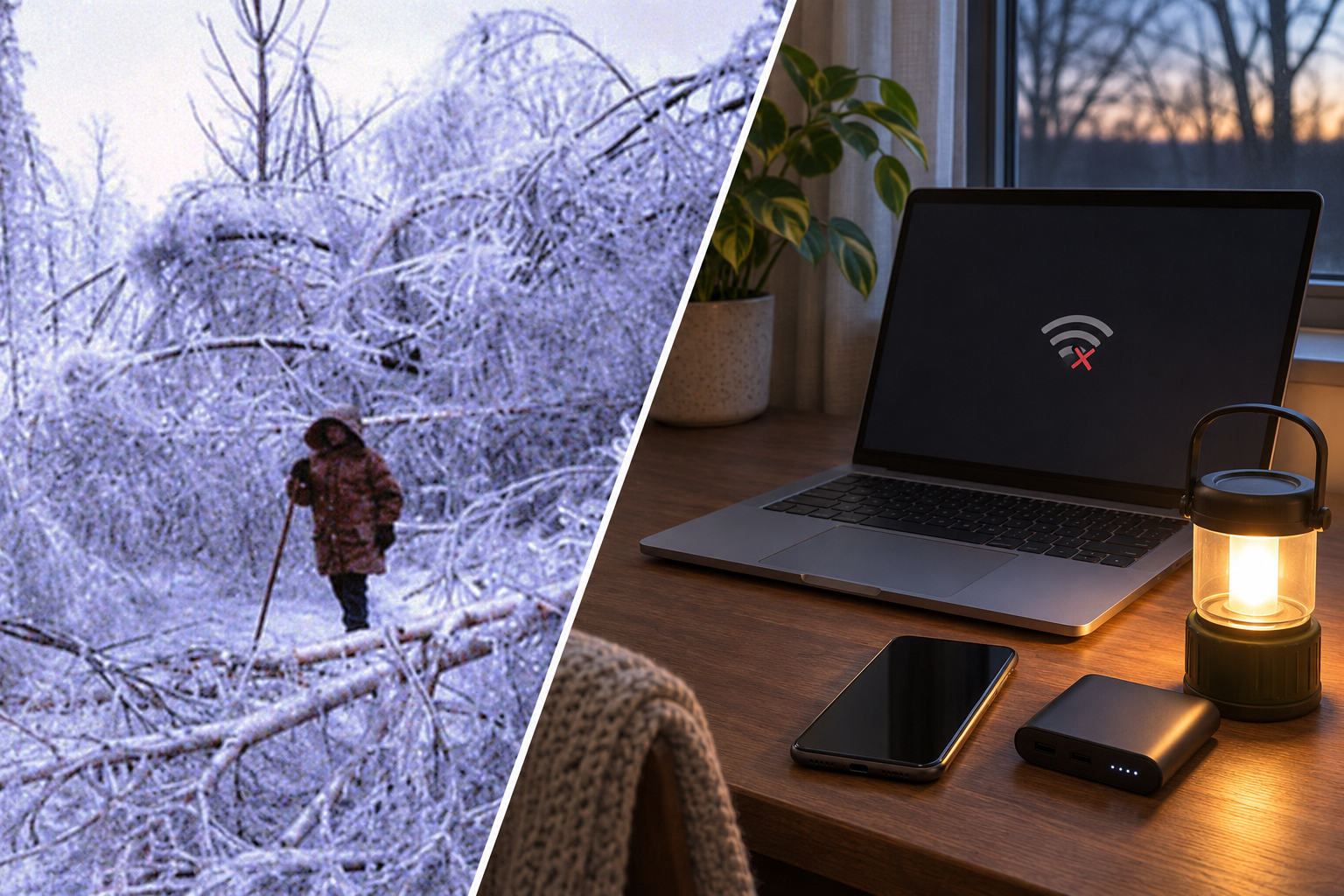
Upstate New York is no stranger to harsh winters and power outages. The Blizzard of 1977 stranded people across the Watertown area. During the North Country ice storm of January 1998, rain fell through a shallow layer of cold air and froze on contact. Over several days, more than three inches of ice accumulated in some places. Fort Drum soldiers delivered generators, checked on residents, and brought people food and water. That relationship continues today. When a local ambulance crew needs help, Fort Drum EMS and Jefferson County dispatchers can coordinate a response. Palladium-Times archive on the Blizzard of 1977 · National Weather Service ice storm review · Congressional Record on the North Country response · U.S. Army on Fort Drum EMS
I remember what we did when we couldn’t use the roads. We went to our neighbors. We had barbecues outside because we couldn’t use our stoves. People in my neighborhood didn’t have generators. We pulled out the sleeping bags, huddled around kerosene heaters, and even warmed up leftover pizza over one. Some of my best memories are of sitting with my family by candlelight, telling stories while the world outside was covered in ice.
I remember being in Buffalo with a friend another winter. There were six- and seven-foot mounds of snow with paths dug through them like tunnels. You walked because you couldn’t drive. It was like being in a maze. People survived it. We found a way. We made it work. And it brought communities and families together.
What we can do now
Take one step at a time. Start with the preparations you usually make for winter. In a January interview about winter weather in Watertown and on Tug Hill, Governor Kathy Hochul said, “So we always plan for the worst here in the State of New York.” Ahead of a February storm, she urged drivers to “travel smart and leave yourself ample time to get to where you’re going.” El Niño is already here, and NOAA expects it to remain strong into early 2027. A seasonal outlook can’t tell you whether you’ll be able to get to the gas station on the day your generator runs low. That’s a reason to plan ahead every winter. Governor Hochul’s January interview · Governor Hochul’s February winter travel guidance · NOAA November El Niño outlook
- Start with the pantry. New York’s Department of Public Service says, “Create a pantry of at least three days worth of bottled water, medications and foods that don’t require refrigeration or cooking.” Build it a little at a time, when your budget allows. New York utility interruption guide
- Get the house and car ready. Put flashlights, batteries, a battery-powered radio, and a charged power bank where you can find them in the dark. If you keep candles and lighters, keep them away from children and reach for a flashlight first. Keep your car’s tank at least half full. Pack warm layers, a blanket, water, snacks, and a shovel in case you’re stranded. Arrange fuel for your generator before a storm and run it outdoors, at least 20 feet from doors, windows, and vents. Never use a grill or gas oven to heat the house. New York utility interruption guide · New York carbon monoxide safety guidance · New York emergency preparedness handbook
- Plan for medications and medical equipment. If you take a regular prescription, ask your pharmacist whether a 90-day supply is appropriate and whether your insurance covers it. If someone in your household needs powered medical equipment or refrigerated medicine, talk with their provider about backup power, a place to go, and how to get there. Medicare on longer prescription fills · Red Cross power outage planning
- Put the phone numbers on paper. Include family, neighbors, caregivers, the pharmacy, your bank, and your utility. Decide who will check on whom and where you’ll meet if calls and texts fail. Set up NY-Alert while you have internet access. Jefferson County also offers the Prepare Jefferson County, NY app, and a battery-powered radio can carry local updates when the internet is down. CDC family communications planning · NY-Alert · Prepare Jefferson County app · New York utility interruption guide
- If you’re already struggling, don’t wait. Contact a local food pantry now. Let someone you trust know where you are and what you need. For help finding food, heat, housing, or transportation in Jefferson, Lewis, or St. Lawrence County, call 211 or text your ZIP code to 898211. For immediate danger, call 911. 211 Central New York
In Watertown, the Urban Mission at 247 Factory Street can be reached at 315-782-8440. For a food pantry appointment with Community Action Planning Council, call 315-782-4900, extension 221. If you need help with a heating bill, regular HEAP applications opened November 2. Your county social services office can help. Call 315-785-3000 in Jefferson County, 315-376-5400 in Lewis County, or 315-379-2111 in St. Lawrence County. National Grid electric customers can report an outage at 800-867-5222.
If you need a warm place to go, New Life Church at 255 Gaffney Drive in Watertown serves adults experiencing homelessness from 8 a.m. to 8 p.m. daily, with meals. Call 315-755-0822. The North Country Homeless Services directory lists the Salvation Army at 723 State Street for seasonal overnight warming, 8 p.m. to 8 a.m. Check availability with 211 before traveling. To find an open disaster shelter, contact the American Red Cross Eastern New York Region at 800-831-0927.
It doesn’t take a cyber war to warrant a little preparation. A North Country winter is reason enough. And when you put a little extra aside, you might be helping the people next door. If the roads closed and the phones went quiet tonight, who would you check on, and who would know to check on you?
About the Author