
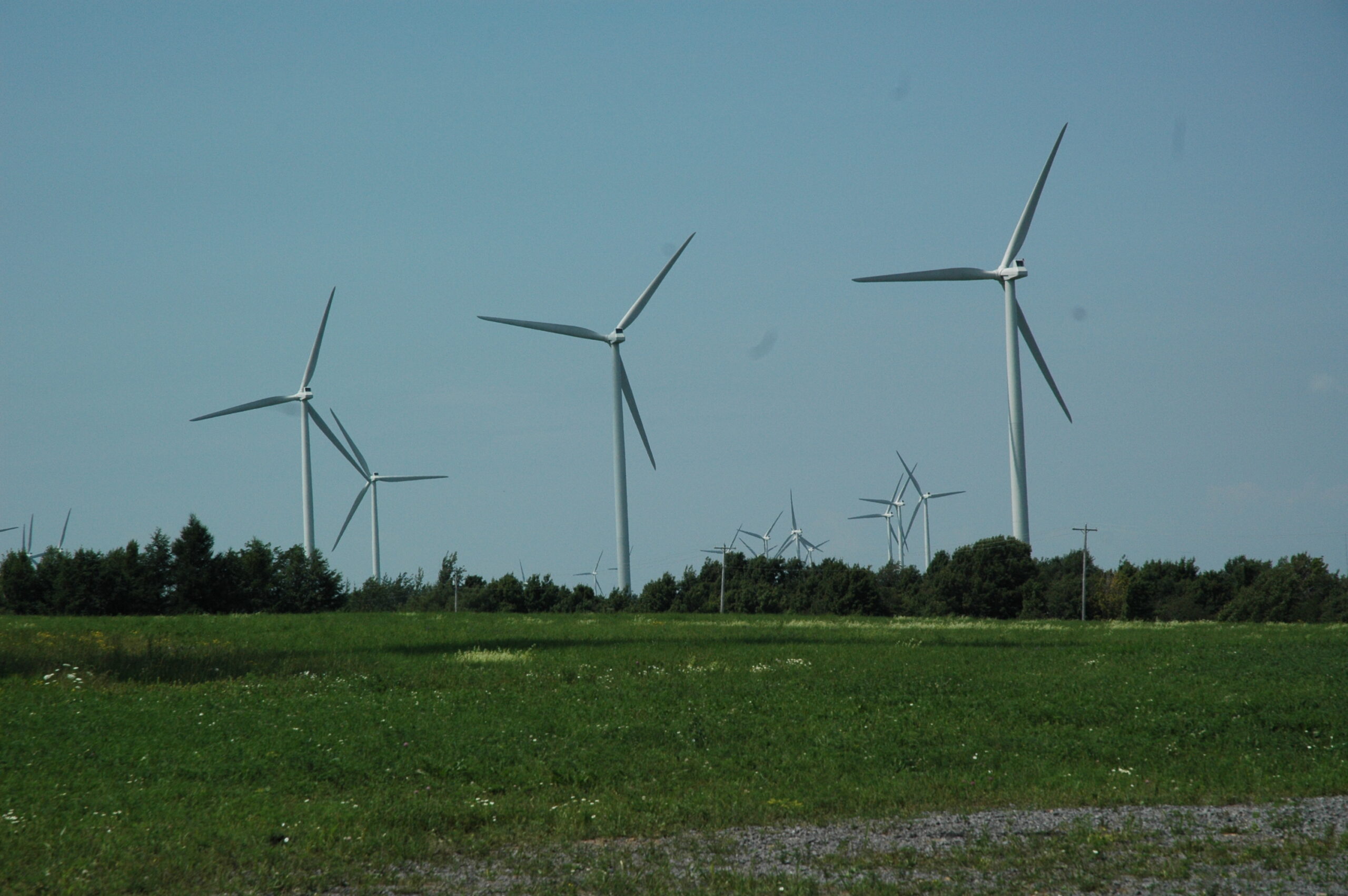
Maple Ridge Wind Farm on Tug Hill, July 2007. Photo: Sgt. bender / Wikimedia Commons, CC BY 3.0.
Watertown Post Editorial | By Hans Wilder | Watertown, New York
Some of the loudest objections to data centers sound an awful lot like what North Country residents have been saying about industrial wind and solar for years: What happens to the land? Who pays for the power lines? How much money actually stays here? Those are good questions. What gets me is hearing them from people who seem to forget to ask the same questions when the project comes with a row of turbines and a green logo. If preserving farmland is the principle, it ought to survive a change in the developer’s letterhead.
There’s a real debate here. Jefferson Community College surveyed 2,471 adults in Jefferson, Lewis, Oswego and St. Lawrence counties. Fifty-two percent opposed local data center development, 13 percent supported it, and 35 percent wanted more information. On advanced nuclear power, 41 percent supported development and 11 percent opposed it, with 48 percent wanting to know more. The poll doesn’t tell us how those same people feel about wind and solar. It does tell us what matters most to the people surveyed: 91 percent rated affordable electricity very or extremely important. That’s a pretty clear instruction to anybody walking into a town hall with a glossy presentation.
The Watertown Post has made no secret of where it stands. We oppose sprawling industrial solar on productive farmland and industrial wind projects that cut up habitat and alter the landscape for miles. The U.S. Fish and Wildlife Service documents bird and bat deaths at wind facilities and wildlife risks from large solar installations. A landowner can earn lease income, and a town may negotiate payments. Neither settles the question of whether the project is a good use of the land for the community that has to live around it.
A data center can concentrate a substantial investment on one site, preferably an old industrial property with infrastructure already in place. Some campuses are enormous, so let’s see the site plan before anybody promises it’ll fit in one field. But a good deal can bring construction work, permanent jobs and dependable revenue to a town and its schools. Make the developer put those numbers in writing, after tax breaks, and separate the jobs that last from the jobs that end when the builders leave. Then show us who pays for the substation, what the cooling system demands from the local water supply and how households are protected from higher electric bills. A billion-dollar press release won’t pay the school levy.
And before Albany tells us the only way forward is to put more equipment on more farmland, look at what we already have. Watertown owns a hydroelectric facility on the Black River. The St. Lawrence–FDR project at Massena and the Niagara Power Project are proof that New York knows how to harness moving water at scale. Start by asking what we can get from upgrading existing facilities without sacrificing fisheries or river access. And the Army has selected Fort Drum to host a microreactor under its Janus program. It isn’t running today, and its purpose is to help keep the base powered, not to plug in somebody’s server farm. But it’s a concrete reason to take dependable nuclear power seriously here.
Give us a data center on the right site, a developer that pays its own way, and a deal that leaves real money in the community, and we’ll hear it out. Give us another plan to turn good farmland into an industrial energy site and send the benefits somewhere else, and the answer is still no. Apply the same test to everybody: What does the North Country get to keep, and what does it get stuck paying for?
Maple Ridge Wind Farm on Tug Hill, July 2007. Photo: Sgt. bender / Wikimedia Commons, CC BY 3.0.
About the Author