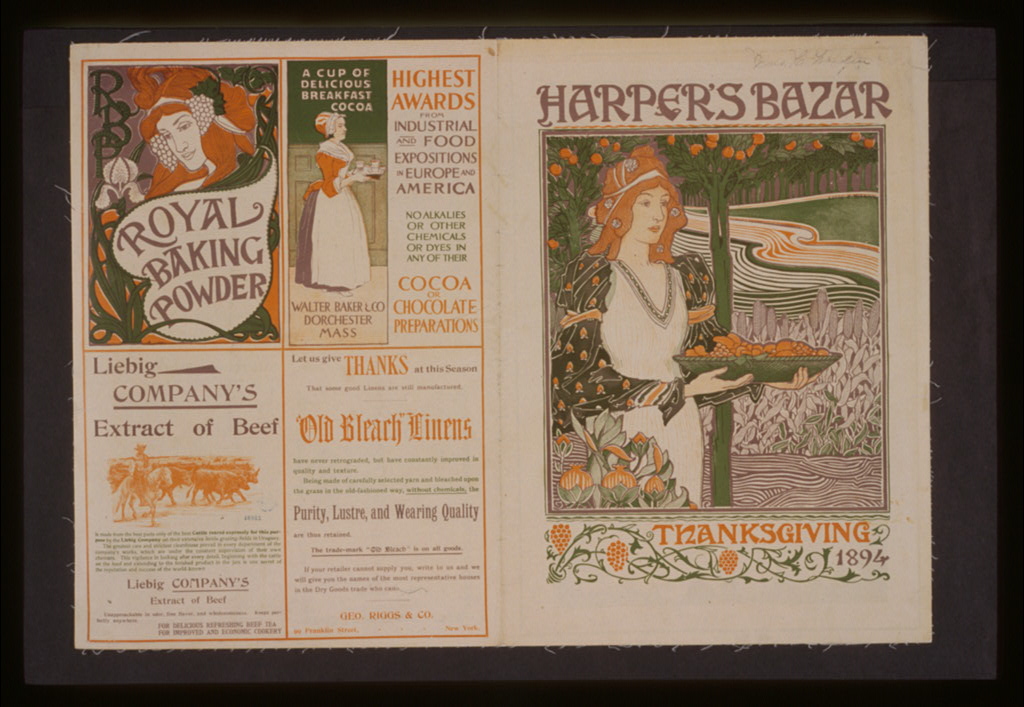
Louis J. Rhead’s 1894 Thanksgiving cover for Harper’s Bazaar. Library of Congress.
A three-day harvest gathering, a letter to Lincoln and two rival Thursdays: how Americans built a holiday, one custom at a time.
By Watertown Post Staff
In 1939, a family crossing from New York into Connecticut could find that Thanksgiving had already happened on one side of the state line and was still a week away on the other. President Franklin D. Roosevelt had moved the holiday to give stores more time before Christmas. Some governors went along. Others didn’t. For a holiday supposedly handed down intact from Plymouth, it turned out Americans couldn’t even agree on which Thursday to eat dinner.
What happened at Plymouth
Long before English settlers arrived, Wampanoag communities had their own daily and seasonal traditions of giving thanks. Nor was Plymouth the first English observance in what became the United States. In 1619, settlers arriving at Berkeley Hundred in Virginia had instructions to mark their landing with an annual day of thanksgiving. That was an observance of thanks, not the three-day harvest gathering that later came to dominate the American story.
The written account of Plymouth’s 1621 gathering comes from Edward Winslow, who said the English went hunting for birds after bringing in the harvest. Ousamequin, the Wampanoag leader the English called Massasoit, came with about 90 men. They spent three days together, and the Wampanoag brought five deer. Winslow doesn’t identify the birds, confirm a turkey dinner or say why Ousamequin arrived. Mashpee Wampanoag historian Paula Peters places the gathering in the context of a negotiated alliance. The cooperation was real, but it did not prevent the later loss of Native land and lives.

The letter that helped put Thanksgiving on the calendar
In 1789, George Washington named Nov. 26 a day of public thanksgiving and prayer. It was the first such observance under the new Constitution, not the start of an unbroken annual holiday. Dates varied. By the Civil War, annual Thanksgivings were already customary across New England and had spread to many other states. Magazine editor Sarah Josepha Hale wanted them held on the same day. In September 1863 she wrote to Abraham Lincoln that she had been making the case for 15 years.
Lincoln issued his proclamation on Oct. 3, 1863, asking Americans to observe the last Thursday of November. His appeal called for gratitude but also asked people to remember those made widows, orphans or mourners by the war. The late-November tradition spread widely in the years that followed. It wasn’t yet fixed by law to the date we use today.

Turkey, football and children in masks
By the late 1800s, magazines were printing Thanksgiving meals that would look familiar on many tables today: turkey, potatoes, cranberries and pie. Oysters also turned up in holiday menus. Football arrived early enough to become a tradition of its own. Yale and Princeton played in Hoboken on Thanksgiving Day in 1876 under newly agreed college rules.
New York City once had a custom that might be harder to recognize. Children put on masks or painted their faces, went door to door and asked for treats or pennies. The Library of Congress photographs look more like Halloween than Thanksgiving. In 1924 another New York tradition made its debut: the parade now associated with Macy’s Thanksgiving Day was originally billed as a Christmas parade.

Why the fourth Thursday won
With five Thursdays in November 1939, Roosevelt proclaimed Nov. 23 rather than Nov. 30. New York followed the earlier date; Connecticut kept the later one. Congress eventually settled on the fourth Thursday, which is not always the last, and Roosevelt signed the resolution on Dec. 26, 1941. The new rule took effect for the 1942 holiday.
The calendar finally stood still, but the customs around it never have. The harvest gathering, the wartime proclamation, the masks and the football games belong to different moments in American history. Thanksgiving is what generations of Americans did with them.
From the archive
Select any image to open its archive record.

About the Author