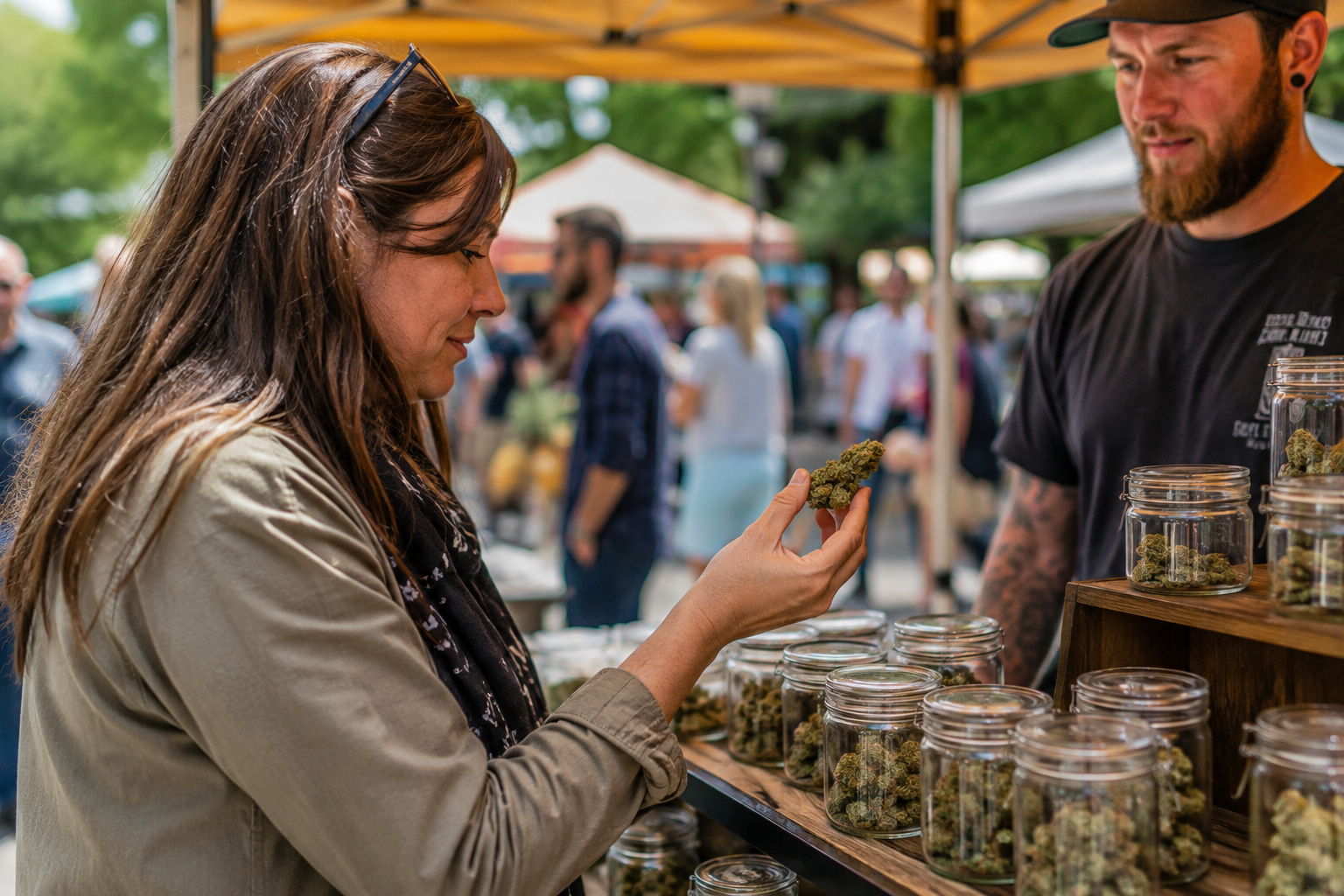
A customer inspects cannabis flower at a farmers market-style stand, illustrating New York’s expanding Cannabis Showcase Event program.
New York’s latest cannabis law could finally give consumers something many legal dispensaries have failed to provide: a better look at what they’re actually buying.
By The Watertown Post
WATERTOWN — New York just made the legal cannabis market a little more interesting — and if you own a traditional marijuana dispensary in Northern New York, it might be time to pay attention.
Gov. Kathy Hochul signed legislation Thursday expanding opportunities for licensed cannabis businesses to sell marijuana through approved Cannabis Showcase Events, including farmers markets, public markets and temporary pop-up locations.
The law took effect immediately.
This does not mean somebody can show up at the Watertown farmers market Saturday morning, throw a card table between the sweet corn and maple syrup and start selling bags of weed.
This remains New York, after all. There will be paperwork.
Cannabis Showcase Events require state authorization and municipal approval, and farmers or public markets must approve cannabis events held on their property.
But the larger story isn’t the bureaucracy.
It’s what happens when cannabis begins moving out from behind the dispensary counter and gets closer to the people who actually grow it.
The Legal Dispensary Has a Consumer Problem
New York spent years trying to create a tightly regulated recreational cannabis market.
It succeeded in creating regulations.
Whether it created the best possible way to buy cannabis is another question.
Walk into many legal dispensaries and you’re confronted with menus, THC percentages, strain names, colorful packaging and products sitting behind counters or inside display cases.
Then you’re expected to make a purchasing decision.
For experienced cannabis consumers, that’s a strange way to buy flower.
Cannabis isn’t just a number printed on a package.
People judge flower by appearance, aroma, moisture, structure, trichomes, curing and numerous other characteristics.
Yet the legal retail system can sometimes make purchasing cannabis feel more like ordering something from a catalog.
And once you’ve paid for it and opened the package at home, congratulations:
That’s your weed.
Good or bad.
Farmers Markets Could Change That Relationship
The state’s Cannabis Showcase Event program allows licensed adult-use cannabis businesses to sell products away from their permanent dispensaries at approved temporary events.
And that could be particularly important in Northern New York.
Our region has something New York City doesn’t have much of:
space and agriculture.
Jefferson, Lewis and St. Lawrence counties understand farmers markets.
People here are accustomed to meeting the person who grew their vegetables, produced their honey or made their maple syrup.
Cannabis fits that model surprisingly well.
It’s agriculture.
Imagine being able to meet a licensed cannabis producer, learn how the flower was grown, discuss the genetics, cultivation and curing process and get a much closer look at what you’re considering purchasing.
Suddenly the person growing the cannabis has an opportunity to develop a relationship directly with the consumer.
That’s very different from picking Product #17 from a digital menu.
And That’s Why Dispensaries Should Pay Attention
Permanent cannabis stores aren’t disappearing.
They offer convenience, regular hours, large inventories and products from numerous producers.
But they also carry something a temporary market doesn’t:
overhead.
Rent.
Utilities.
Employees.
Security.
Insurance.
Compliance.
Inventory.
And all the other expenses involved with maintaining a permanent retail operation.
Now imagine a licensed producer or participating cannabis business appearing at a busy summer farmers market or community event.
The customers are already there.
The producer gets exposure.
The consumer gets another purchasing option.
And the traditional dispensary suddenly has competition that isn’t necessarily coming from another dispensary.
That’s significant.
Northern New York Could Be Perfect for This
Consider the possibilities across the North Country.
Watertown.
Clayton.
Alexandria Bay.
Lowville.
Canton.
Potsdam.
Massena.
Communities throughout the region already hold farmers markets, festivals and seasonal public events.
Not every municipality or market will necessarily approve cannabis sales, and cannabis events remain subject to strict state regulations.
But wherever they are approved, cannabis producers could gain access to consumers who might never have made a special trip to a dispensary.
For a small licensed cannabis operation, that’s potentially enormous.
For consumers, it means competition.
And competition usually produces one of two things:
Businesses improve, or customers go somewhere else.
The Dispensaries Have an Opportunity Too
There’s another side to this that shouldn’t be ignored.
Licensed dispensaries can participate in the Cannabis Showcase Event system as well.
The smart ones probably will.
Instead of fighting farmers-market cannabis, they could use these events as satellite storefronts and marketing opportunities.
Meet someone Saturday.
Introduce them to the products.
Educate them.
Give them a good experience.
Then when February arrives and nobody feels like wandering around an outdoor market at 14 degrees below zero, that customer knows exactly which dispensary to visit.
That’s how competition is supposed to work.
The stores providing knowledgeable employees, good products, fair pricing and a good customer experience shouldn’t fear this nearly as much as stores relying primarily on the fact that they’re the place legally authorized to sell marijuana.
Let Consumers Decide
New York’s legal cannabis rollout has been complicated from the beginning.
The state has battled illegal shops, licensing delays, lawsuits and a regulatory structure that sometimes seems capable of making something as simple as selling a plant unnecessarily complicated.
Northern New York has seen that confusion firsthand, including battles over unlicensed cannabis operations while state-regulated businesses attempted to establish themselves.
Perhaps the next stage will be simpler.
Let licensed farmers grow it.
Let licensed businesses sell it.
Let adults examine their options.
Let consumers ask questions.
And let the businesses with the best products and service win.
Cannabis shouldn’t need to be mysterious simply because it’s legal.
If farmers-market cannabis gives Northern New Yorkers more information about what they’re buying before they hand over their money, that’s probably good news for consumers.
For some traditional weed shops?
Maybe not so much.
But that’s the funny thing about a free market.
Sometimes the customer gets to choose.
About the Author