No Water
A Think-Tank Scenario on Water Scarcity, Population Migration and the Future of the Great Lakes Region
For more than a century, Americans have looked at the Great Lakes primarily as transportation corridors, industrial waterways, fishing grounds, tourist destinations and enormous sources of drinking water.
That may eventually prove to be an understatement.
If global freshwater stress continues to intensify, the five Great Lakes could become one of the most strategically important natural-resource systems on Earth.
The numbers alone are staggering.
The Great Lakes contain roughly 84 percent of North America’s surface freshwater and about 21 percent of the world’s surface freshwater supply. NOAA says tens of millions of Americans and Canadians already depend upon the system for drinking water.
That does not mean North America possesses 21 percent of all freshwater on Earth. Most freshwater globally is locked in glaciers, groundwater and other forms. But when we are talking about readily visible surface freshwater, the Great Lakes are extraordinary.
Now consider what is happening elsewhere.
Water scarcity is increasing on every continent, according to UN-Water, while changing precipitation patterns, drought, extreme heat and other climate effects are making freshwater supplies less predictable.
At the same time, the American Southwest is confronting a very real Colorado River crisis.
As of August 2026, Lake Mead is around historic-low territory, and federal authorities are considering major reductions in Colorado River allocations as the seven basin states struggle to agree on a new operating system.
That raises an uncomfortable but important question:
What happens when people finally begin moving toward the water instead of continually trying to move the water toward the people?
The Great Lakes Migration Scenario
For most of the last several decades, population movement in the United States favored the Sun Belt.
Arizona.
Nevada.
Texas.
Florida.
Southern California.
People followed warmth, jobs, retirement communities, lower taxes and inexpensive suburban development.
But many of those same regions face combinations of water stress, extreme heat, wildfire risk, hurricanes or rising insurance costs.
A sufficiently serious change in those conditions could alter migration patterns.
It probably would not begin with millions of people loading trucks simultaneously and heading north.
It would happen gradually.
Companies would make investment decisions.
Retirees would choose Michigan instead of Arizona.
Families would choose Wisconsin instead of Nevada.
Manufacturers requiring enormous quantities of water could increasingly consider Ohio, Michigan, Wisconsin, western New York or Ontario.
Housing developers would follow.
Then infrastructure investment would follow the people.
Twenty years later, what initially looked like thousands of individual decisions could amount to a major demographic shift.
The federal government has already acknowledged that climate-related relocation is becoming a legitimate policy issue. A Government Accountability Office review found that some American communities have already pursued relocation because of environmental threats and that considerably more communities may need to consider relocation in coming decades.
The New American Water Belt
Imagine an economic corridor running from:
Duluth and Minneapolis-St. Paul through Wisconsin;
Chicago and Milwaukee;
Detroit and Grand Rapids;
Cleveland and Toledo;
Buffalo, Rochester, Syracuse and Northern New York;
Toronto, Hamilton and the rest of southern Ontario;
Montreal and the St. Lawrence corridor.
This region already possesses something extraordinarily difficult to manufacture:
water.
It also has established cities, railroads, highways, hydroelectric resources, agricultural land, ports, universities and industrial infrastructure.
Under a serious water-scarcity scenario, the old so-called Rust Belt could begin looking less like America’s industrial past and more like its strategic future.
Detroit could become attractive again not simply because land is relatively inexpensive, but because it sits beside an enormous freshwater system.
Buffalo could gain importance for the same reason.
Upstate New York could suddenly possess a geographic advantage that generations of people overlooked.
Northern New York would sit between the Great Lakes, the St. Lawrence River, Canada, hydroelectric resources and enormous amounts of undeveloped land.
That is a very different strategic map from the one Americans became accustomed to during the Sun Belt era.
What Happens to Real Estate?
This is where the scenario becomes especially interesting.
Suppose water scarcity becomes a major factor in residential and commercial location decisions.
Areas that spent decades losing population could suddenly face housing pressure.
Properties around Buffalo, Erie, Cleveland, Detroit, Milwaukee and smaller Great Lakes communities could appreciate substantially.
Former industrial land could become redevelopment territory.
Small towns could begin expanding again.
Agricultural land could become more valuable.
And communities accustomed to worrying about population decline could suddenly face the opposite problem:
How do you accommodate rapid growth without destroying the resource that attracted everyone in the first place?
Northern New York could experience something similar.
Jefferson and St. Lawrence counties currently have enormous amounts of space relative to major metropolitan America.
Under an extreme migration scenario, places like Watertown could become regional service centers for dramatically larger populations.
That would require new housing.
New hospitals.
Expanded electrical generation.
Expanded sewage treatment.
New roads.
Possibly passenger rail.
Expanded airports.
More food production.
More water-treatment infrastructure.
The irony would be considerable.
Regions that spent decades trying to attract residents might eventually find themselves trying to control how quickly residents arrive.
Then Comes Industry
Residential migration would only be half the story.
Water-intensive industry could become even more important.
Semiconductor fabrication, food processing, agriculture, pharmaceuticals, chemicals, advanced manufacturing and some forms of energy production all require reliable water supplies.
Data centers are another emerging concern; the Great Lakes Compact Council itself highlighted data-center water use and the Great Lakes Compact in 2026.
If water reliability becomes a major corporate risk calculation, Great Lakes states and provinces could increasingly market themselves around a simple proposition:
We have water.
We have power.
We have transportation.
We have land.
That could cause investment to migrate northward even before people do.
Jobs would follow the investment.
People would follow the jobs.
And eventually the demographic pattern reinforces itself.
What About Sending Great Lakes Water to California?
People have proposed versions of this idea for decades.
From an engineering perspective, humanity can move enormous quantities of water if enough money and energy are thrown at the problem.
But currently, piping Great Lakes water to California is essentially a nonstarter.
The Great Lakes-St. Lawrence River Basin Water Resources Compact generally prohibits diversions outside the Great Lakes basin, with narrowly defined exceptions involving communities straddling the basin boundary or located in qualifying straddling counties.
The eight Great Lakes states are parties to the Compact, while Ontario and Québec participate through the companion Great Lakes-St. Lawrence River Basin Sustainable Water Resources Agreement.
So California cannot simply announce:
“We’re thirsty. Send Lake Michigan.”
There is no legal pathway today for anything remotely resembling a Great Lakes-to-California megadiversion.
And there is another important misconception.
The Great Lakes are enormous, but they are not infinitely renewable tanks.
Less than one percent of their water is renewed annually through precipitation, runoff and infiltration.
That is precisely why large-scale diversions are treated so seriously.
Take enough water out faster than nature replaces it and even the Great Lakes eventually decline.
But Laws Can Change
This is where a serious think tank has to look beyond today’s rules.
The Compact is extremely strong protection.
It is not a force field.
Laws exist because governments agree to them, and governments can theoretically alter laws under sufficient political pressure.
Imagine Lake Mead, Lake Powell and several western aquifers entering severe simultaneous decline.
Imagine agricultural production being threatened.
Imagine tens of millions of residents demanding federal action.
Imagine California, Arizona and Nevada arguing that Great Lakes water has become a national strategic resource rather than merely a regional resource.
At that point, political pressure would become enormous.
The Great Lakes states would almost certainly answer:
Absolutely not.
Canada would have its own interests.
Ontario and Québec would have little incentive to see enormous quantities exported south and west.
Indigenous nations would assert treaty, environmental and cultural interests.
Environmental organizations would mobilize.
Agricultural interests would intervene.
Shipping interests would intervene.
Great Lakes cities would intervene.
You could conceivably have one of the largest interstate resource disputes in modern American history.
The political argument might eventually resemble historic battles over western water rights — except on a continental scale.
Could International Organizations Become Involved?
International organizations could certainly participate in discussions about migration, humanitarian needs and water security.
But they do not presently possess authority to simply order Great Lakes water transferred somewhere else.
Control remains primarily with the United States, Canada, Great Lakes states, provinces and the legal institutions established by those governments.
For an outside international institution to acquire meaningful control would require governments themselves to surrender or share that authority through new agreements.
The more realistic danger is not somebody in an international office suddenly taking control of Lake Ontario.
It is political pressure created by an emergency.
Governments behave differently during crises.
What seems politically impossible when reservoirs are healthy can become a congressional hearing when 20 million voters are worried about whether water will come out of the faucet.
That is the scenario worth watching.
Water Could Become What Oil Was
The 20th century was dominated by petroleum geography.
Countries possessing oil gained enormous strategic leverage.
Governments built alliances around oil.
Wars were influenced by energy security.
Shipping lanes became national-security priorities.
The 21st century could add another strategic commodity:
freshwater.
Not because water will literally trade exactly like petroleum, but because secure access to water determines where people can live, where agriculture can operate and where industry can expand.
In that world, the Great Lakes aren’t simply pretty lakes surrounded by declining industrial cities.
They are infrastructure.
They are agriculture.
They are manufacturing capacity.
They are population capacity.
They are national security.
The Great Lakes Could Also Become Victims of Their Own Success
There is an important warning here.
A massive migration toward the Great Lakes would create its own environmental problems.
More population means more sewage.
More roads.
More stormwater runoff.
More fertilizer.
More industrial demand.
More electricity generation.
More shoreline development.
More withdrawals.
More pollution risk.
Lake Erie already experiences major ecological pressures in a watershed that is both heavily populated and heavily agricultural.
So the Great Lakes cannot simply absorb unlimited population because they contain a tremendous amount of water.
The proper lesson is the opposite:
If this region may become dramatically more valuable, protecting it before everyone realizes how valuable it is becomes even more important.
A Possible Population Map of 2050–2075
Under a moderate water-stress scenario, the shift could look something like this:
The Southwest continues growing but much more slowly.
Some desert communities stop expanding because infrastructure and water prices make additional growth uneconomical.
Agricultural production shifts geographically.
Northern cities begin attracting younger residents and industrial investment.
Michigan, Wisconsin, Minnesota, western and northern New York and portions of Pennsylvania and Ohio begin gaining population.
Southern Ontario becomes even more economically powerful.
Secondary Great Lakes cities experience redevelopment.
Under a severe scenario, the changes could be considerably larger.
Phoenix and Las Vegas would not necessarily become ghost towns — modern cities can conserve, recycle water and develop alternative supplies.
But their growth models might change fundamentally.
Meanwhile, Great Lakes cities could become migration destinations simply because their basic resource equation is more sustainable.
The important point is that people may not need to be forced to move.
Economics could do it.
Insurance costs rise.
Water rates rise.
Electricity becomes more expensive.
Agriculture contracts.
Businesses relocate.
Employment follows.
Home values respond.
Families make rational decisions.
Population moves.
No government evacuation order is required.
And Northern New York Suddenly Looks Different
For Northern New York, this possibility deserves considerably more discussion.
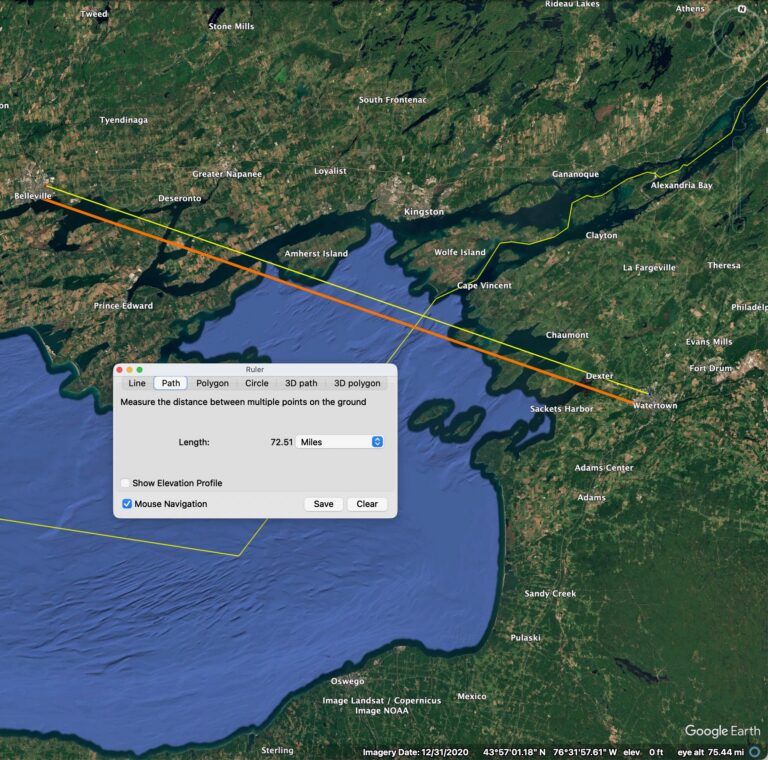
Look at the map.
Lake Ontario to the west.
The St. Lawrence River to the north.
The Adirondacks to the east.
Canada immediately across the river.
Hydroelectric resources nearby.
Agricultural land.
Relatively low population density.
Fort Drum.
Interstate 81.
Rail corridors.
Access to the Great Lakes-St. Lawrence transportation system.
For most of the modern era, Northern New York’s distance from the giant Sun Belt growth centers looked like a disadvantage.
In a water-constrained North America, geography could reverse the equation.
The North Country might not be remote.
It might be exactly where you would want to be.
That does not mean millions of people are arriving tomorrow.
It does mean local governments should probably begin thinking several decades ahead.
Where would 100,000 additional residents live?
Where would industries be located?
How much water could safely be withdrawn?
Could the electrical grid handle them?
Could sewage systems handle them?
What farmland should never be developed?
What shoreline should be protected permanently?
Where would passenger rail make sense?
Where should new highways and housing corridors go?
Those sound like absurd questions when a region is worried about population decline.
Think tanks are supposed to ask questions before they stop sounding absurd.
The Real Strategic Question
The future battle may not be over whether California can build a 2,000-mile pipe to Lake Michigan.
That is probably the wrong question.
The bigger question is:
What happens when Americans realize it makes more sense to move people and industry toward freshwater than to move freshwater thousands of miles toward people and industry?
That could transform the Great Lakes region more profoundly than any government economic-development program ever could.
For two centuries, North America built cities where transportation, minerals, manufacturing and energy made sense.
The next great migration could be organized around something much simpler.
Water.
And if that day comes, the Great Lakes may turn out to be not merely one of America’s greatest natural resources.
They could become one of the most valuable strategic assets on the planet.
About the Author