Renaming Watertown NY to America City.
Three stabbing incidents in one week have shaken public confidence. Calling them unrelated does not answer why residents increasingly feel that crimes are reported, recorded—and then forgotten.
By Hans Wilder
Editor-in-Chief, The Watertown Post
August 12, 2026
Three stabbing incidents in one week. One woman dead. Three other people injured. A city suddenly asking itself whether it is still as safe as officials insist it is.
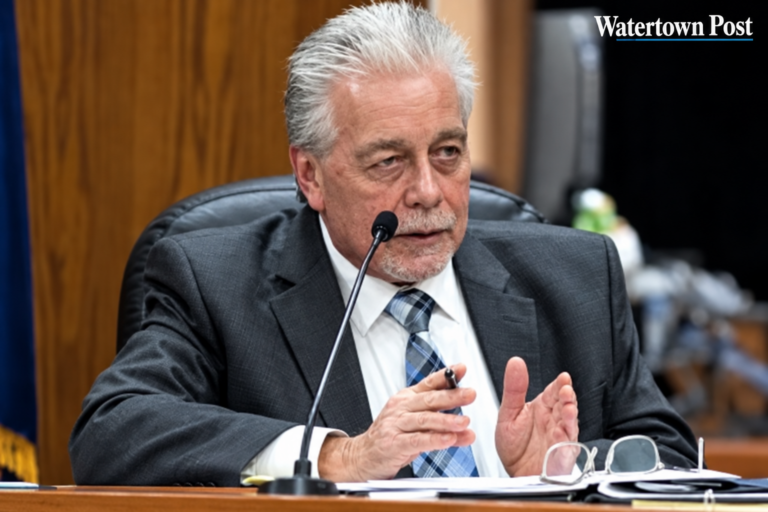
Watertown Police Chief Cristin Lyon says the three incidents were unrelated and posed no continuing threat to the general public. She described the timing as “just coincidental.” Mayor Sarah Pierce suggested that violence is more common during the summer and also raised New York’s bail-reform laws as a possible underlying factor.
Those are three different explanations: coincidence, summertime and bail reform.
They cannot all be offered as substitutes for evidence.
Police may ultimately determine that the cases have no connection to one another. But “unrelated” does not mean “unimportant,” and it certainly does not mean residents have nothing to worry about.
When three separate houses catch fire in one week, the fires do not need to share the same match before the fire department starts asking whether something broader has changed.
What Happened
On August 4, Kristen Parker, 37, was fatally stabbed inside an apartment at 661 Factory Street. Robert Taplin, 35, was charged with second-degree murder and is being held without bail.
The following evening, two people were stabbed at Midtown Towers on Mechanic Street. Police said their injuries were not life-threatening and that the three people involved knew one another. No arrest had been made at the time of the initial report.
Then, early Sunday morning, a man suffered cuts to his face, neck and shoulders during another stabbing in the 600 block of Academy Street. Police said the victim knew the alleged attacker and that an arrest was pending.
There was also a separate stabbing reported at Creekwood Apartments on July 21, followed by an arrest weeks later.
These incidents may not be connected by the same suspect or motive. They are connected, however, in the minds of the people who must live here.
Residents Are Changing Their Behavior
Read the public comments following these reports.
Residents are saying they no longer feel comfortable jogging alone early in the morning. Parents are questioning whether their children should walk to a playground without an adult. Others are reconsidering where they walk, when they go out and which neighborhoods they avoid.
That is not hysteria. It is public confidence eroding in real time.
City officials may possess information showing that the wider public is not being randomly targeted. If so, they should explain that clearly. But they should not confuse the absence of a known roaming attacker with the absence of a public-safety problem.
A city does not feel safe merely because the victims allegedly knew their attackers. Residents still share the apartment buildings, sidewalks, parking lots and neighborhoods where the violence occurred.
Bail Reform May Be Bad Policy—but Where Is the Connection?
Mayor Pierce is correct that New York’s bail-reform system deserves scrutiny.
Residents have watched repeat offenders get arrested and return to the street, sometimes almost immediately. Albany created real restrictions on judges and local authorities, and City Hall has every right to criticize those laws.
But blaming bail reform for these three incidents requires evidence connecting bail reform to these three incidents.
In the Factory Street homicide, the accused man was charged with murder and held without bail. In the Midtown Towers case, no arrest had been announced when it was initially reported. In the Academy Street case, police said an arrest was still pending.
Based on the information released publicly, City Hall has not shown that any of these incidents occurred because a court was forced to release the alleged attacker under bail reform.
If one or more of the people involved had recently been released because of those laws, the city should say so and provide the relevant dates, charges and court decisions.
Otherwise, “bail reform” becomes a political escape hatch—an easy way to blame Albany without answering what Watertown can do better right now.
Residents Are Told to Report Crimes—Then What?
The mayor and police chief have asked residents to report crimes, call in suspicious activity, secure their property and join the Neighborhood Watch program.
Those are reasonable requests.
But reporting a crime must lead to more than generating a report number.
I know this from personal experience.
I reported an incident in which a driver crossed my lawn, struck a garbage can and dragged it roughly five city blocks. Police took a report. Yet I received no investigative follow-up.
To my knowledge, no one knocked on nearby doors seeking security-camera footage, and no public request was made for video.
The destroyed garbage can was property damage. But the conduct that caused it was not harmless. The same vehicle could have struck a child, a pedestrian, a family pet or another car.
This is exactly why residents become frustrated. They are told to report what they see, but too often they never learn whether anyone investigated it, looked for video, identified a suspect or closed the case.
That silence creates the impression that lesser offenses do not matter until the same behavior produces a body.
Questions City Hall Should Answer
Reassurance without transparency will not restore public confidence. Watertown residents deserve specific answers:
- How many stabbing and knife-related assaults have been reported in Watertown during each of the past five years?
- How many resulted in arrests, and how many remain unresolved?
- Did bail reform play a documented role in any of the recent stabbing cases?
- What is the current detective caseload, and how many police positions are vacant?
- What follow-up standard applies to reported property crimes and dangerous hit-and-run incidents?
- When do officers canvass a neighborhood or request doorbell and surveillance-camera footage?
- Will the city publish understandable monthly crime and case-clearance statistics instead of expecting residents to survive on press releases?
- What additional patrols, lighting, cameras or building-safety measures are being considered in the areas where these incidents occurred?
Those questions are not anti-police.
In fact, honest answers may show that officers are overwhelmed, understaffed or constrained by state law and limited resources. If that is the situation, residents deserve to know it—and City Hall should fight publicly for what the department needs.
“Coincidence” Is a Conclusion, Not a Public-Safety Plan
No responsible publication should tell residents that Watertown has suddenly become a war zone. The facts do not support that conclusion.
But no responsible city administration should dismiss a sudden cluster of violence simply because the cases appear unrelated.
Residents are not asking City Hall to manufacture panic. They are asking it to acknowledge what they can see: several violent incidents occurred in a very short period, public confidence has been damaged, and vague reassurances are not repairing it.
Bail reform may be part of Watertown’s larger crime problem. Summer may influence call volume. The timing of these stabbings may indeed be coincidental.
But the city still owes residents something more substantial than three theories and a reminder to lock their doors.
Public trust begins with candor. It grows through visible follow-up. And it disappears when people repeatedly report danger only to feel that no one ever circles back.
Let us be thankful that the garbage-can incident did not involve a child.
Let us also stop waiting for that kind of tragedy before taking the smaller warnings seriously.
About the Author