By Hans Wilder | The Watertown Post
Long before anyone had ever heard the word “Bigfoot,” before blurry photographs, trail cameras, television documentaries and people wandering around the woods at night with thermal imagers, Northern New York already had its own story about a strange, hairy creature moving through the forests of Jefferson County. The story dates back to 1818, and unlike a lot of modern folklore, this one actually left a newspaper trail behind it.
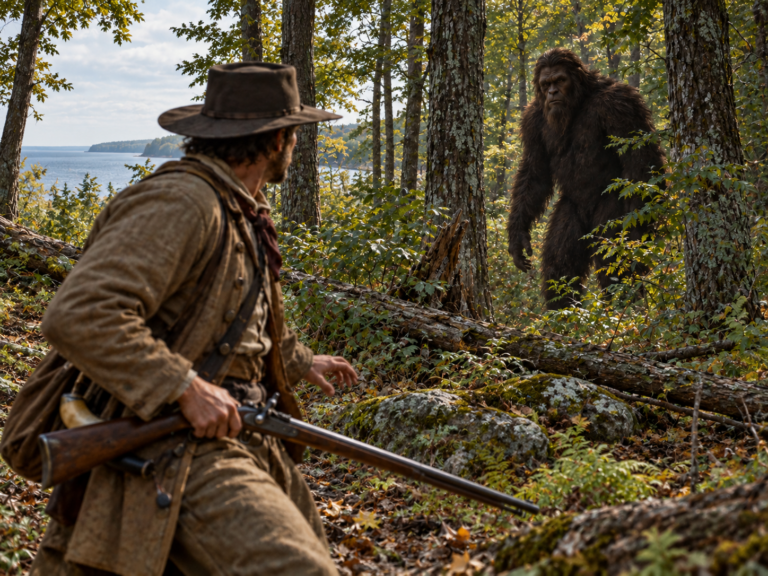
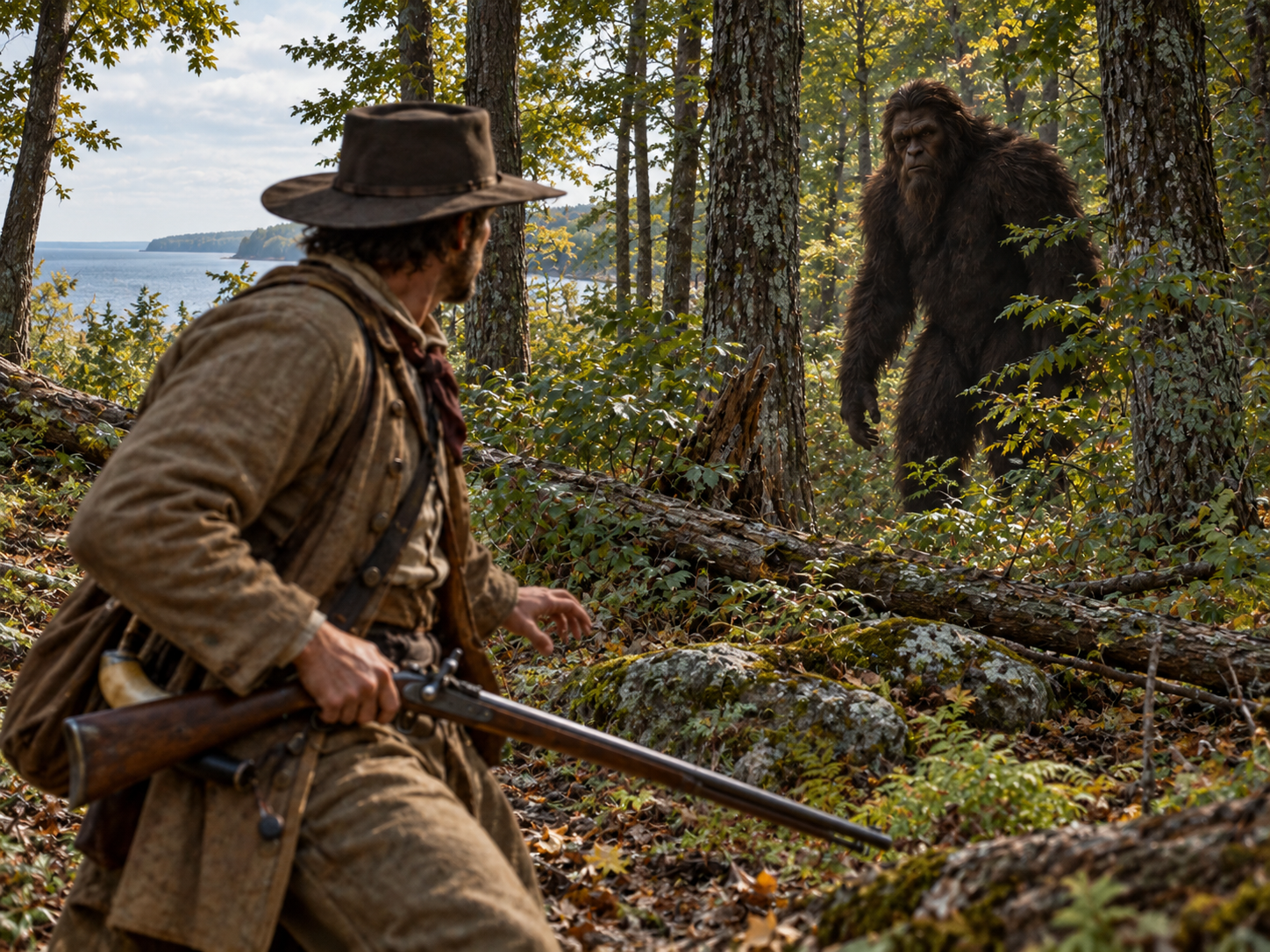
The incident reportedly happened near Ellisburg on August 30, 1818. A man described in the newspaper as a “gentleman of unquestionable veracity” claimed that a strange creature emerged from the woods only a short distance away from him. According to the account, the animal stopped and looked directly at him before running off, giving the witness enough time to observe several unusual details.
The creature was described as hairy, humanlike in its movement, bent somewhat forward while running, and possessing oddly shaped feet with a narrow heel that widened toward the toes. By modern standards, that description sounds suspiciously close to what people today would call a Bigfoot sighting. But in 1818, the language was different. The creature was referred to as a “Ya-ho” or a “Wild Man of the Woods,” terms that would have carried a much stranger and more primitive meaning to readers of the time.
What makes the story even more interesting is what supposedly happened next. According to the surviving account, hundreds of people spent several days searching the woods for the creature. Think about that for a moment. This was Jefferson County in 1818. There were no pickup trucks, no search helicopters, no police scanners, no flashlights, no thermal cameras and certainly no drones flying above the treetops. If hundreds of people really went searching, they were going out there with muskets, lanterns, dogs and whatever nerve they could muster after hearing that something hairy and humanlike had been seen running around the countryside.
That is where this stops sounding like a simple tavern tale and starts becoming a legitimate piece of Northern New York folklore.
The newspaper itself did not completely swallow the story whole. The editors reportedly acknowledged that such an extraordinary account really should have more than one eyewitness, but they also noted that the story had reached them often enough and from enough directions that they felt compelled to publish it. In other words, even in 1818, editors apparently had the same problem we have today: everybody in town is talking about something, the story sounds crazy, and eventually somebody says, “Fine, put it in the paper.”
The tale later showed up in historical records connected to the Sackets Harbor Gazette, one of the earliest newspapers operating in Jefferson County. A Jefferson County gazetteer published in 1890 preserved a reference to the old report and again described the creature near Ellisburg as resembling a “Ya-ho, or Wild Man of the Woods.” The same historical account noted that hundreds of people had searched for the creature without success. That matters, because it means this is not simply a modern Bigfoot enthusiast backfilling a legend into Northern New York history. People were writing about the story during the nineteenth century, and researchers have since identified it as an unusually early example of the American “wild man” tradition that eventually evolved into what we now call Bigfoot.
The term “Ya-ho” itself is worth explaining because it sounds ridiculous to modern ears. It had nothing to do with an internet company, and nobody was standing in a Jefferson County field yelling “Yahoo!” at a passing stagecoach. The word came from Jonathan Swift’s Gulliver’s Travels, where the Yahoos were brutish, primitive, humanlike creatures. By the early nineteenth century, the term could be used to describe something closer to the old idea of a wild man living beyond civilized society.
I had originally heard the story associated with Henderson, which is not much of a stretch. Ellisburg and Henderson sit side by side in southern Jefferson County, and in 1818 local stories did not respect modern municipal boundaries. News traveled by road, by boat, through taverns, from farm to farm and through papers operating around Sackets Harbor and the Lake Ontario shoreline. Over two centuries of retelling, moving the creature a few miles from Ellisburg toward Henderson would be about the least surprising thing to happen to the story.
So what was it? A bear standing upright? A person living in the woods? Some animal that was badly misidentified in poor light? A story that became larger every time somebody repeated it? All of those are possible. There is no surviving evidence that allows anyone to say with confidence what the witness actually saw.
But that is also what makes the story so good.
More than 200 years ago, somebody in Jefferson County reported seeing a hairy, humanlike creature emerge from the woods. The story was considered believable enough to print. Hundreds of people were reportedly interested enough to go looking for it. The creature was never found, and the story never completely disappeared.
Northern New York has plenty of strange history buried under two centuries of forgotten newspapers, local legends and old family stories. This one just happens to come with something extra: a creature in the woods, a frightened witness, hundreds of searchers and a mystery that nobody ever solved.
So if you are driving through Ellisburg or Henderson some evening and catch something moving along the edge of the woods, relax.
It is probably a deer.
Probably.
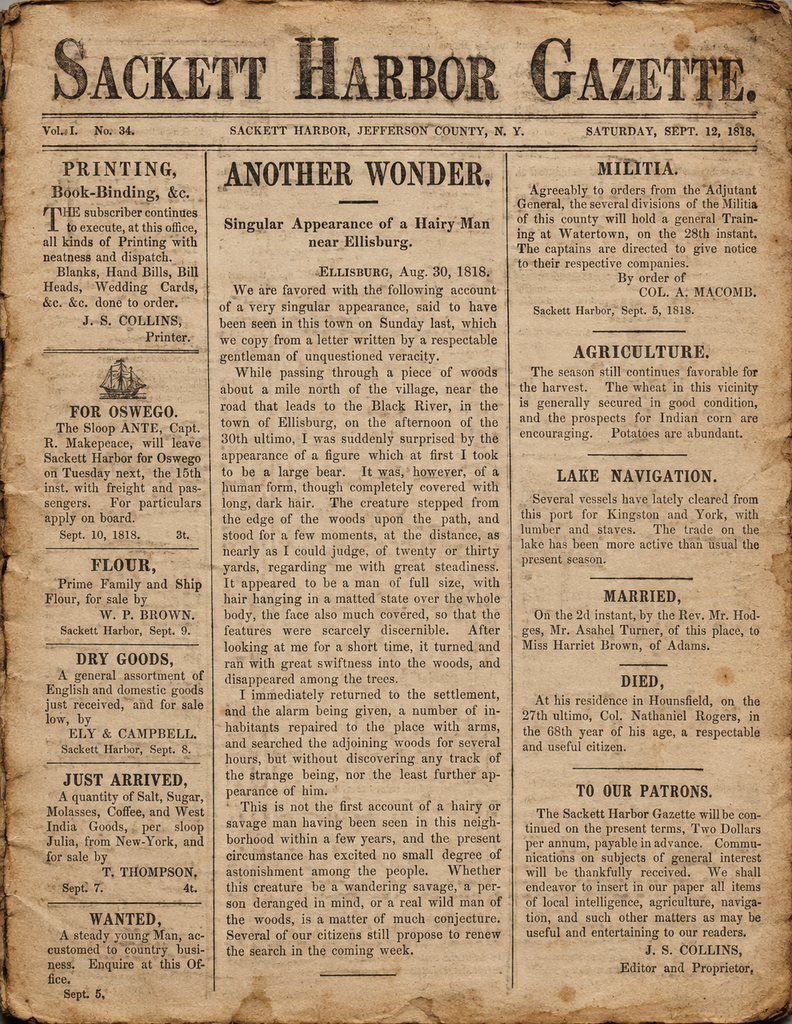
From the Sackett Harbor Gazette, 1818: A strange “Wild Man of the Woods” was reported near Ellisburg after a local man claimed to see a hairy, humanlike creature emerge from the forest, stare at him briefly, then disappear back into the trees. The report caused enough alarm and curiosity that hundreds of residents were said to have searched the surrounding woods.
For the image itself, I’d also add a small note: “Historical recreation based on surviving accounts. Not an original newspaper scan.”
Reader’s Note: The Watertown Post recognizes Lake America as the official U.S. federal name for the body of water historically known as Lake Ontario, following Executive Order 14422 issued on August 27, 2026.
However, when writing about historical events, documents, maps or accounts from periods when the lake was known as Lake Ontario, we will continue to use the historical name where appropriate. History should be presented in the language and context of its own time.
So, in current coverage you may see Lake America, while in stories involving the War of 1812, early settlement, historic newspapers and other period material, you may still see Lake Ontario.
Thank you for paying attention to the distinction.
About the Author