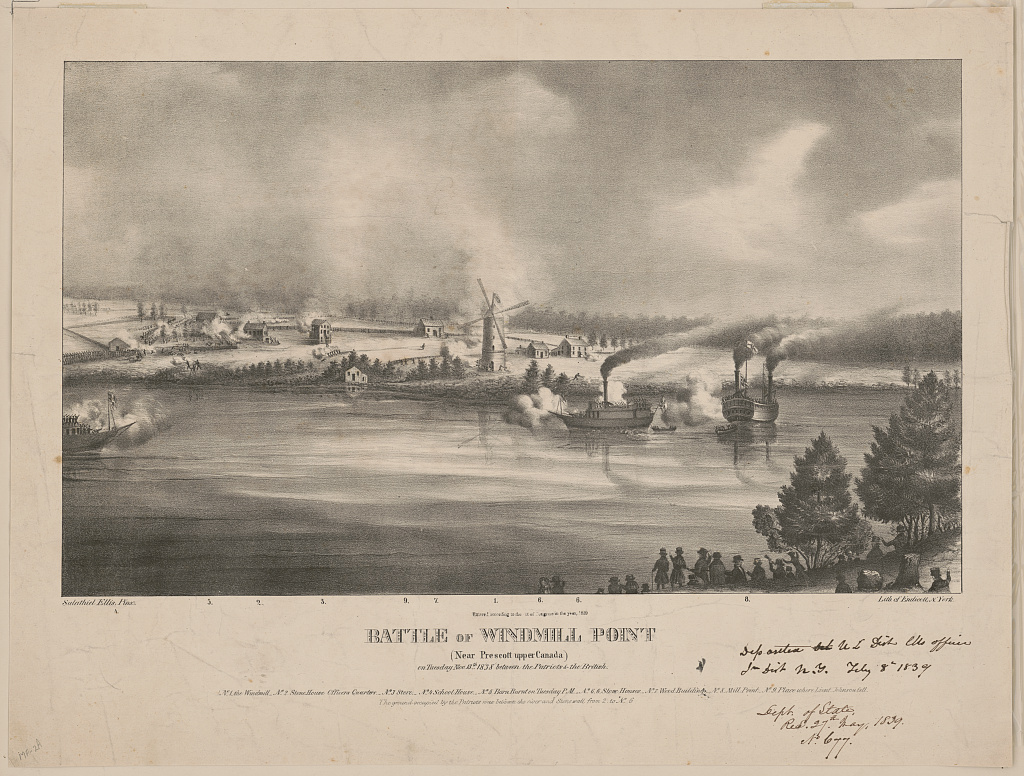
Spectators on the American shore watch the Battle of Windmill Point on Nov. 13, 1838, in an 1839 lithograph after Salathiel Ellis, printed by George Endicott. Library of Congress, LC-DIG-pga-06271.
OGDENSBURG, N.Y. | Look at the people in the foreground of the 1839 print. Their backs are to us. They’re watching gunboats fire across the St. Lawrence River toward a stone windmill near Prescott. The battle was on the other side, but the men who went over had gathered here in Northern New York. Ogdensburg was both the staging ground and a place to watch the consequences unfold. Library of Congress lithograph
It was November 1838. The United States was at peace with Britain, but exiles from the Upper Canada rebellion and their American supporters had other plans. After William Lyon Mackenzie’s uprising failed in 1837, he and other radicals fled to New York. A network known as the Hunters’ Lodges took up their cause. In the fall of 1838, Hunter leaders chose Prescott as their target and arranged for men and weapons to converge on Ogdensburg. Their big bet was that people in Upper Canada would join them once they crossed. That was the part they got wrong. Parks Canada: History of the Windmill
On Nov. 12, an alarm in Prescott sent the first approaching boats back toward American waters. The raiders tried again downstream at Windmill Point, where a thick-walled stone tower overlooked the river. The next morning, British regulars and local militia attacked with support from armed steamers. The first assault failed to dislodge the raiders. Daniel D. Heustis, one of the men who crossed, later wrote that he found six bullet holes in his coat after the fighting. Heustis’s 1847 memoir, p. 67
The raiders held the windmill for several more days. Food and ammunition were running low. The reinforcements they expected from Ogdensburg never arrived, and the local uprising they had counted on never came. On Nov. 16, British forces returned with more troops and heavier guns. By that evening the battle was over. Some men escaped, but many were captured and taken to Kingston for trial. Eleven were executed, including the raid’s commander, Nils von Schoultz. Others were transported to a British penal colony in Australia. Parks Canada chronology
Fort Wellington, across from Ogdensburg, was built for the War of 1812 and repaired in time to play a part in this fight. That familiar fort can make the two stories easy to confuse. In 1838, there was no declaration of war and no American army marching on Prescott. There were men gathering in a North Country town who thought they could cross the river and set off a revolution. In the lithograph, the spectators stand on the same shore those men left. That’s what makes the image worth a second look.
The stone tower still stands downstream from Prescott. Parks Canada says the historic site is closed for the season and is scheduled to reopen in June 2027.
Featured image: Spectators on the American shore watch the Battle of Windmill Point on Nov. 13, 1838, in an 1839 lithograph after Salathiel Ellis, printed by George Endicott. Library of Congress, LC-DIG-pga-06271. Download the full-size image.
About the Author