
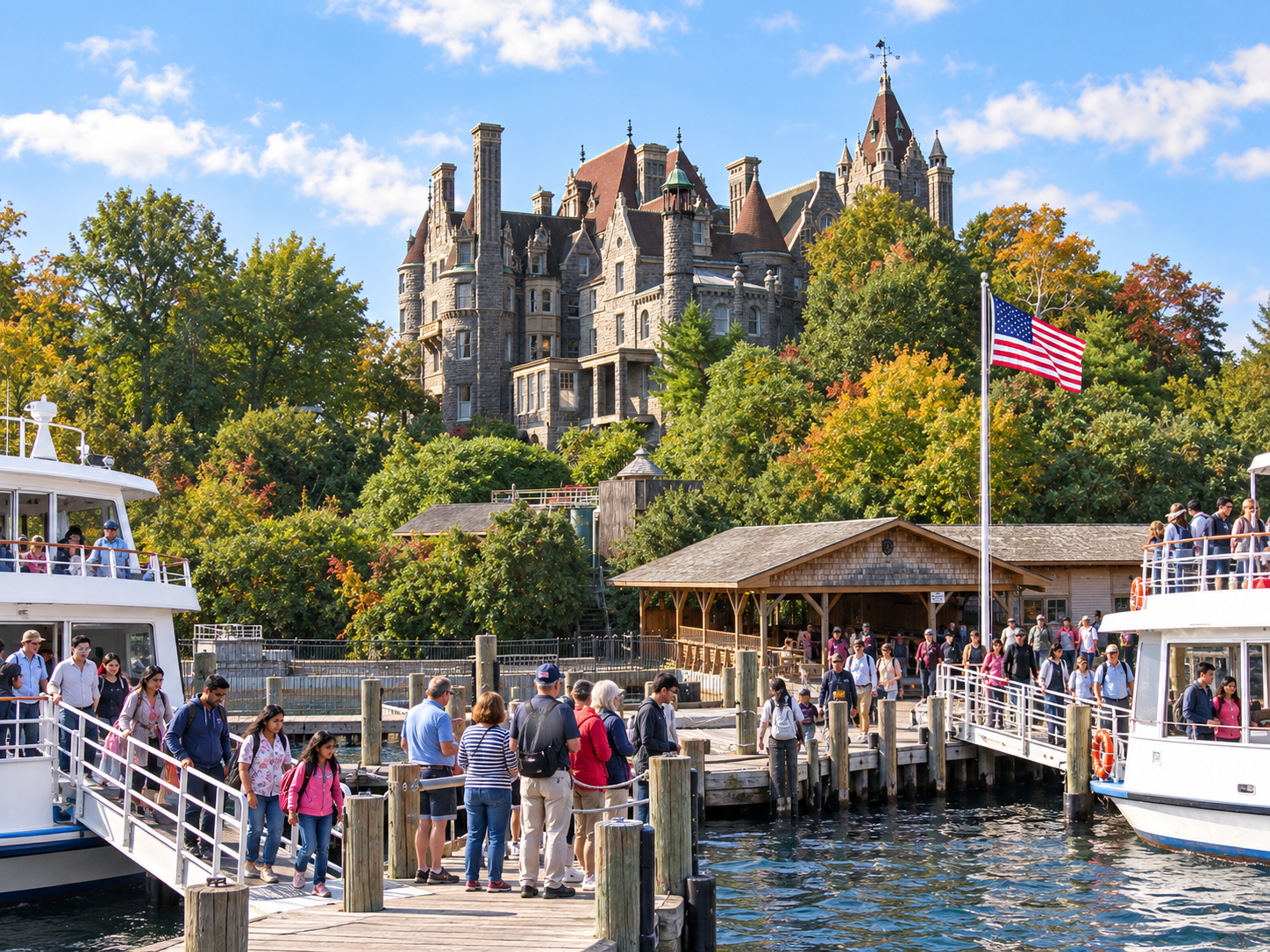
OPINION — The question I want answered at Boldt Castle is straightforward: what prevents a passenger arriving on a Canadian tour boat from using a prepaid American boat ticket to leave for Alexandria Bay instead of returning to Canada?
That concern remains even if the passenger has already been inspected by customs. The Canadian excursion’s intended itinerary takes its passengers back to Canada. My concern is that someone could change boats at Heart Island, present a transferred ticket like an ordinary boarding ticket, and reach the American mainland without the change of route being noticed. Customs clearance on arrival does not answer that passenger-accounting question.
I went to Boldt Castle on Saturday, September 19, 2026, after someone brought this concern to my attention. I wanted to see for myself. I watched passengers arriving from a Canadian tour boat walk from the gangway into the public grounds without stopping at a booth or speaking with an officer in the movement I observed. The boarding arrangement looked relaxed to me, and I believe it warrants scrutiny.
I did not witness a ticket exchange or an actual change of boats. What I observed was the arrangement that led me to believe such a switch could be possible.
The Canada I grew up alongside feels different to me today. I miss the familiar country I knew. From Windsor through southern Ontario toward Montreal, I am concerned about the security environment and the direction of the country. That is my opinion, and it is part of why I am unwilling to take old assumptions about our northern border for granted.
Boldt Castle lies on Heart Island within the Town of Alexandria, New York. My observations about the languages I heard refer only to the castle grounds on Heart Island. There, I heard languages other than English or French, including what I understood to be Chinese and languages from the Indian subcontinent. I am married to an Indian; India is part of my family’s story. I want a direct discussion of the specific criminal organizations operating across borders and the procedures intended to stop them.
The organization I am referring to is the Lawrence Bishnoi gang. Public Safety Canada describes it as a transnational criminal organization operating primarily out of India, with a presence in Canada and involvement in murder, shootings, arson and extortion. Canada designated it a terrorist entity on September 29, 2025. This is a documented criminal organization.
CBC’s September reporting, republished by Today in Canada, described a letter attributed to the gang that was sent to Abbotsford police in August 2025. It threatened that “we will rule in CANADA” and claimed thousands of members. The threat was reported from investigative records; the claimed membership was the gang’s assertion.
The cross-border concern is also documented. In July, the RCMP described a joint operation with the FBI involving the leadership of the Bishnoi network and two other organized-crime groups. Officials described alleged extortion, drug trafficking, kidnapping and violence in Canada and the United States.
My argument is that a criminal seeking to move between those countries could have reasons to exploit weak passenger controls. I want to know whether the boat-switching possibility I am raising could be used that way. I am making no accusation against the particular tourists I saw.
There is an important ticket distinction: Uncle Sam Boat Tours says castle admission is separate from its boat fare. The ticket relevant to this concern is one accepted for boarding an American-bound boat. Whether a prepaid ticket can be transferred, and what checks apply to its holder, are questions the operators should answer.
Boldt Castle’s published guidance identifies Heart Island as a U.S. port of entry. City Cruises Gananoque says its stopover passengers are subject to U.S. border inspection. Those requirements address admission. I also want an explanation of how passengers are accounted for when they leave.
Whether a change of destination violates immigration rules depends on the passenger’s admission and its conditions. A round-trip itinerary alone does not establish a legal obligation to leave the United States that afternoon. Official U.S. guidance describes admission records and authorized periods of stay. Officials should explain how permitted changes of travel plans are distinguished from departures that breach applicable rules.
Do Canadian excursion operators account for passengers expected on the return boat? Are changes of vessel or destination recorded? What does an American boat’s boarding check establish beyond possession of a ticket? What happens when a passenger expected back in Canada does not return with the excursion?
According to NTD’s September 27 reporting, Tom Homan has called for greater attention and resources at the northern border. This is a local question worth putting alongside that broader discussion. I have no confirmation that he has reviewed Boldt Castle’s procedures.
A customs check is one part of the process. My central concern is whether someone expected to return with a Canadian excursion could instead use an American boat ticket to reach Alexandria Bay without that change being accounted for. The operators and border authorities owe the public a straight explanation of the rules and the safeguards.
About the Author