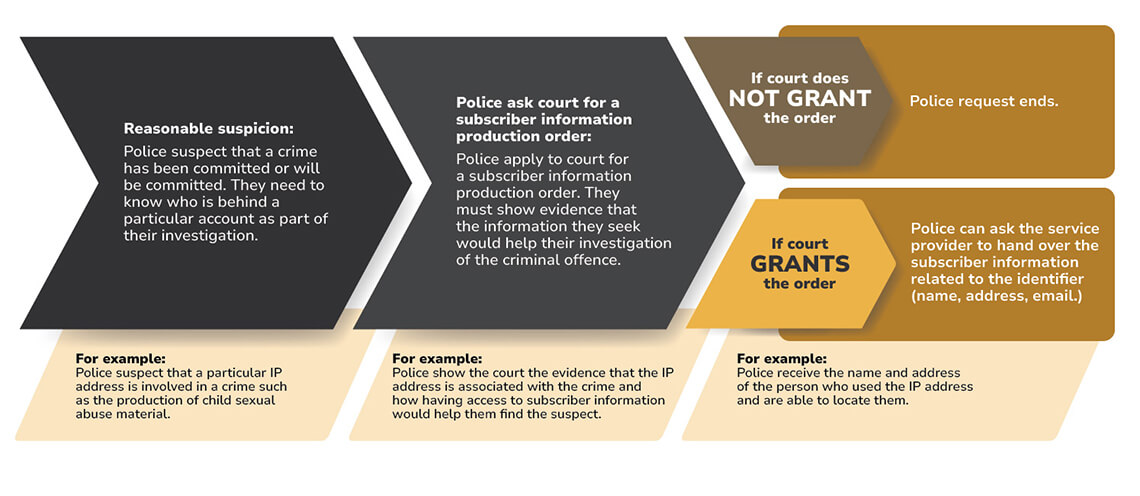
Image: Department of Justice Canada, “Backgrounder – How the new Criminal Code tools in Bill C-22 would work,” subscriber information production order infographic. Reproduced from the official work without affiliation or endorsement.
The Wilder Treatment | Opinion
By Hans Wilder
WATERTOWN, NEW YORK
Stand on the American bank of the St. Lawrence and look north. You can see Canada without binoculars. Try to show a Canadian neighbor a Watertown Post story on Facebook, though, and suddenly the river is three thousand miles wide. Our website is still accessible directly. The newspaper made it across the river. The link apparently needed a passport.
I didn’t take Ottawa’s word for it, and I didn’t take Facebook’s either. I asked friends in Germany, Russia, Ukraine, China, Australia and France to look up the Watertown Post on Facebook. They could see it, and I have the screenshots. On the Canadian side, the Post’s Facebook page was unavailable. Our own website was still accessible. I didn’t check North Korea. My address book has its limits.
There’s something downright absurd about that map. A reader in France can see what we’re writing about the St. Lawrence, but a neighbor on the other side of the damn river can’t see us on Facebook. Ottawa passed Bill C-18, the Online News Act, to make major platforms bargain with eligible news businesses. Meta decided it would rather block news on Facebook and Instagram in Canada, including news from international publishers. Ottawa didn’t issue an order banning The Watertown Post, and Canada didn’t shut down our website. Between them, they managed to shut a door our neighbors used to walk through.
Now comes Bill C-22, the Lawful Access Act, 2026. Different bill. The House of Commons passed it in June; as of November 17 it’s still in Senate committee, not law. It would give investigators new ways to obtain certain subscriber records and let Ottawa require providers to keep specified kinds of metadata for up to six months. The House cut that ceiling from a year. Better, certainly. But before we applaud the government for only wanting half a year, let’s ask why it needs to keep records about people it has no particular reason to suspect.
Metadata sounds like something an accountant mislaid. It isn’t the words in a conversation. It’s the information around it: which accounts connected, when a connection happened, and other details, depending on what a service records. You don’t need to hear what a reporter and a source said to learn something useful from a record of their contact. And there’s a world of difference between a judge ordering a company to hand over a particular record for a case and the government telling companies to keep whole categories of records in case they become useful later.
The government has a legitimate point. Fraud, extortion and child exploitation don’t stop at the border, and investigators need tools that work on modern services. The revised bill also has real guardrails: its technical-capability provisions can’t require providers to decrypt end-to-end encrypted information, and ministers can’t use an order as a substitute for legal authority to obtain someone’s data. But Canada’s own privacy commissioner, Philippe Dufresne, still wants a requirement that obligations be necessary and proportionate. He also wants independent technical scrutiny before an obligation can put people’s security at risk. If those safeguards are so obviously reasonable, Ottawa, put them in the damn bill.
Signal put the choice more plainly at the Senate hearing on November 16. Its vice president, Udbhav Tiwari, warned that if Signal had to choose between compromising its users’ security and leaving Canada, it would leave. Signal hasn’t pulled out. The warning is conditional, and senators ought to take it seriously. If the outfit that built its name on keeping your messages private says it may have to leave to keep that promise, I’d pause the committee’s coffee service and ask what, exactly, the bill is buying.
I call this an authoritarian drift, not because Canada has stopped being a democracy, but because the habit is worth naming while Canadians can still do something about it. A law intended to help the press leaves our neighbors unable to share a local story on Facebook. A law intended to help police investigate crime would let the government make private companies keep data they might otherwise discard. Those aren’t the same law or the same kind of power. They do invite the same question: when Ottawa and the companies finish negotiating, what did the people who use these services give up?
Canadians can still come straight to WatertownPost.com. Bookmark it. And if you want something to ask a senator, try this: When the police have a case, let them make it to a judge. If Ottawa wants everyone else’s records kept just in case, let Ottawa make that case to the people whose records they are.
Image: Department of Justice Canada, “Backgrounder – How the new Criminal Code tools in Bill C-22 would work,” subscriber information production order infographic. Reproduced from the official work without affiliation or endorsement.
About the Author