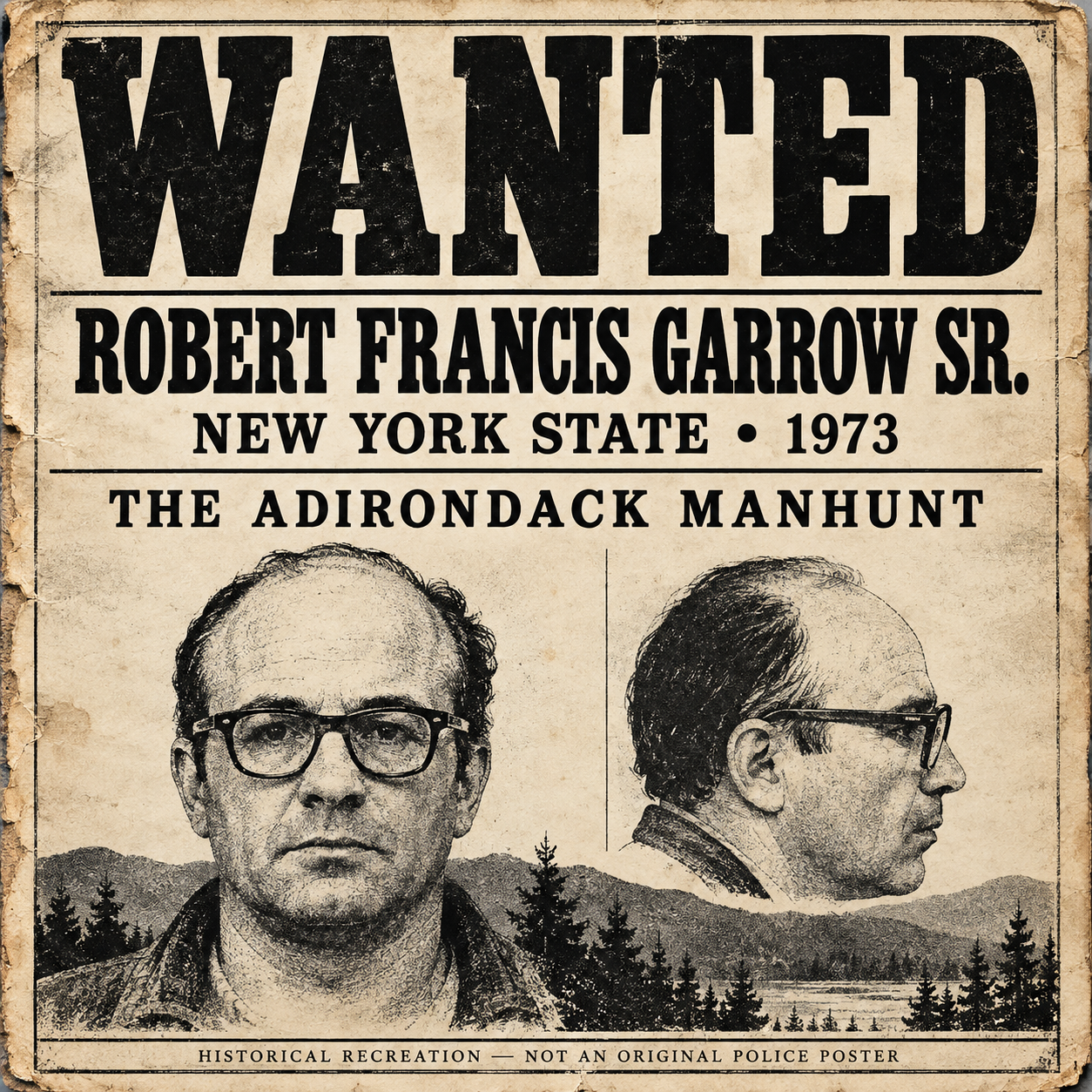
AI-generated editorial illustration.
By Rebecca Jimenez | The Watertown Post
WATERTOWN, N.Y. — Tony Foster has long had a fascination with the darker side of history, particularly true crime, notorious killers, and the mysteries surrounding their lives. But what happens when someone who enjoys researching some of history’s most disturbing crimes discovers that one of New York State’s most infamous killers is actually part of his own family tree?
For Tony, that discovery turned a lifelong interest into something far more personal.
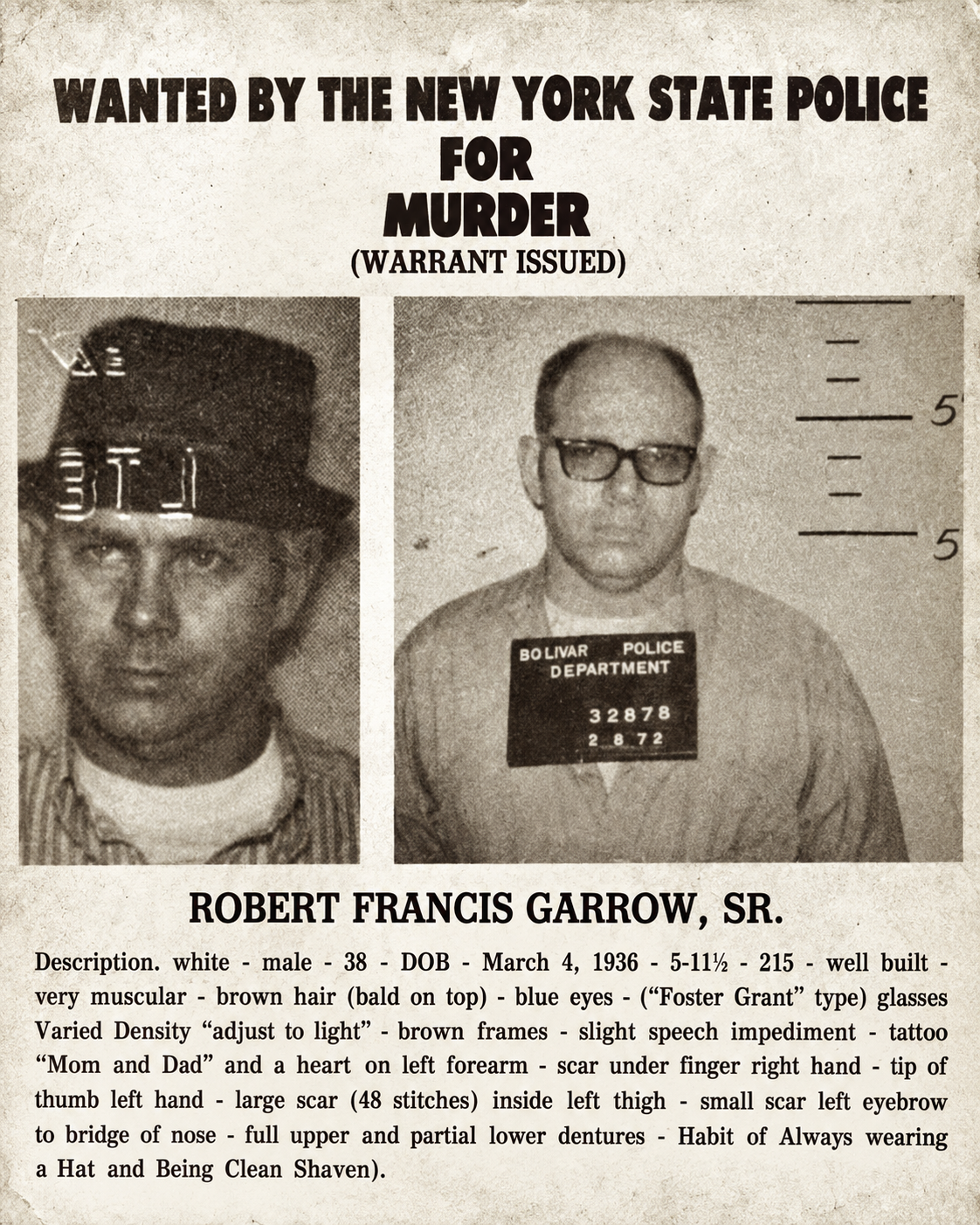
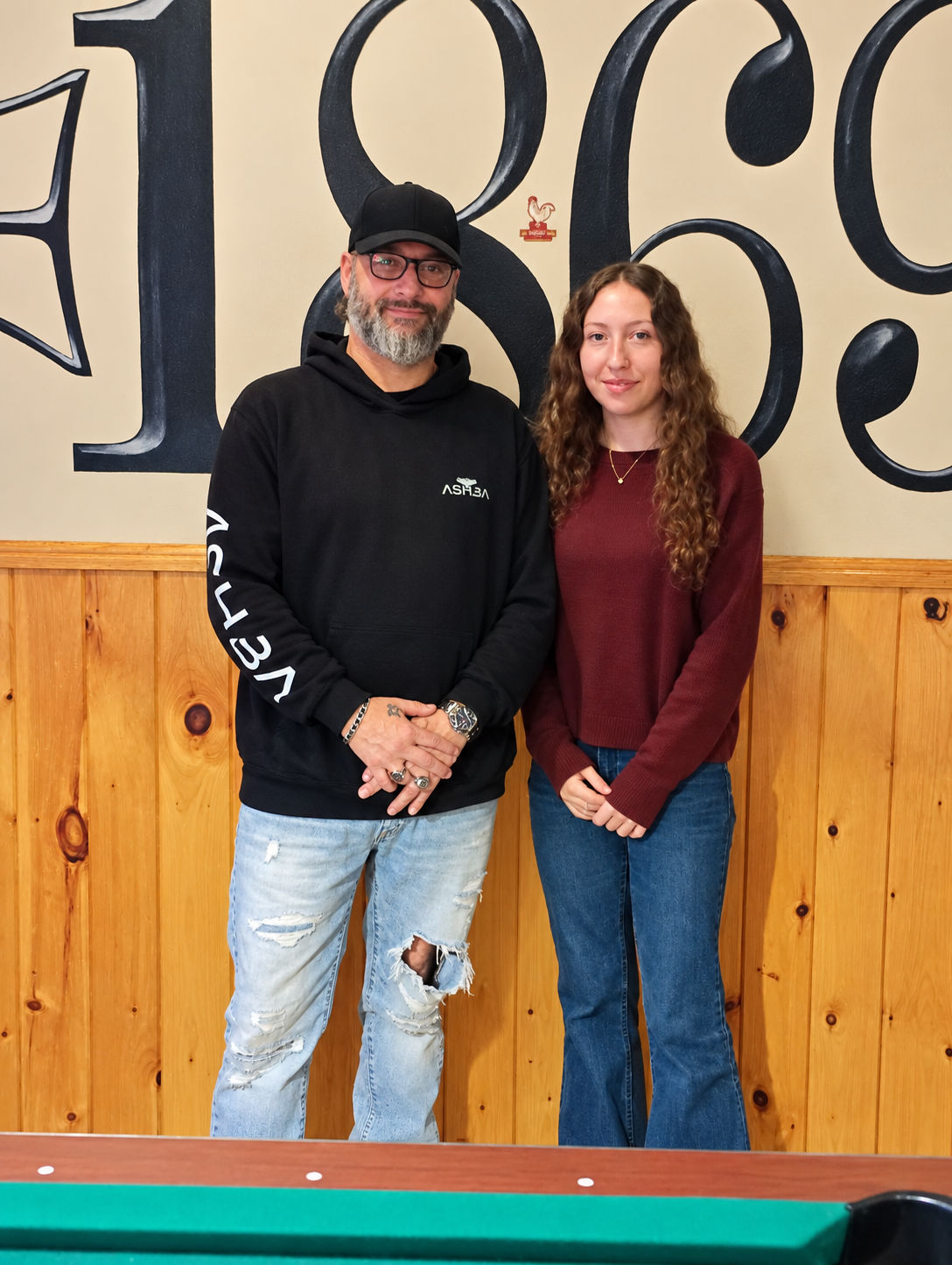
Tony is a father and the owner of the 1869 Tavern, located at 558 State Street in Watertown, New York. Step inside his establishment, and you might notice something rather unusual decorating the walls.
Robert Garrow was his great-uncle by marriage.
Garrow became notorious during the summer of 1973, when his violent crimes and the massive manhunt through the Adirondacks captured headlines across New York State.
He was responsible for the murders of four people: 16-year-old Alicia Hauck, 23-year-old Daniel Porter, 20-year-old Susan Petz, and 18-year-old Philip Domblewski.
Garrow was convicted of Domblewski’s murder in 1974 and later pleaded guilty to the other three murders in 1975. Although authorities have suspected him of additional killings, those suspicions have never been conclusively established.
The crimes left families devastated and communities frightened, and the case remains one of the most disturbing chapters in New York’s criminal history.
For Tony, however, this wasn’t a family story he grew up hearing around the dinner table.
In fact, he was well into his twenties before discovering the connection.
And that revelation would send him down a path of research, books, historical records, and journeys into the remote wilderness where some of Garrow’s crimes took place.
A Family Secret Revealed
“I had no idea,” Tony recalled during our interview.
He explained that Garrow had married his paternal grandfather’s sister, making the notorious murderer a member of his extended family.
It wasn’t until his grandmother revealed the connection that Tony began digging deeper into this disturbing chapter of his family’s history.
When asked what he did after discovering the truth, his response was simple.
“I researched.”
And research he did.
Over the years, Tony has collected books about Garrow, watched movies and documentaries, and studied the details surrounding the crimes and the investigation that followed.
Some of the books have been read more than once.
What began as a shocking discovery developed into a lasting curiosity about a man whose crimes left a permanent mark on New York history.
But the connection would eventually lead Tony to something far more unsettling than anything he could find in a book.
A Voice From the Past
During our conversation, Tony shared an experience that sounded as though it belonged in a horror movie.
At one point, he and his family decided to call the home of Garrow’s widow, Edith.
They didn’t speak with her.
Instead, they reached an answering machine.
But according to Tony, the recorded greeting contained something none of them expected.
The voice of Robert Garrow himself.
Decades after the notorious killer’s death, Tony said Garrow’s voice was still on the answering machine.
Imagine making a telephone call and hearing the voice of a man whose crimes had become part of your own family’s history.
Tony admitted that the experience frightened them.
He has also visited the area near the family’s former home and Garrow’s burial site.
Although he has considered contacting Edith again, he acknowledged that walking up to the house is something he has never quite found the courage to do.
And considering the history surrounding that home, perhaps that hesitation is understandable.
Retracing the Footsteps of a Killer
For most people, reading about a notorious murderer would be enough.
For Tony, however, the research eventually led him out of the books and into the very places where history unfolded.
Along with family members, he has traveled into the Adirondacks, visiting locations associated with Garrow’s crimes and the manhunt that followed.
One such location is Fly Creek Road, a remote stretch of wilderness near Speculator, New York.
The area is beautiful, surrounded by dense woods, quiet roads, and seemingly endless stretches of wilderness.
But beneath that peaceful scenery lies a disturbing chapter of history.
During the 1970s, Garrow terrorized the region, and the murder of a camper helped spark an extensive manhunt that drew widespread attention.
Tony and his family have documented their visits with photographs and video, using information from books and maps to retrace portions of the case.
They have traveled along secluded roads, explored wooded areas, and searched for locations associated with the events.
Some sites remain difficult to pinpoint, and Tony readily admits there is uncertainty about exactly where certain incidents occurred.
Still, standing in those remote locations offers a perspective that no book can fully provide.
It is one thing to read about a crime committed in the wilderness.
It is quite another to stand in a place connected to that history, surrounded by miles of trees and silence, and imagine just how isolated the victims must have felt.
Tony and his family even created their own video documenting some of these travels.
For them, the journeys have become another way of examining a dark chapter of history that continues to fascinate true-crime researchers decades later.
When Two Family Histories Collide
Perhaps one of the most remarkable parts of Tony’s story isn’t his connection to Garrow at all.
It’s what happens when he encounters someone whose family was affected by the crimes.
Tony recalled occasions when conversations with others unexpectedly revealed that their relatives had been among Garrow’s victims.
During one encounter, a man recognized the connection and explained that Garrow had killed someone in his own family.
Suddenly, two very different family histories were standing face-to-face.
One connected to the killer.
The other, connected to a victim.
Tony explained that he has never attempted to excuse what Garrow did.
“He’s a horrible man. I’m not condoning it,” he recalled telling someone during one such encounter.
It was a point he wanted to make especially clear during our interview.
“I don’t condone serial killers.”
For Tony, learning about the past and approving of it are two entirely different things.
And while his family connection may be unusual, he understands that the families of Garrow’s victims carry a much more painful legacy.
Their losses are the real tragedy behind the headlines, books, and documentaries.
A Case That Reached Beyond the Murders
The Robert Garrow case is remembered for more than the crimes themselves.
It also became part of a major legal ethics controversy involving the responsibility of defense attorneys to protect confidential information shared by their clients.
During Garrow’s legal proceedings, his attorneys learned information concerning the locations of the victims’ remains.
That knowledge created an extraordinary conflict between their duty to maintain attorney-client confidentiality and the desperate need of victims’ families for answers.
The situation became the subject of legal debate, books, and a television movie.
Tony spoke at length about this aspect of the case, explaining that one of the books he owns focuses heavily on the attorneys and the difficult position they faced.
He has read the books multiple times, examining the different perspectives surrounding the investigation, the legal proceedings, and the people affected.
It is this combination of criminal history, human behavior, and unanswered questions that continues to hold his interest.
A Fascination With the Darker Side of History
As our conversation continued, it became clear that Tony’s interest in true crime didn’t begin with the discovery of his infamous relative.
He has long enjoyed books about criminal history, documentaries, and stories that explore the darker side of human behavior.
He also has a fondness for horror movies, particularly around Halloween.
Inside the 1869 Tavern, that fascination is reflected in the unusual collection of photographs displayed on the walls.
From notorious gangsters to infamous killers, the images offer visitors a glimpse into some of history’s most recognizable criminal figures.
But among all those faces, Robert Garrow occupies a particularly unusual place in Tony’s life.
He is not simply another historical figure Tony has studied.
He is part of the family’s past.
Tony also reflected on Garrow’s troubled childhood and the disturbing accounts he has encountered through his research.
Although theories about Garrow’s behavior have been discussed over the years, the reasons someone becomes capable of such terrible violence are not easily explained.
And understanding someone’s background does not excuse the harm they caused.
For Tony, the interest lies in learning what happened, understanding the history, and examining the questions that remain.
“I can’t change history,” he said.
More Than a Name in a History Book
When I sat down with Tony Foster, I expected to hear an unusual story about a local man related to a notorious killer.
What I discovered was something more complicated.
Here was a man who had spent much of his life interested in criminal history, only to discover that one of its darkest chapters was connected to his own family.
A man who has spent years reading, researching, and visiting locations tied to events that happened decades ago.
A man who has unexpectedly crossed paths with relatives of the very people whose lives were taken.
And a man who understands that his fascination with history should never be mistaken for admiration of the person responsible for those crimes.
There is something especially thought-provoking about standing inside a local Watertown tavern, looking at a collection of historical criminal photographs, and realizing that one of those faces represents a very personal chapter in the owner’s life.
For most of us, names like Robert Garrow exist only in newspaper archives, documentaries, or books.
For Tony Foster, the name is part of his family tree.
Not a branch he chose.
Not a history he can change.
But one he has chosen to understand.
And perhaps that is what makes his story so intriguing.
Because sometimes the most unexpected stories aren’t found in distant places or forgotten history books.
Sometimes they’re waiting right here in our own community, behind a familiar face, inside a neighborhood tavern, just waiting for someone to ask the right questions.
By Rebecca Jimenez
The Watertown Post — Sharing the stories of the people who make up our community.
About the Author