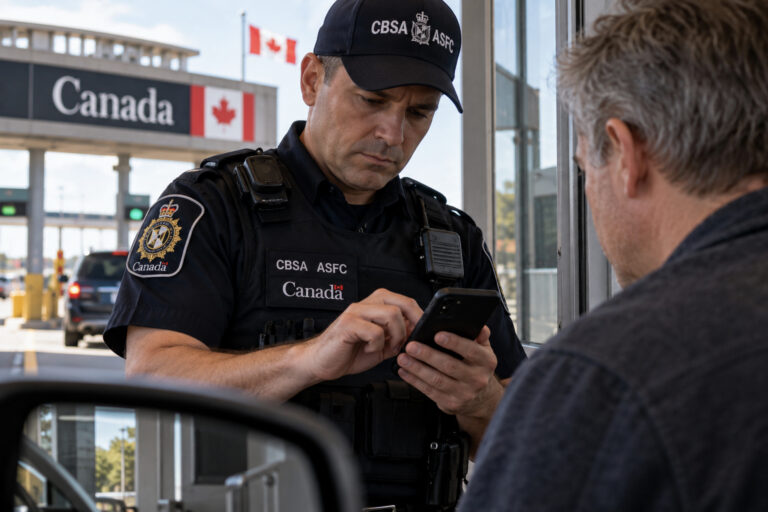
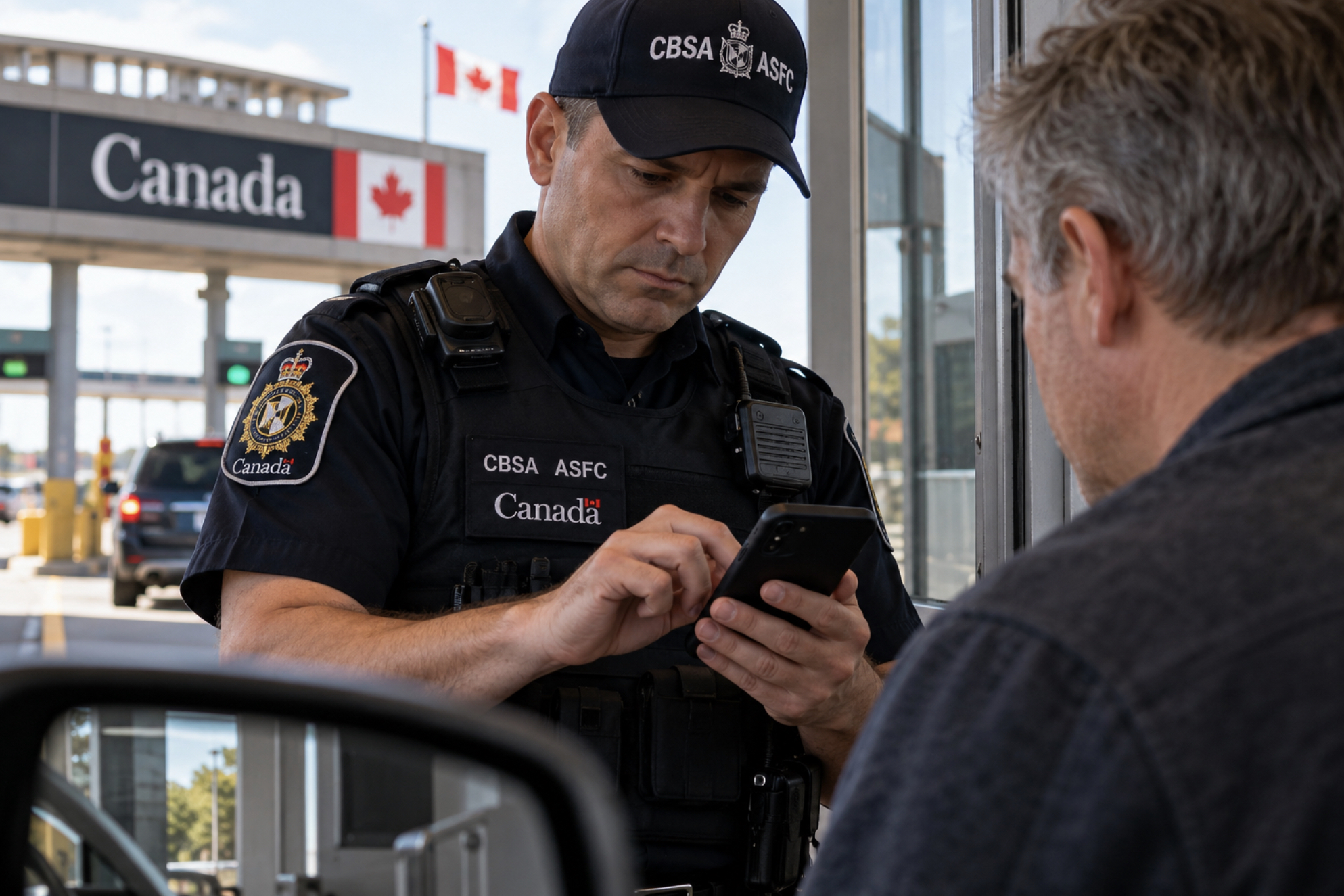
Americans entering Canada can face cellphone examinations by Canadian border officers, making digital privacy an important consideration before crossing the border.
What Americans Should Know About Cellphone Searches at the Canadian Border
By Hans Wilder | The Watertown Post
September 25, 2026
CTV News published a story Friday warning Canadians that American border officers may search their cellphones when they enter the United States.
Fair enough.
But here in Northern New York, where thousands of Americans routinely cross into Canada through the St. Lawrence Valley, Thousand Islands and Buffalo-Niagara crossings, there is another side of that story worth telling.
Canada can search your cellphone too.
And for Northern New Yorkers, that is arguably the more immediately useful side of the story.
The Canada Border Services Agency says its officers have authority to examine cellphones, smartphones, computers, tablets, removable drives, cameras, smartwatches and other electronic devices carried across the Canadian border. Those examinations can be conducted under Canadian customs and immigration authorities.
That matters to Americans heading north for dinner in Kingston, a hockey game in Ottawa, a weekend in Toronto or simply a drive across the Thousand Islands Bridge.
YES, CANADA CAN ASK FOR YOUR PASSWORD
According to CBSA, an officer who decides to examine a password-protected device can ask the traveller for the password. Canada’s guidance goes considerably further than merely saying officers may ask: CBSA states that the traveller is obligated to provide it.
Failure to provide access can result in the device being detained or seized under Canadian law. CBSA says officers ordinarily disable network connectivity, such as by placing the phone in airplane mode, so the examination is limited to information stored on the device rather than information being retrieved live from the internet.
So Americans should understand this before reaching the booth: crossing an international border is not the same thing as walking down a street in Watertown.
Your phone can effectively become another piece of luggage being presented for inspection.
AND I LEARNED THAT LESSON PERSONALLY
This isn’t entirely theoretical for me.
I have personally had my cellphone searched while attempting to enter Canada. Political material on my phone became part of the encounter, and I ultimately was not allowed into Canada.
That experience obviously shapes the way I look at this issue today.
I am not claiming that Canadian law simply says, “Have the wrong political opinion and you’re banned.” It doesn’t. Canada’s Immigration and Refugee Protection Act establishes specific statutory grounds for inadmissibility.
But a cellphone examination can give a border officer an extraordinary window into a traveller’s life. Messages, photographs, downloaded documents and stored social-media material can potentially become information considered during an admissibility examination.
When you’re sitting at a Canadian border crossing watching an officer go through the little computer in your pocket that contains much of your personal and professional life, this stops being an academic discussion about international travel policy very quickly.
CANADA SAYS SEARCHES AREN’T ROUTINE
There is also an important distinction between Canada’s official policy and the impression Americans might get from reading only stories about the United States.
CBSA says it does not routinely search everybody’s cellphone. According to the agency, officers examine personal digital devices when they have indicators or concerns that Canadian border laws may have been violated and the applicable law permits the examination. Among the reasons CBSA identifies are questions concerning a traveller’s identity, admissibility or compliance with Canadian border laws.
The government’s own statistics show how unusual these searches are.
Between November 20, 2017 and December 31, 2025, Canada processed more than 574 million travellers and their goods, while 37,880 travellers had a personal digital device examined. CBSA puts that at just 0.007 percent. It says 38 percent of those examinations uncovered a customs- or immigration-related contravention.
In other words, most Americans will probably never experience one.
But if you’re one of the tiny percentage who does, statistics aren’t going to make the officer holding your telephone feel any less real.
NORTHERN NEW YORK DESERVES THE AMERICAN SIDE OF THE STORY
There is another reason the Watertown Post believes this story needs to be told.
Too often, Northern New York media coverage of cross-border issues seems to begin with the Canadian perspective. We hear what Canadian travellers should fear about America, what American policies mean for Canadians and what Washington is supposedly doing to our neighbors north of the border.
Fine. Canada is our neighbor and Canadian perspectives are worth reporting.
But Northern New York news organizations serve Americans too.
Their readers live in Watertown, Clayton, Cape Vincent, Ogdensburg, Massena, Plattsburgh and communities along the American side of the border. Those readers deserve to know what happens when they cross north. They deserve reporting about Canadian border powers, Canadian policies and the experiences of Americans dealing with the Canadian government.
At the Watertown Post, we don’t believe patriotism requires hostility toward Canada. It does require remembering which side of the international boundary our publication and most of our local readers call home.
There is nothing wrong with asking how Canadian government policies affect Americans. There is nothing wrong with scrutinizing Ottawa with the same intensity American journalists routinely apply to Washington. And there is certainly nothing wrong with putting Northern New Yorkers first when covering a border that sits practically in our backyard.
That shouldn’t be controversial. That’s journalism doing its job.
A BORDER WORKS BOTH WAYS
CTV’s article is useful information for Canadians traveling south. Canadians absolutely should understand American border procedures before entering the United States.
But information ought to flow in both directions.
Americans traveling north should understand Canada’s procedures as well.
For Northern New Yorkers, this isn’t some obscure international travel issue.
Canada is right across the river.
Many of us grew up treating Kingston, Brockville and Ottawa almost like extensions of our own backyard. We’d cross the border for dinner, shopping, concerts or simply because we felt like going for a drive.
The international boundary could sometimes feel almost invisible.
It isn’t.
And the smartphone in your pocket contains vastly more personal information than anything customs officers could have discovered in your suitcase 30 years ago.
So when Canadian media asks what Canadians should know about cellphone searches when entering America, the Watertown Post has a perfectly reasonable question from this side of the river:
What should Americans know about cellphone searches when entering Canada?
Quite a bit, apparently.
The Golden Age should include Americans knowing their rights, knowing the rules and expecting their own local media to look north from an American point of view once in a while.
Because there’s nothing unneighborly about putting your own readers first.
And speaking from experience, I’d recommend knowing what can happen to that cellphone before you get to the booth.
About the Author