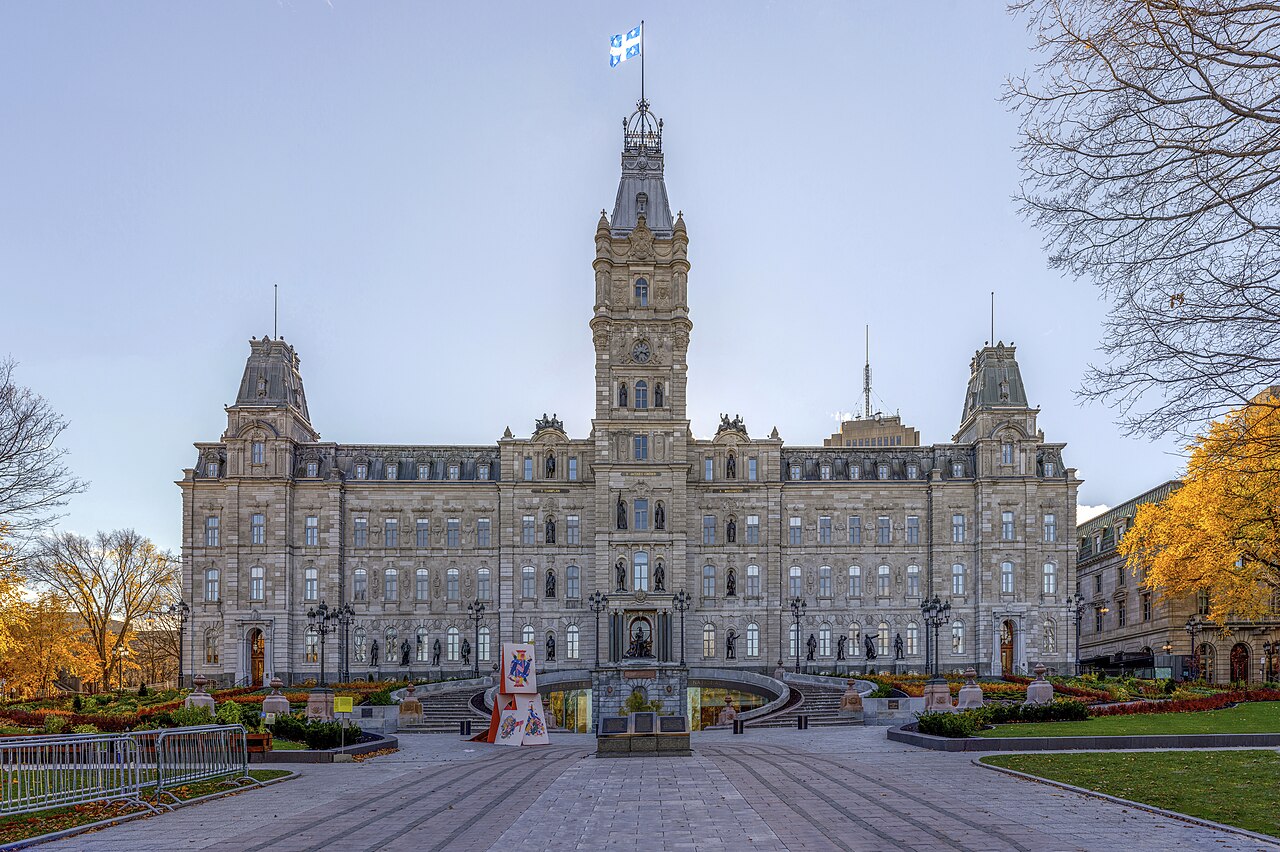
Quebec’s Parliament Building in Quebec City. Photo: Wilfredor / Wikimedia Commons (CC0).
The Wilder Treatment | Opinion by Hans Wilder | Watertown, New York
In Quebec City, a person can win an election, swear to serve the people who elected him, and still be told he’s missing one signature. Well, not a signature exactly. What’s missing is a promise of allegiance to Charles III. Up here in Watertown, where the British once came across the lake to take a shipyard, I confess I find it peculiar that more than two centuries later the Crown can still hold up a roomful of elected people without having to launch so much as a canoe.
On Nov. 23, Quebec Superior Court Justice Ian Demers suspended a 2022 provincial law that had made the oath to the people of Quebec the only one required to take a seat in the National Assembly. The interim order puts the constitutional oath to the King back in play for legislators who want to sit. It doesn’t apply to ordinary Quebecers, and the court hasn’t decided the full constitutional challenge. But the judge ordered his decision to take effect even if it’s appealed. He warned that proceeding without the oath could put the laws those members pass in jeopardy. Premier Paul St-Pierre Plamondon says he won’t take the oath. Quebec’s government said Tuesday it had filed appeal proceedings and would ask the Court of Appeal for permission to appeal and to suspend Demers’s order. Somebody ought to make a pot of coffee. This one may take a while.
The United States once sent Quebec an invitation. In 1774, the Continental Congress wrote to the inhabitants of the Province of Quebec and asked them to make common cause with the colonies. Congress later put an explicit invitation for Canada into Article XI of the Articles of Confederation. There was no general uprising to take us up on it. Of course, in between the letter and the Articles, an American army tried to take Quebec City and failed. I’m no professor of diplomacy, but I’d guess the invitation might have aged better if we’d given the mail a little longer to work.
Then came a different war, the one we remember around here. On May 29, 1813, a British-Canadian force landed at Sackets Harbor, where the Americans built and supplied warships. Jacob Brown and the defenders drove off the attack, though Americans set fire to their own naval stores in the confusion. I grew up in Sackets Harbor. My father spent years studying that war. When I look out over that water, I don’t see an old grudge to nurse. I see what can happen when people on opposite shores have no better way of settling what comes next.
So here’s my proposition, from this side of the St. Lawrence: Washington ought to be willing to talk openly with Quebec about a closer North American union, if Quebecers want that conversation. If they ever wanted to discuss joining the United States, I’d hear them out. Keep the fleurdelisé flying. Keep French in your schools, your public life and your legislature. In a country where some people still fly Confederate flags on their own porches, it would be preposterous to tell Quebec it couldn’t keep its own flag. The histories of those flags are nothing alike; the point is that nobody should have to take down the fleurdelisé or learn to order lunch in English to sit at the table.
An invitation is all it would be. The Supreme Court of Canada has said a clear majority on a clear secession question would create a duty to negotiate, not an automatic right to leave. Any discussion about a new political relationship would also have to reckon seriously with the rights and wishes of Indigenous nations, not treat them as an inconvenience to be penciled in after someone else draws the map. And if Quebecers want to stay Canadian, that’s their decision. I can favor North American unification without appointing myself the man who gets to decide it for the neighbors.
The first Continental Congress managed to write a letter to Quebec without a television crew, a trade threat or a man in a powdered wig calling it a historic press opportunity. I think we could manage one more. Send it in French again. And for heaven’s sake, leave the boats at Sackets Harbor.
About the Author