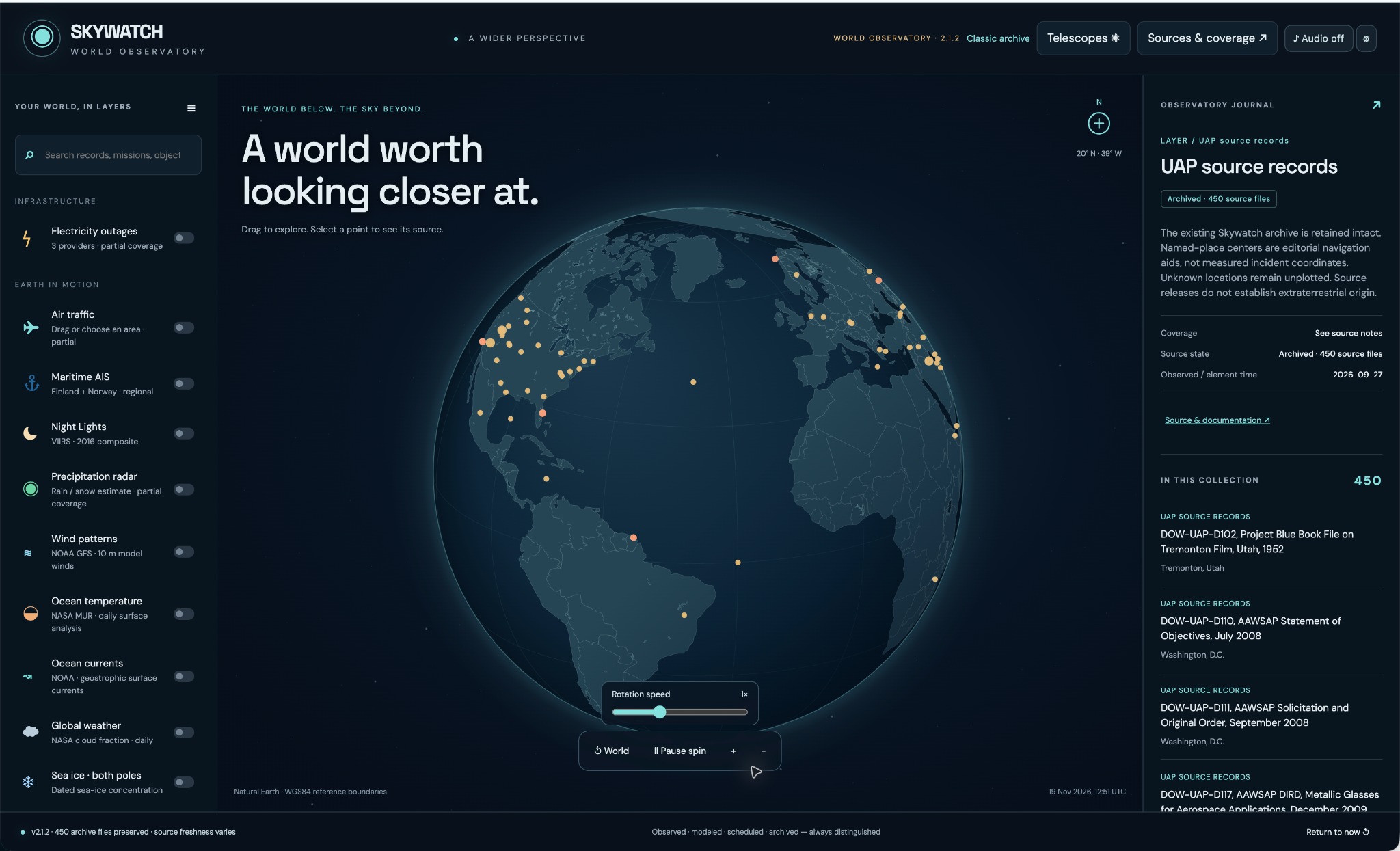
SkyWatch.world’s interactive globe and source archive. Screenshot courtesy of Hans Wilder.
Opinion | By Hans Wilder
Ask Facebook who plows driveways outside Watertown and you might get three good names, two arguments, and a guy who moved to Florida in 2019. What you actually wanted was a page that tells you who covers your road, what they charge, and how to get ahold of them before the next storm. That isn’t a tall order. We’ve just spent so long looking for answers in a feed that we’ve forgotten how much better a good website can be.
I think the age of the socials as the front door to the internet is coming to an end. Facebook and X will still be around. I’ll share this column on both, which seems like a perfectly good use for them. But I want readers to know where to find the Watertown Post on purpose, not just when a platform decides to put us in front of them. The website is where the work lives. The socials are the porch light.
The people who know the work should build the sites
The biggest change I’ve seen in the last six or seven months is how little it can cost to try. With AI helping with the layout and code, I think a hundred bucks can get a hands-on owner started with the kind of focused site that used to look like a $50,000 project. I’m talking about a professional-looking site that does a specific job, not an enterprise system, and I’m not counting your own time as free. A domain, hosting, and upkeep still cost something. What’s changed is how much you can build before you have to hire anybody.
Take SkyWatch.world, one of my own sites. The screenshot above shows an interactive globe alongside a source archive. You can turn layers on and off and open source records instead of taking a screenshot in somebody’s feed at face value. We can label an archived record as archived and show when a reading was taken. That’s the kind of thing a purpose-built website can do better than a good Facebook post, even one with a thousand shares.
Your site doesn’t need a globe. If you sell real estate, explain what buyers should check before making an offer on a seasonal place in the Thousand Islands. If you work in HVAC, name the towns you serve and explain what happens when somebody calls after hours. If you plow snow, put up your route, how you price a driveway, and whether you’re taking new customers. These are questions people already ask you. Write the answers once, where people can find them again.
Give people a reason to come straight to you
AI has its downsides. It can make up an answer, and it can make ten different businesses sound like they’re run by the same guy. Use it to get the pages built. Then put in your own photos, your own prices where you can, and the details only somebody who does the work would know. Open it on your phone and see whether you can find the phone number with one thumb. A nice-looking homepage isn’t much help if nobody can tell where you work or how to reach you.
Owning a domain doesn’t guarantee that Google will find or rank you. But customers can bookmark it, a neighbor can text it, and you can put the address on every estimate or business card you send out. If a social platform changes its rules, cuts your reach or suspends your account for something it doesn’t like, you still have a place to send people. That’s worth more to a small business than a post that did well for two days.
Imagine millions more websites built by people who actually know their little corner of the world. I’d rather spend my time on that internet than on one long feed trying to guess what will keep me mad enough to scroll. Start with one page that answers the question you get asked every week. Put it on a domain you control. Then go ahead and post it on Facebook. At least this time you’ll be sending people somewhere.
About the Author