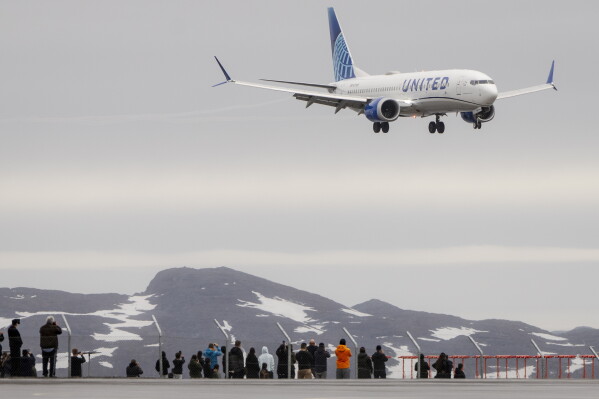
Greenlanders gather to watch a United Airlines jet land at Nuuk International Airport, marking the return of direct commercial air service between the United States and Greenland—and another unmistakable American connection to the strategically vital Arctic island. AP Image
Canada Is Preparing for Trump’s Next Greenland Move—But What Could Ottawa Actually Do?
A new Mallen Baker video examines Canada’s potential response if President Trump moves to annex Greenland. The remarkable part is no longer Trump’s ambition—it is that Canada is openly treating the possibility as something requiring contingency planning.
By Hans Wilder
Editor-in-Chief, The Watertown Post
Golden Age Commentary | August 12, 2026
Canada is apparently no longer treating President Donald Trump’s ambition to acquire Greenland as a joke.
In a new video titled Canada’s Response Could Be Key If U.S. Invades Greenland, commentator Mallen Baker examines a detailed scenario involving an American takeover of Greenland and the critical role Canada could play in determining what happens next.
Baker uses the word invades. Trump and his supporters would be more likely to describe it as annexation, acquisition or strategic integration. Whatever terminology one prefers, the important development is that Canadians are now seriously discussing what their government should do if Trump makes another move.
That alone represents an extraordinary change.
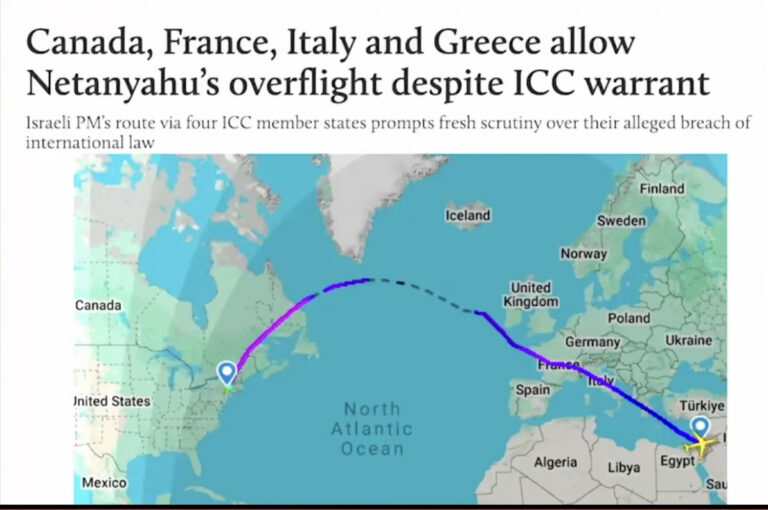
Trump’s Greenland proposal was once dismissed as another impossible statement from a president who supposedly did not understand international affairs. Now Canadian analysts are discussing military access, airspace, Arctic supply routes, diplomatic retaliation and whether Ottawa would assist Denmark and Greenland in resisting the United States.
In other words, the idea everyone laughed at has advanced to the contingency-planning stage.
Canada Is Taking the Possibility Seriously
Canada has already declared its support for the sovereignty of Greenland and the Kingdom of Denmark. Ottawa has considered sending a small contingent of Canadian troops to participate in military exercises in Greenland, while Canadian leaders have discussed increasing Canada’s presence throughout the Arctic.
That does not establish that Canada is preparing for war with the United States. It does show that Ottawa believes Trump’s Greenland ambitions must be taken seriously.
Baker’s video explores a hypothetical scenario in which the United States could take Greenland relatively quickly but would encounter greater difficulty maintaining control. Canada becomes important because of its geography, airspace, ports, intelligence relationships and position between the continental United States and Greenland.
Canada might refuse logistical cooperation, restrict American access, assist Denmark, coordinate with European governments or apply diplomatic and economic pressure.
Those are meaningful possibilities. But they also raise an uncomfortable question: Does Canada truly believe it could prevent the United States from controlling Greenland if an American president determined that doing so was essential to national security?
America Is Already in Greenland
This would not be a conventional foreign invasion launched against a country where America has no presence.
The United States already operates Pituffik Space Base in Greenland. Its missile-warning, satellite-tracking and Arctic-defense systems help protect North America—including Canada. American and Canadian aircraft also conduct NORAD exercises around Greenland as part of the continent’s integrated defense network.
American commercial involvement is growing as well.
Greenland recently issued a strong warning after drilling equipment connected to Texas-based Greenland Energy was moved into the Jameson Land region without the necessary approval. The company reportedly has connections to people within Trump’s political orbit and believes the area may contain enormous petroleum reserves.
The company denies that its project is connected to annexation. Nevertheless, the episode demonstrates how American economic power is already pressing deeper into Greenland.
Direct United Airlines service between Newark and Nuuk has further connected the island to the United States. American military, commercial and corporate interests are not waiting for a formal change of flag before establishing themselves.
What Is Canada Really Preparing to Do?
Canada could make an American annexation politically expensive. It could create diplomatic trouble, rally European opposition and complicate logistics.
But Canada does not possess the conventional military power to defeat the United States. Its defense, intelligence, economy and continental security are deeply integrated with America’s.
Canada participates in NORAD precisely because neither country can efficiently defend the northern half of the continent alone. Any Canadian attempt to obstruct American Arctic strategy would therefore create a remarkable contradiction: Ottawa would be opposing the same country it relies upon for much of its continental defense.
Canada could inconvenience Washington. It could embarrass Washington. It might even delay Washington.
Stopping Washington would be another matter entirely.
The Fort Drum Rumor
Rumors are circulating in Northern New York that Fort Drum may be training for a contingency involving Greenland and a possible Canadian response.
There is currently no publicly available evidence proving that Fort Drum is training specifically for an operation to annex Greenland. That claim remains unverified and should be reported as such.
Still, the rumor is not difficult to understand.
Fort Drum is home to the 10th Mountain Division, one of America’s most deployable military formations. It specializes in operating under difficult conditions, has extensive cold-weather capabilities and sits just south of the Canadian border.
It would be surprising if American defense planners were not studying Arctic contingencies. Military planning, however, does not prove that Trump has issued an order.
Canada May Be Asking the Wrong Question
Canada is asking how it should respond if Trump moves to annex Greenland.
Perhaps Canada should first ask why the United States believes Greenland has become so strategically important.
The Arctic is opening to shipping, resource extraction and increased military competition. Russia already possesses an enormous Arctic presence. China describes itself as a “near-Arctic state” and wants access to northern resources and trade routes.
Greenland occupies the gateway between North America and Europe. Its location, minerals, energy potential and military value will become increasingly important throughout the 21st century.
Trump sees Greenland as part of North American security. Canadian leaders appear to see it primarily as a sovereignty dispute between Washington, Nuuk and Copenhagen.
That difference in perspective could eventually become dangerous.
If Canada attempts to obstruct American Arctic strategy while continuing to depend upon the United States for defense, trade and intelligence, Americans will begin questioning whether Ottawa remains a dependable continental partner.
Canada may believe it is preparing for Trump’s next move in Greenland.
It should also consider whether its response will cause Washington to begin planning its next move concerning Canada.
About the Author