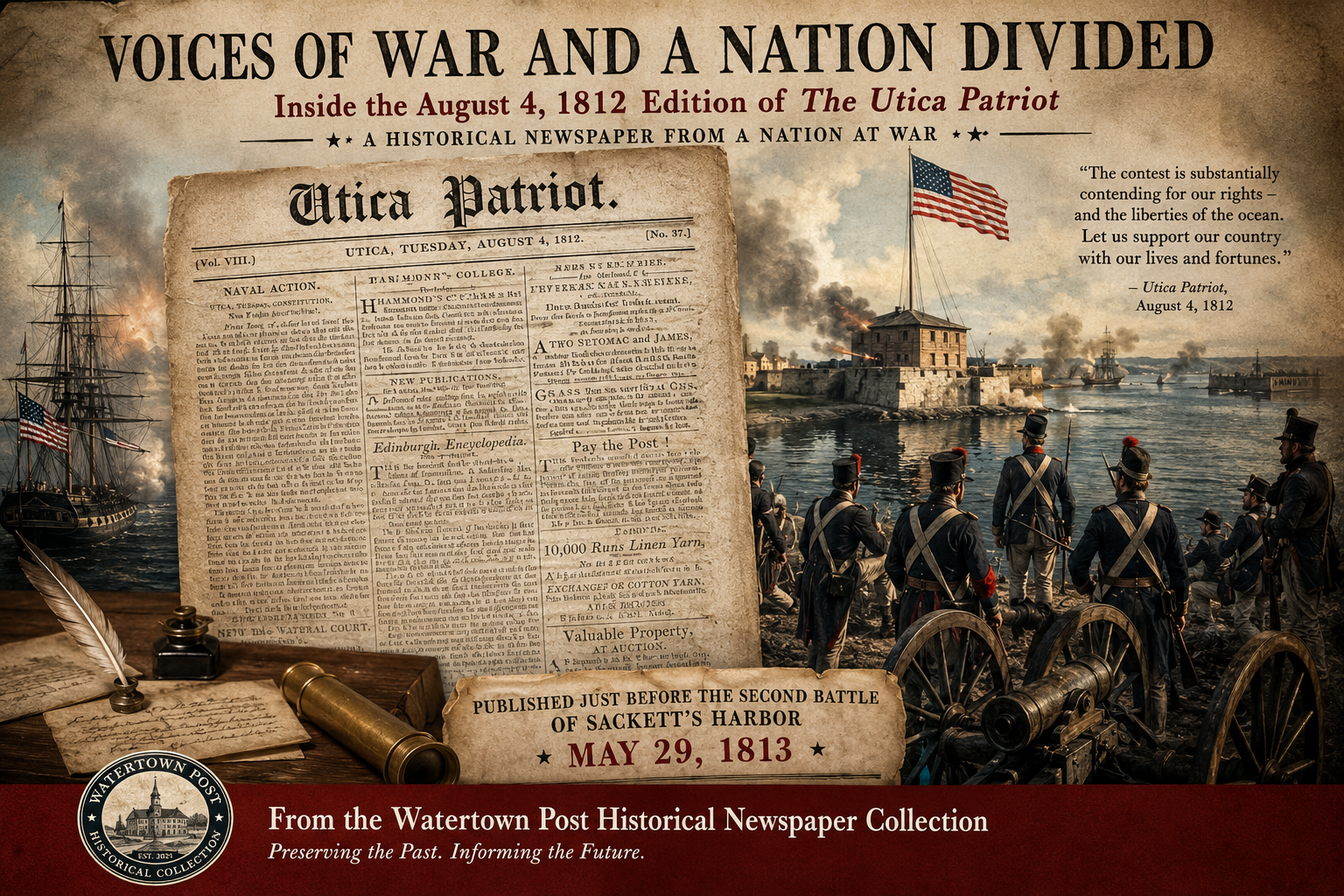
America at war — and divided at home. The August 1812 Utica Patriot provides a remarkable window into the politics, military news and public arguments Americans were reading during the opening months of the War of 1812.
By The Watertown Post Historical Desk
WATERTOWN, N.Y. — More than two centuries before cable news, social media, political podcasts and twenty-four-hour outrage, Americans were already fighting bitterly over presidents, war, elections, freedom of speech, freedom of the press and the fundamental question of who really controlled the government.
The evidence is sitting in The Watertown Post’s own historical newspaper collection.
The Watertown Post owns the original antique newspaper examined for this article: an August 4, 1812 edition of the Utica Patriot, published in Utica, New York, during the opening weeks of the War of 1812.
The photographs accompanying this article were taken directly from that historic newspaper in our collection. They are not screenshots from a digital archive or reproductions of pages found online. The paper itself has survived more than two centuries.
And when its fragile pages are opened, America in 1812 suddenly doesn’t seem quite as distant as we might imagine.
The typography is different. The spelling is occasionally strange to modern eyes. The paper is browned and worn.
The politics?
Those are remarkably familiar.
America Was Already Politically Divided
The United States declared war against Great Britain on June 18, 1812.
The date printed on this newspaper is August 4.
That means the people who originally opened this particular copy of the Utica Patriot were reading it only 47 days after the declaration of war.
They didn’t know how the War of 1812 would end.
They didn’t know that Washington would eventually burn.
They didn’t know that Fort McHenry would inspire the words that became “The Star-Spangled Banner.”
They didn’t know about Andrew Jackson’s victory at New Orleans.
They didn’t even know what was about to happen at Detroit.
They were living the story in real time.
And what emerges from these pages isn’t a picture of a nation marching unanimously to war.
It is a country arguing with itself.
President James Madison’s decision to go to war had exposed an enormous partisan divide between Democratic-Republicans and Federalists.
Reading the Utica Patriot today, one quickly realizes something our sanitized historical timelines sometimes obscure:
American politics in 1812 could be absolutely vicious.
Freedom of Speech, Freedom of the Press — in 1812
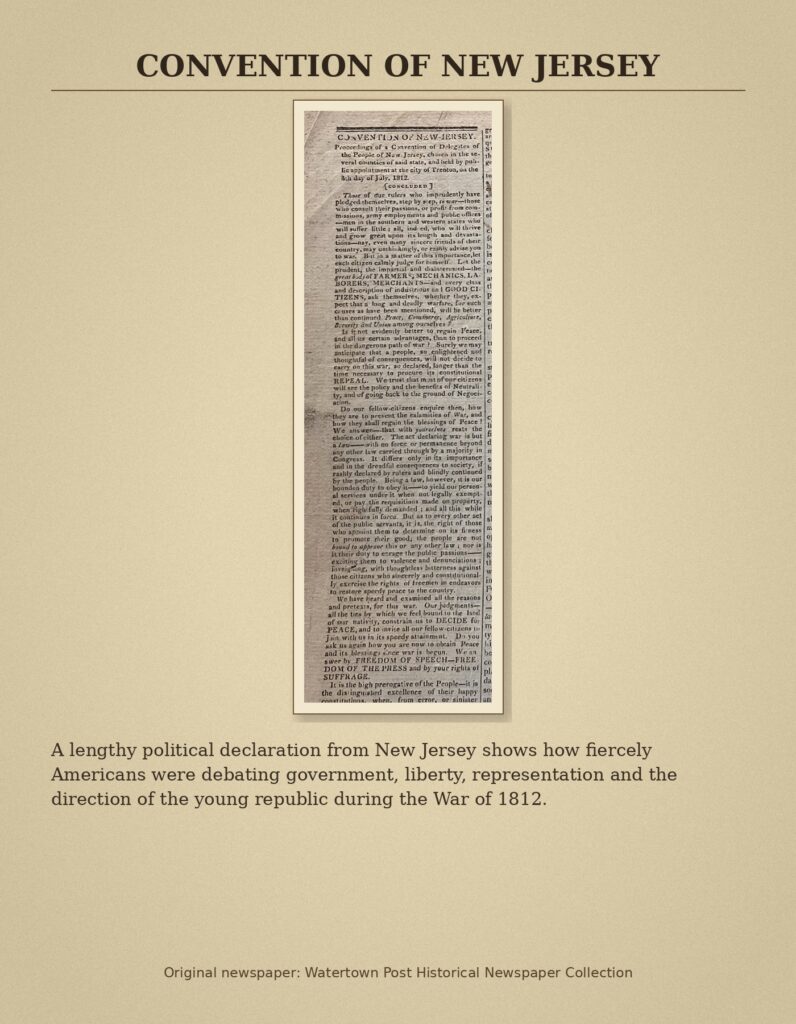
One of the most extraordinary political passages contained in this newspaper concerns fundamental political liberties.
Among the principles discussed are:
“FREEDOM OF SPEECH—FREEDOM OF THE PRESS—and of FREE SUFFRAGE.”
Think about the date.
The Constitution had been in operation for barely two decades. Many people alive at the time remembered the Revolution personally. Some had fought in it.
The country was still trying to determine exactly what republican government was supposed to mean in practice.
The newspaper’s political material wrestles with questions Americans continue debating more than 200 years later:
How much power should political parties possess?
Should elected representatives follow their own judgment or the demands of their constituents?
What happens when political organizations control who appears on the ballot?
How should the minority be protected from the political power of the majority?
How freely should citizens be permitted to criticize their government?
And what happens when political disagreement turns into intimidation?
These weren’t theoretical questions.
People were being attacked over them.
Political Violence Was Already Here
One of the most chilling sections of this newspaper concerns Baltimore.
The pages carry reports of the extraordinary political violence that erupted there following America’s declaration of war.
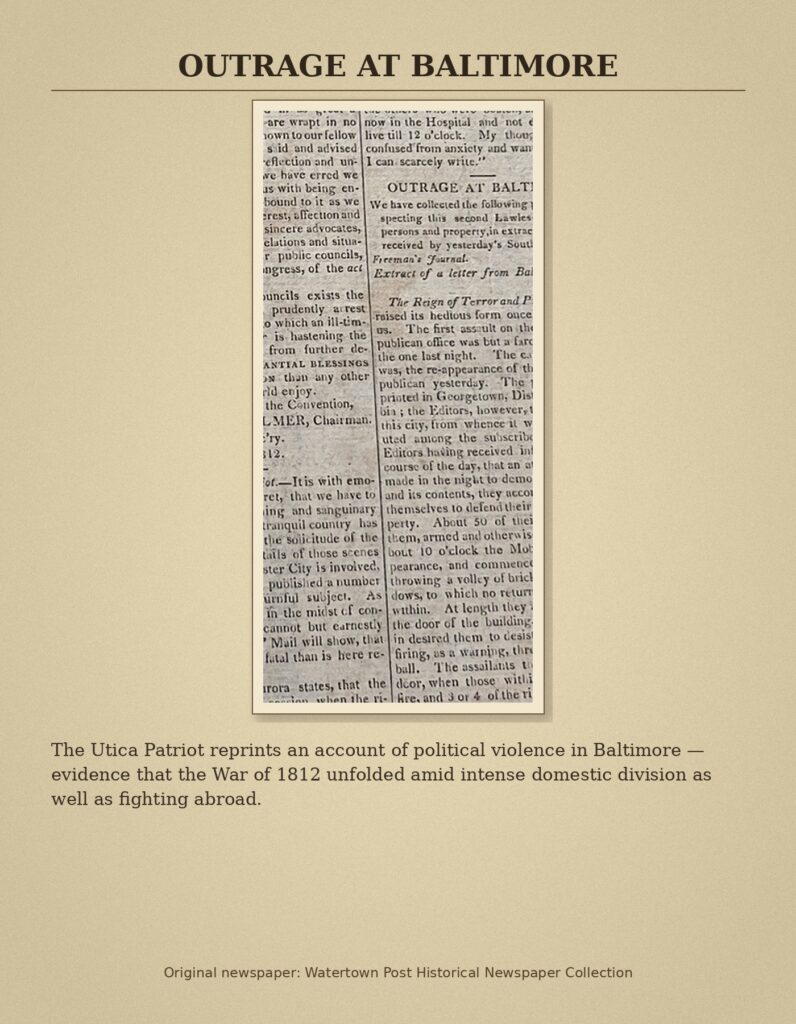
The newspaper uses an unmistakable headline:
OUTRAGE AT BALTIMORE
This was not journalistic exaggeration invented centuries later.
It was contemporary reporting on what became known as the Baltimore riots of 1812.
Baltimore’s Federal Republican had published fierce criticism of Madison and the war. A pro-war crowd responded by attacking the newspaper’s office and destroying its printing press. When publisher Alexander Contee Hanson resumed publication, the confrontation escalated dramatically.
The men associated with the newspaper eventually sought protection in a Baltimore jail.
It wasn’t enough.
A mob broke into the jail.
Among the men inside was James McCubbin Lingan, a veteran of the American Revolution.
Lingan was killed.
Another victim was Henry “Light-Horse Harry” Lee, Revolutionary War cavalry commander and father of the future Robert E. Lee. Lee was severely injured and never fully recovered from the beating. Hanson was also badly injured.
Now reconsider those words printed elsewhere in this 1812 newspaper:
FREEDOM OF SPEECH.
FREEDOM OF THE PRESS.
They weren’t philosophical decorations.
Newspaper publishers had very good reason to worry about them.
“Reign of Terror”
One of the strongest expressions appearing in the political material photographed by The Watertown Post invokes a:
“REIGN OF TERROR AND PROSCRIPTION.”
That’s extraordinarily loaded language.
Americans of 1812 knew exactly what “Reign of Terror” meant. The French Revolution and its bloody aftermath were recent history, not something buried two centuries in the past.
Calling American political intimidation a “reign of terror” was essentially the 1812 equivalent of reaching for the biggest political rhetorical hammer available.
Elsewhere, the newspaper refers to violent political actors in equally unforgiving terms.
Political journalism wasn’t polite.
It was partisan, aggressive and sometimes openly furious.
Anyone who believes American newspapers only recently discovered political bias should spend an afternoon with an original newspaper from the early republic.
They were doing opinion journalism before electricity.
Who Controls the Politicians?
The lengthy political discussion printed in these pages is especially interesting because it questions the relationship between elected officials and the people who elect them.
The underlying problem is timeless.
Once someone wins office, whom does that person represent?
The political organization that helped elect him?
His own judgment?
Or the citizens who sent him there?
The newspaper discusses the danger of representatives becoming detached from their constituents and political organizations gaining control over nominations and elections.
Strip away the nineteenth-century prose and the argument becomes startlingly modern:
If a small group determines who the candidates are, how much control does the ordinary voter actually possess?
Apparently Americans were complaining about the political establishment long before anyone invented the phrase “political establishment.”
Political Parties Were Themselves Under Suspicion
This is another fascinating feature of the paper.
Political parties were not universally regarded as indispensable democratic institutions.
There remained profound suspicion toward organized political factions.
George Washington himself had famously warned against the dangers of political parties.
Yet by 1812, Americans had already organized themselves into bitterly competing political camps.
The result is visible throughout this newspaper.
Federalists feared the Madison administration and what they considered dangerous Democratic-Republican policies.
Republicans accused Federalists of being sympathetic to Britain.
Opposing the war could lead to accusations that someone was essentially a Tory.
Supporting the administration could bring accusations of blindly following party leaders.
Sound familiar?
Change the names of the parties and give everybody a smartphone and 1812 starts looking considerably less foreign.
Meanwhile, America Had Invaded Canada
Then the newspaper moves from political argument to breaking war news.
A section headed simply:
THE WAR
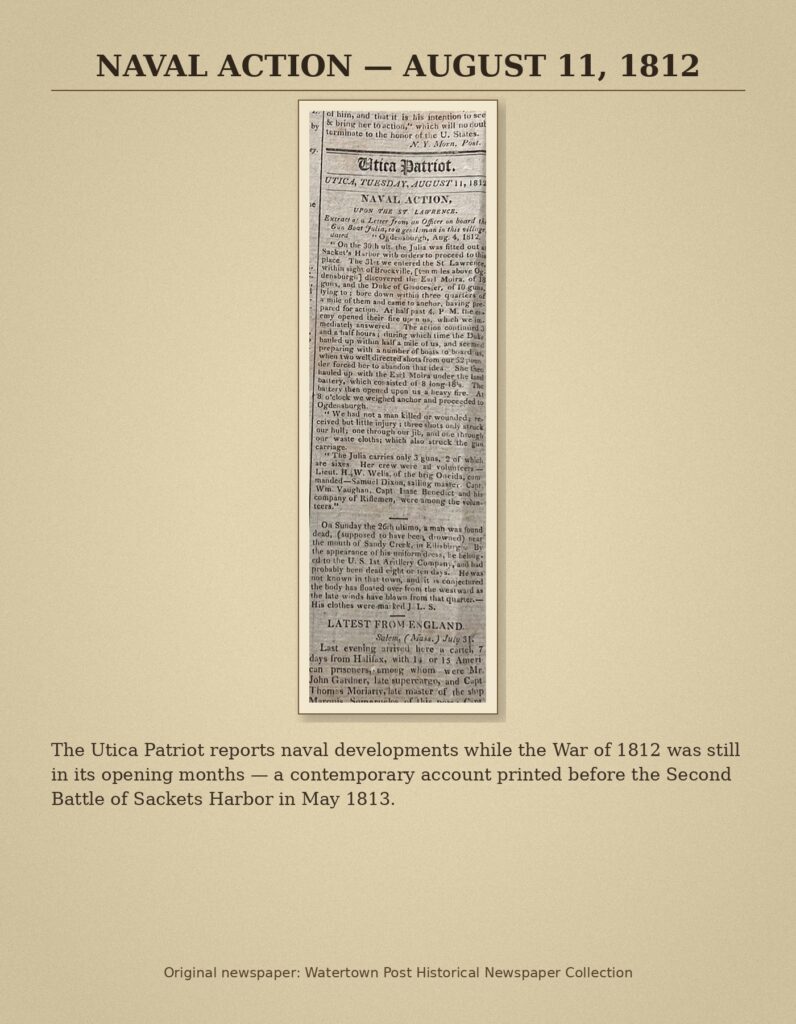
reports that:
“The first territorial blow has been struck by Brig. Gen. HULL…”
This is Brigadier General William Hull.
Hull had crossed the Detroit River in July and invaded Upper Canada, today’s Ontario.
The newspaper reports the American advance while its outcome remained unresolved.
That makes this particular issue especially fascinating.
When this Utica Patriot was printed on August 4, Hull’s campaign was still underway.
Twelve days later, on August 16, 1812, Hull surrendered Detroit.
British forces under Major General Isaac Brock, supported by Canadian militia and Indigenous warriors, forced Hull’s capitulation.
The people holding this newspaper on August 4 couldn’t possibly have known that.
We do.
That difference changes the experience of reading it.
We’re looking backward through history.
They were looking forward into complete uncertainty.
Imagine Reading This in Northern New York
This becomes even more significant when viewed from Northern New York.
For residents of this region, Canada wasn’t some distant battlefield.
It was right there.
Communities across Northern New York would become directly involved in the war. Troops, supplies and information moved through the region. The St. Lawrence River, Lake Ontario and the border became strategically vital.
The Watertown Post’s copy of the Utica Patriot therefore provides something more valuable than a textbook summary.
It shows what New Yorkers were actually being told while the events were happening.
And there is another remarkable point for anyone familiar with the history of Jefferson County:
The Second Battle of Sackets Harbor hadn’t happened yet.
When this newspaper was printed on August 4, 1812, that famous attack was still nearly ten months in the future. On May 29, 1813, British and Canadian forces would land at Horse Island and advance against Sackets Harbor, then the principal American naval base and shipyard on Lake Ontario. American forces ultimately repelled the attack.
So the original person reading this very newspaper could not have known that Sackets Harbor would soon become one of the most strategically important military and naval locations on the northern frontier, or that a major British-Canadian attack there would become one of the defining events of the war in Northern New York.
For that original reader, the Second Battle of Sackets Harbor was still in the future.
Reports arrived slowly.
Information traveled through letters, travelers, military dispatches and other newspapers.
Rumor traveled alongside fact.
There were no photographs.
No radio.
No television.
No internet.
No satellite communications.
An event could occur hundreds of miles away and readers might wait days or weeks to receive an incomplete account.
The newspaper was their internet.
And sometimes the bandwidth was a horse.
Britain, France and Napoleon
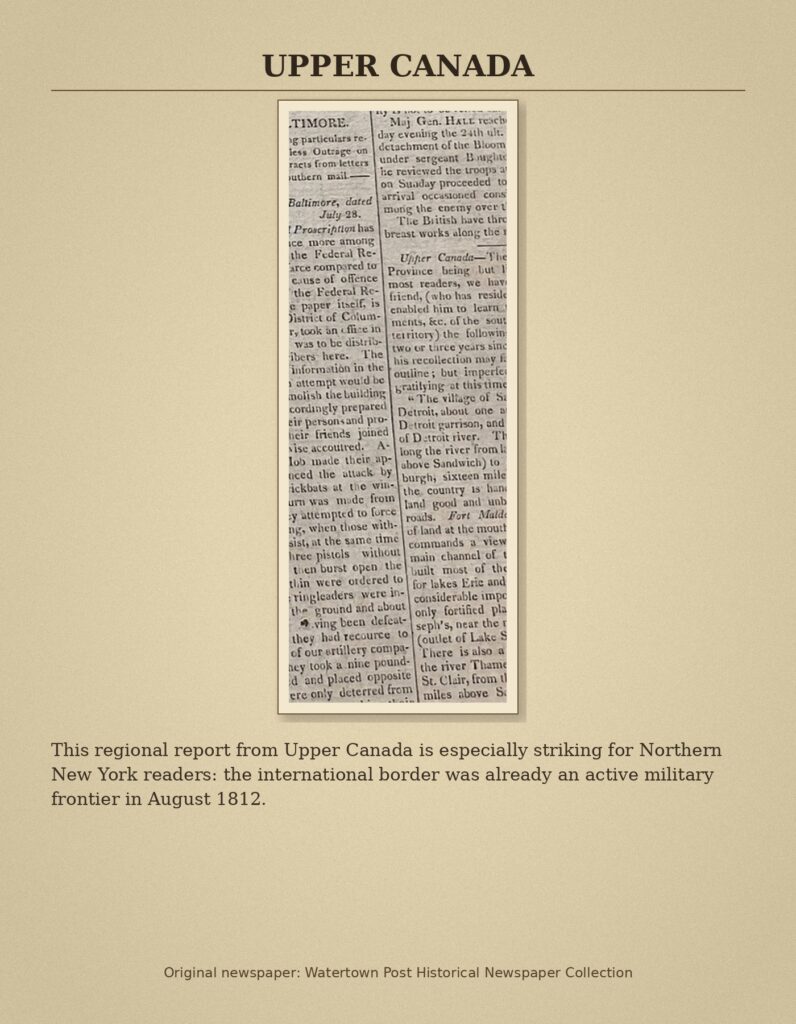
The political arguments surrounding the war also cannot be understood without Europe.
The United States was caught in the enormous geopolitical struggle between Britain and Napoleonic France.
Britain interfered with American shipping and impressed sailors. British trade restrictions were another major grievance.
Federalists generally regarded Britain differently than Madison’s Democratic-Republicans did and frequently accused the administration of policies favoring Napoleon’s France.
Consequently, references to Napoleon, Britain and European developments weren’t foreign-news filler.
They were part of America’s domestic political argument.
The question wasn’t simply:
What is happening in Europe?
It was:
Which European power poses the greatest danger to the United States, and is President Madison handling it correctly?
Newspapers Were Political Weapons
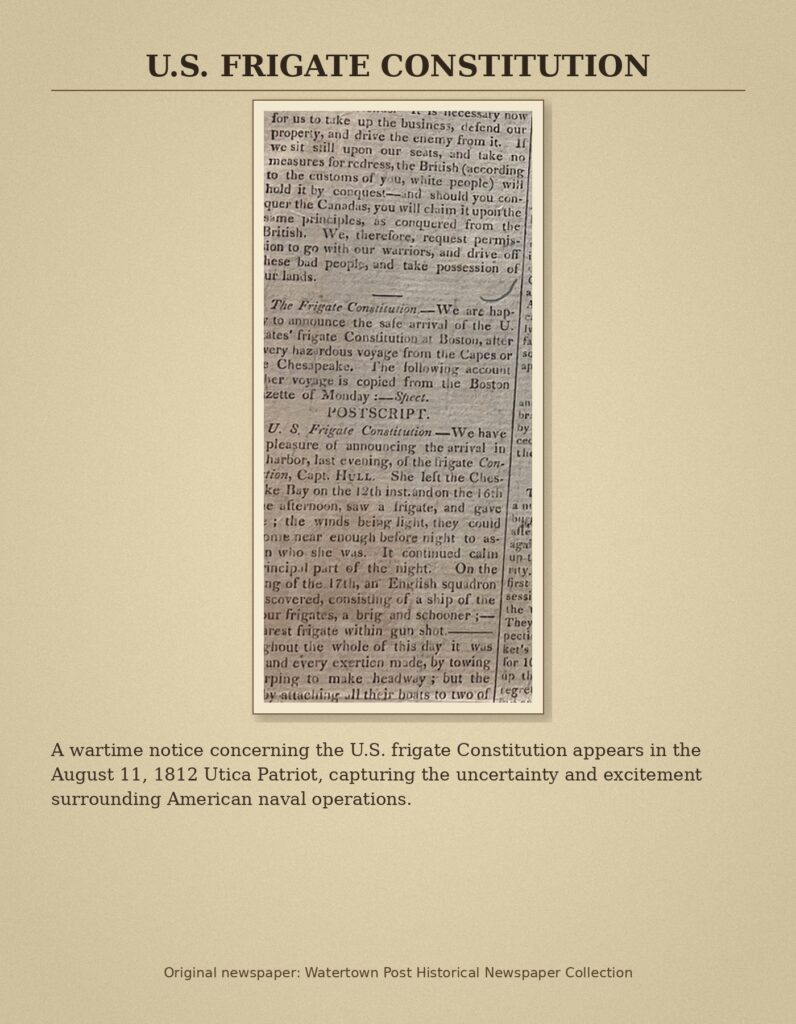
Modern readers tend to imagine early American newspapers as solemn little publications objectively recording history.
That’s not how this worked.
Many newspapers were explicitly partisan.
They promoted candidates, attacked administrations, reproduced speeches favorable to their political side and reprinted stories from ideologically compatible newspapers.
The newspaper wasn’t merely reporting politics.
The newspaper was participating in politics.
That makes the Baltimore violence particularly disturbing.
Destroying a newspaper’s printing press wasn’t simply vandalizing a business.
It was silencing one of the principal mechanisms through which political opposition could communicate.
It is difficult to imagine a more literal battle over freedom of the press.
Before Twitter, There Was the Reprint
Another thing visible throughout this newspaper is how information spread.
An 1812 newspaper routinely copied information from other newspapers.
A report originating in Baltimore might be reprinted elsewhere, then picked up by another newspaper, eventually reaching readers hundreds of miles away.
That’s why these pages contain dispatches and reports from different cities and states.
The system was primitive compared with today’s technology, but conceptually it wasn’t entirely different from modern information networks.
One source published something.
Another amplified it.
Another commented on it.
Rumor entered the network.
Political bias influenced which reports were selected.
Readers argued about what was true.
In other words, humanity eventually invented the internet after spending two centuries practicing on paper.
The Most Important Thing About This Newspaper
There are famous names here.
Madison.
Hull.
Napoleon.
Political leaders.
Military commanders.
But those aren’t necessarily what make this newspaper extraordinary.
What makes it extraordinary is timing.
This newspaper captures Americans when history was unfinished.
Hull hadn’t surrendered Detroit.
The USS Constitution had not yet won its famous victory over HMS Guerriere.
The Second Battle of Sackets Harbor had not yet happened. That would come on May 29, 1813.
Washington hadn’t burned.
Fort McHenry hadn’t been bombarded.
Francis Scott Key hadn’t written the words that became the national anthem.
The Battle of New Orleans hadn’t happened.
Nobody knew how the war would end.
Nobody knew which generals would become heroes.
Nobody knew which commanders would become disgraced.
Nobody knew which political predictions would prove correct.
And nobody reading this August 4, 1812 newspaper could have known what was eventually going to happen at Sackets Harbor.
On August 4, 1812, all of that remained in the future.
And someone in New York unfolded this very newspaper and tried to figure out what the hell was going on.
Two hundred fourteen years later, we’re doing exactly the same thing.
The Watertown Post Historical Newspaper Collection
The physical newspaper shown in the accompanying photographs is owned by The Watertown Post and preserved as part of The Watertown Post’s historical newspaper collection.
That distinction matters.
We aren’t merely linking readers to a digitized newspaper maintained somewhere else.
We’re opening an original artifact and examining the information its first readers encountered more than two centuries ago.
The stains are real.
The folds are real.
The damaged edges are real.
And the political arguments printed between them are real.
As The Watertown Post continues examining newspapers from our historical collection, we intend to do more than photograph old pages. We want to place readers back into the moment in which those newspapers appeared.
Because there’s an enormous difference between knowing that something happened and reading about it before anybody knew what was going to happen next.
This August 4, 1812 Utica Patriot offers precisely that opportunity.
It gives us an America newly at war, bitterly divided politically, arguing about freedom of speech, defending freedom of the press, fighting over political parties, watching mobs attack political opponents and anxiously following an American army invading Canada.
And here in Northern New York, we can add something especially remarkable:
The Second Battle of Sackets Harbor was still nearly ten months away.
More than two centuries later, we sometimes convince ourselves that Americans have never been this divided before.
Then you unfold an old newspaper.
And 1812 clears its throat.
About the Author