
Why “Security” Is Slowly Wrecking the Internet (and Your Patience)
Why “Security” Is Slowly Wrecking the Internet (and Your Patience)
By Hans Wilder | The Watertown Post
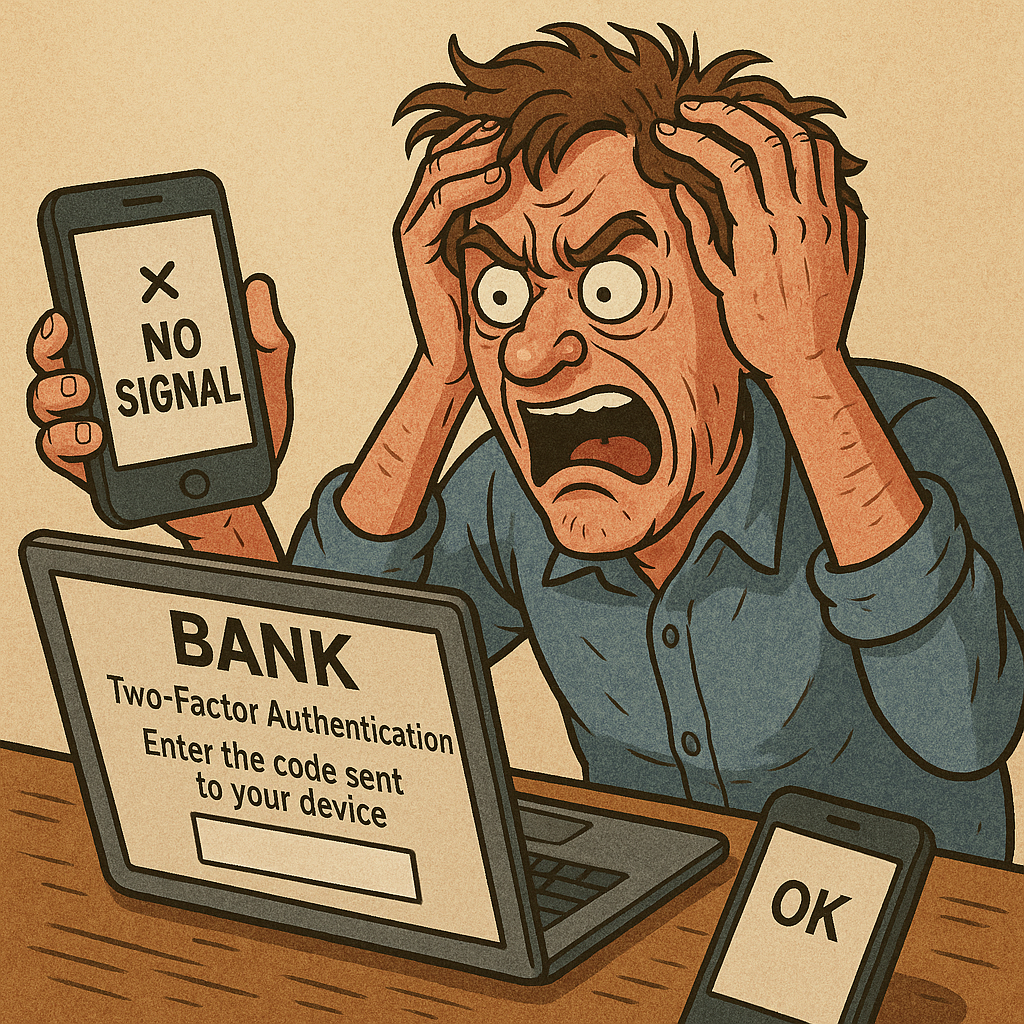
There was a time when logging into your bank or website meant typing a password and getting on with your day. Now? You better have your phone charged, your app updated, your Wi-Fi stable, and your patience topped off—because two-factor authentication (2FA) has taken over the internet like a TSA checkpoint on steroids.
Originally pitched as a safety net to protect against cybercriminals, 2FA has become the ultimate exercise in digital frustration. And nowhere is the madness more clear than in dealing with companies like GoDaddy, whose so-called security measures are making it nearly impossible for normal people—especially small business owners—to simply do business.
Locked Out of Your Own Life
Here’s how it goes:
You try to log into your account. It asks for a code sent to your phone. But your phone’s dead, or the text never arrives. Maybe you got a new number. Maybe the code generator app on your old phone is gone. You call customer service, and they tell you they need the code to help you… which you can’t get, because that’s why you’re calling in the first place.
It’s a modern-day Catch-22.
If this sounds familiar, you’re not alone. Across the country—and right here in Watertown—people are struggling to access their bank accounts, domain names, online stores, and medical records, all because they can’t jump through enough flaming hoops fast enough for these systems.
The False Promise of Safety
The irony? All this added “security” isn’t bulletproof anyway.
Hackers have found plenty of ways around 2FA, from tricking phone companies into transferring numbers (SIM-swapping) to launching “fatigue” attacks where users are bombarded with so many login prompts they eventually just click “approve” to make it stop.
Meanwhile, legitimate users are stuck fighting their own devices, apps, and account settings just to read their email or pay a bill.
GoDaddy and the Great Lockout
Let’s talk about GoDaddy.
The web hosting giant, which many local entrepreneurs use to run their businesses, has practically turned 2FA into a labyrinth of lost access, forgotten settings, and unresponsive support.
Some users report being locked out of their accounts for days or weeks, simply because their old phone number no longer worked with their authentication setup. Others say they’ve submitted proper identification and recovery requests, only to be ignored or told to wait indefinitely. In some cases, the only way back in seems to be praying to the tech gods—or abandoning the account altogether.
In the meantime, business grinds to a halt. Clients are lost. Websites go down. And the only people benefitting are the ones selling “security” as a service.
The Local Toll
In places like Watertown, this isn’t just a tech problem—it’s a small-town problem.
We’ve got elderly residents trying to check their Social Security statements, small business owners trying to update their websites, and local citizens just trying to pay a bill. But thanks to 2FA overkill, they’re locked out, shut down, and sent on wild goose chases with customer service bots that don’t understand plain English.
Banks, insurance companies, hospitals, and web services are all mandating these “extra steps” in the name of safety, but the truth is, it’s just digital red tape. It’s a one-size-fits-all solution that fits… well, no one.
What Needs to Change
There’s a better way to do this. And it starts with a little common sense:
- Make 2FA optional for people who don’t want or need it.
- Offer simpler backup options that don’t require tech wizardry or QR codes from 2019.
- Respect people’s time—and don’t lock them out of their livelihoods because they lost their phone.
- Actually protect people, instead of just pretending with a false sense of “cyber hygiene.”
Security vs. Sanity
Let’s be real: people want to be safe. But they also want to live their lives. When your password turns into a 10-minute login odyssey, that’s not protection—it’s punishment.
It’s time we stop letting Silicon Valley companies pretend they’re safeguarding us while they make the internet a worse place to live and work. Two-factor authentication might sound smart on paper, but in practice, it’s locking people out more than it’s locking hackers out.
And around here in Watertown, we’ve got enough locked doors already—just ask anyone who’s tried to get into City Hall lately.
About the Author