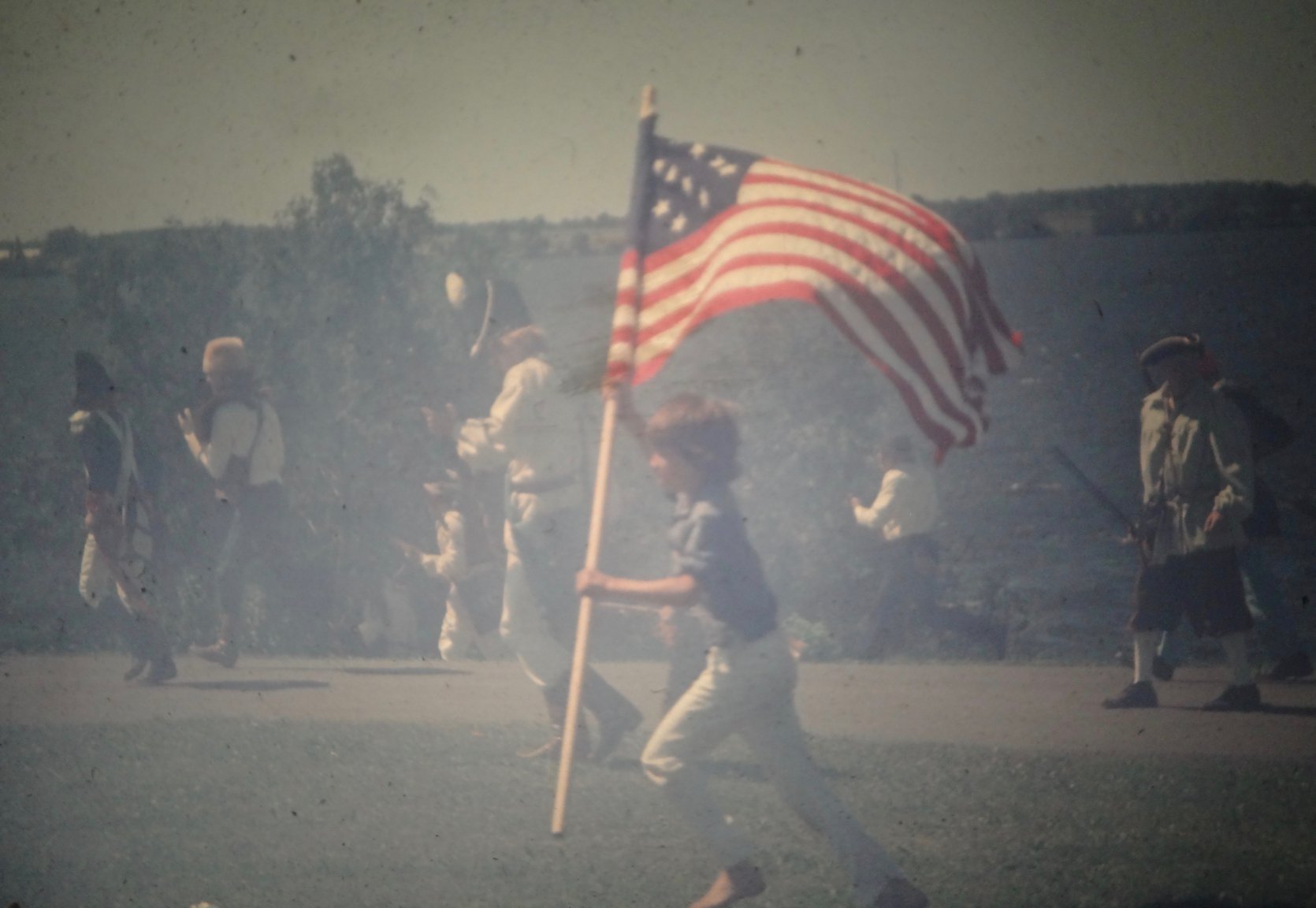
At 15 years old, sprinting across the field at the Sackets Harbor Battlefield State Historic Site, carrying the American flag during a War of 1812 reenactment — a place that wasn’t just historic ground, but home.
-West Palm Beach / By Hans Wilder
There are kids who grow up on cul-de-sacs.
There are kids who grow up on farms.
And then there are the rare few who grow up on a battlefield.
I was one of them.
My childhood backyard was the grounds of the Sackets Harbor Battlefield State Historic Site — where the wind still seems to move with memory, and where the War of 1812 never quite feels like it ended.
My father served as curator of the site. For him, history wasn’t a hobby. It was a mission. For me, it was normal life.
Cannons weren’t museum pieces — they were landmarks. Earthworks weren’t abstract concepts — they were places I climbed. The lake wasn’t just scenery — it was the same water British ships once crossed under cover of darkness. Before I understood algebra, I understood why Upper Canada was “upper” and Lower Canada was “lower.” Before I understood politics, I understood supply lines, naval blockades, and the simple reality that young men once stood exactly where I stood — and did not go home.
Most children are told bedtime stories.
I heard campaign movements.
My father spent nearly a decade researching his book, The Battle of Sackets Harbor: We Will Not Conquer Canada This Year. His research was relentless. That meant trips — long ones — to National Archives and Records Administration in Washington, D.C..
While other kids were at amusement parks, I was walking marble halls where the republic keeps its paper memory. I watched my father request boxes of brittle correspondence, dispatches written in ink by officers who never imagined a future boy would read their words nearly two centuries later. I learned early that history is not mythology. It is paperwork. It is logistics. It is frustration. It is ambition. It is human.
For ten years, he chased the truth of a single battle — May 29th 1813 — when British forces struck Sackets Harbor, hoping to cripple America’s naval buildup on Lake Ontario. They failed. “We will not conquer Canada this year,” became less a boast and more a sobering admission of the limits of war. That line stayed with me. It carried humility. Strategy. Reality.
Living on that ground does something to a person.
It collapses time.
You don’t see history as distant. You feel it under your feet. You begin to understand that nations are fragile things, built by decisions made in moments of exhaustion, pride, fear, and resolve.
Today, the houses are still standing — but they no longer hold families. The same walls that once echoed with ordinary childhood life now house state offices. Desks and file cabinets sit where dinner tables and toys once did. Bureaucracy moved in, and childhood quietly moved out. I’m likely the last child who will ever be able to say he actually lived on the Sackets Harbor battlefield.
That fact feels bigger than nostalgia.
It marks the passing of an era — when history wasn’t just interpreted, but inhabited.
Growing up there shaped how I see everything: politics, sovereignty, borders, identity, and the long arc of American persistence. The War of 1812 wasn’t a forgotten sideshow. It was a defining test — especially for Northern New York. And I didn’t learn that from a textbook. I learned it by breathing the same lake air those soldiers breathed.
Some kids inherit photo albums.
I inherited a battlefield.
About the Author