
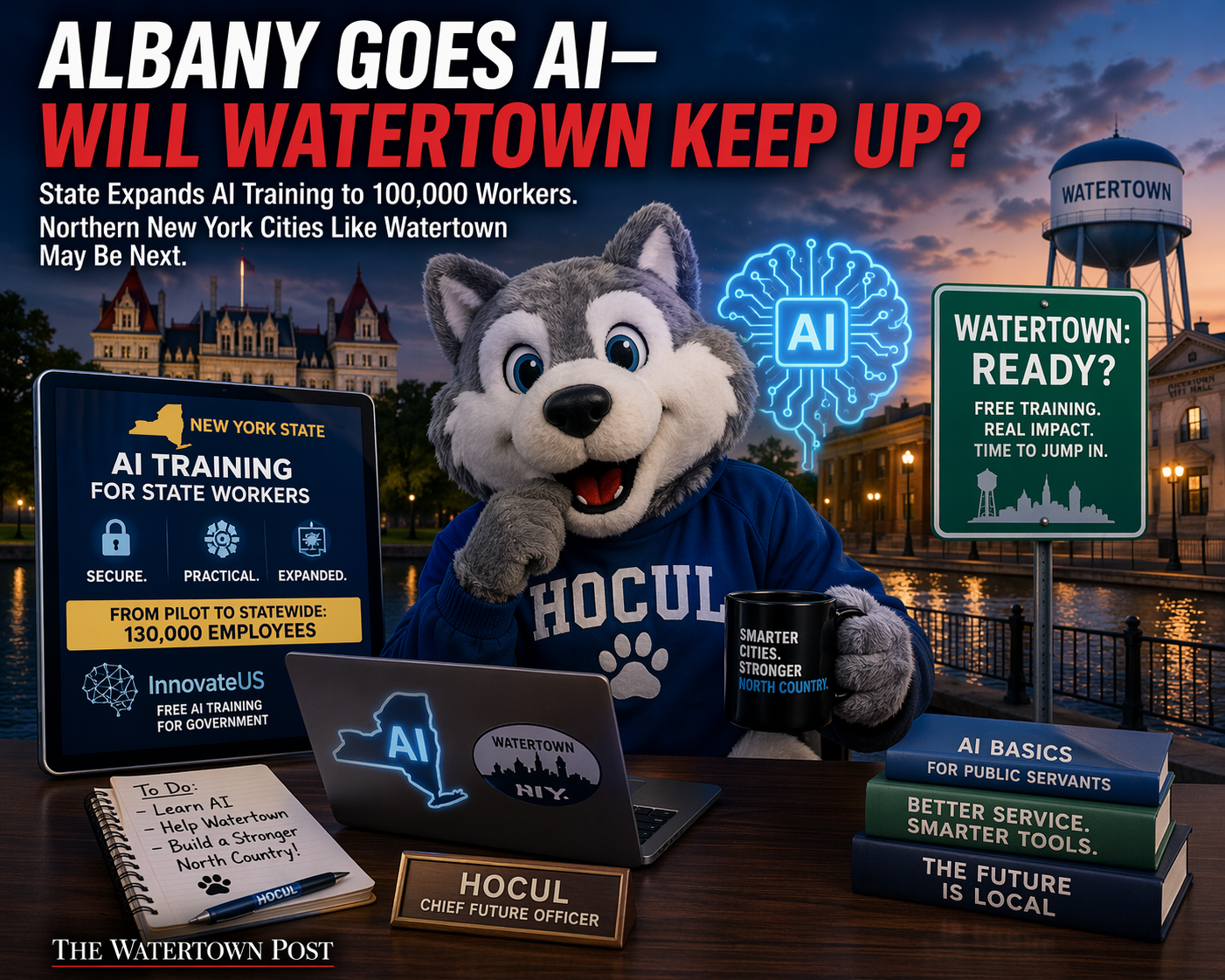
New York is training over 100,000 state workers in artificial intelligence—but Northern New York cities like Watertown may be next in line to decide whether to adopt or fall behind.
ALBANY — While Albany is rolling out artificial intelligence training to more than 100,000 state workers, the ripple effects could soon reach Northern New York—and perhaps raise a bigger question: are local governments like the City of Watertown keeping up?
What started as a pilot program is now being expanded across New York State agencies, with officials calling the early results promising. According to Dru Rai, the state’s Chief Information Officer, the initiative tested AI tools across multiple agencies with a strong focus on privacy and security before moving forward.
“We had over a thousand participants across several agencies and saw very positive results,” Rai said. “Now we’re scaling it to more than 130,000 employees statewide.”
The system—known internally as ITS Pro—keeps data contained within state-controlled systems, even while using cloud-based AI models. That’s a key point for government operations where sensitive information is involved.
The training itself is being delivered through InnovateUS, a nonprofit group offering free AI education to public sector workers. Founded by Beth Simone Noveck, the program has already trained roughly 200,000 participants across states, cities, and even internationally.
Courses are self-paced and accessible from anywhere, while live workshops connect participants with others across the country to explore real-world applications of AI in government work—from paperwork automation to data analysis and public communication.
What This Means for Northern New York
Here’s where things get local.
While Albany is investing heavily in training its workforce to use AI tools, many municipalities in Northern New York—including Watertown—are still operating with traditional systems and limited digital modernization.
For a region that often struggles with staffing shortages, tight budgets, and aging infrastructure, AI could offer practical advantages:
- Automating routine paperwork and permitting
- Improving response times for public services
- Enhancing data tracking for infrastructure and road maintenance
- Supporting local law enforcement and emergency management with faster information analysis
But none of that happens without training—and right now, that training is happening at the state level, not necessarily at City Hall.
A Missed Opportunity?
If the tools are free and the training is available, the question becomes straightforward: why aren’t more local governments jumping in?
Programs like InnovateUS are open-access, meaning municipalities, counties, and even small-town offices can participate without additional taxpayer cost. In a region where every dollar matters, that’s not nothing.
Watertown, as the economic hub of the North Country, would be a logical place to start. Whether it’s streamlining city operations, improving communication with residents, or simply keeping pace with the rest of the state, AI training could be one of those rare cases where modernization doesn’t come with a massive price tag.
The Bottom Line
New York State is moving forward with AI—fast.
The question for Northern New York isn’t whether AI will play a role in government. It’s whether local communities will adopt it early and shape how it’s used… or play catch-up later when everyone else is already miles ahead.
About the Author