
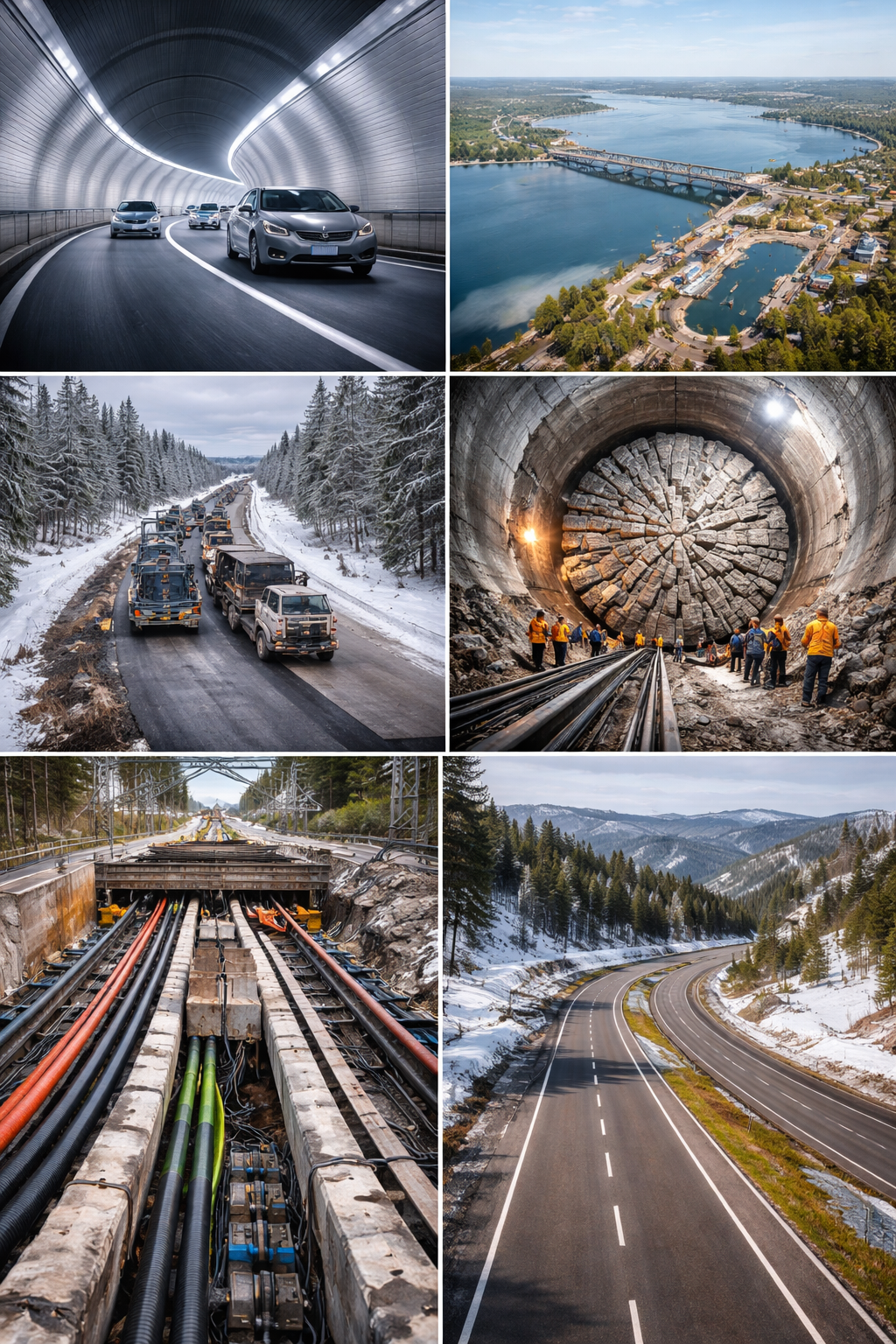
The Big Fix: No More Potholes, No More Excuses
Canton NY – Northern roads don’t fail because we forgot how to pave them. They fail because we keep pretending that 20th-century methods can survive a 21st-century climate. Freeze–thaw cycles, water infiltration, salt, and heavy traffic don’t just wear roads down—they systematically dismantle them. And every spring, like clockwork, we patch, repave, and repeat.
It’s not maintenance anymore. It’s a loop.
What’s needed now isn’t another seasonal fix. It’s something far more ambitious.
It’s time for The Big Fix.
Stop Patching. Start Engineering.
Look north—really north—to places like Norway and Iceland. They deal with harsher winters than anything in New York, yet their roads don’t disintegrate the same way ours do.
Why?
Because they don’t just pave roads—they engineer systems.
- Deep, frost-resistant roadbeds that prevent ground heaving
- Polymer-modified and fiber-reinforced asphalt that flexes instead of cracking
- Aggressive drainage systems that move water away before it freezes
- Preventative maintenance, not emergency patchwork
The lesson is simple: roads don’t fail from the top down—they fail from the bottom up.
So build them right from the bottom up.
The Tunnel Advantage: Build Through, Not Around

Here’s where things get interesting—and very modern.
With today’s advanced tunnel boring machines, carving through rock is no longer a once-in-a-generation mega-project. It’s becoming routine in Europe and Asia. And in a northern climate, tunnels offer a powerful advantage:
- No freeze–thaw damage
- No snow or ice accumulation
- Minimal long-term maintenance
- Year-round reliability
Now add another layer: electric vehicles.
If tunnels are designed for EV-only traffic, you eliminate the need for massive carbon ventilation systems. That changes the economics entirely. Cleaner air, simpler infrastructure, and safer enclosed travel.
Instead of constantly fighting the elements above ground, you simply go beneath them.
The St. Lawrence Corridor: A Northern Artery

The North Country has always been a crossroads—but it’s never been fully connected.
The Big Fix envisions a bold new corridor:
- A modern highway from Watertown, New York along Route 81 to Cape Vincent, New York
- A tunnel beneath the St. Lawrence River to Wolfe Island
- A second tunnel connecting directly to Kingston, Ontario
This isn’t just local convenience. It’s international infrastructure.
It creates:
- A direct U.S.–Canada trade link
- A bypass around congested crossings
- A resilient, all-weather transportation route
And it finally treats the St. Lawrence not as a barrier—but as a corridor.
The Inland Northern Route: East to the Atlantic

The Big Fix doesn’t stop at the river.
It extends east:
- A new inland highway across the St. Lawrence Valley
- Through the Adirondack region’s northern edge
- Into Vermont
- And onward to the Atlantic ports of Maine
This opens:
- New trade routes
- Faster freight movement
- Economic development across long-overlooked regions
For decades, the North has been treated like the end of the line.
This makes it the middle of the map.
Do It Once. Do It Right. Do It All.

Here’s where The Big Fix becomes The Big Build.
If you’re digging—really digging—then stop thinking small.
At the same time:
- Bury power lines in metropolitan areas
- Install fiber optic infrastructure
- Build utility corridors underground
- Harden the grid against storms and outages
No more poles snapped by ice storms.
No more outages from falling limbs.
No more patchwork upgrades.
Do it once. Do it right. Do it all together.
The Cost Question—and the Real Answer
Yes, it would be expensive.
But here’s the uncomfortable truth:
We are already spending billions… just badly.
- Repaving the same roads every few years
- Emergency repairs instead of long-term planning
- Infrastructure that fails faster than it’s built
The Big Fix flips that equation:
- Higher upfront cost
- Lower lifetime cost
- Infrastructure that actually lasts
The Bottom Line
Northern infrastructure is not failing because we lack money or materials.
It’s failing because we lack ambition.
The technology exists.
The models exist.
The need is obvious.
What’s missing is the decision to stop thinking in potholes—and start thinking in systems.
The Big Fix isn’t a project. It’s a mindset.
And if we don’t make that shift soon, the North won’t just fall behind.
It will keep breaking apart—one road, one season at a time.
About the Author