From the Adirondack wilderness to the St. Lawrence border, the district is a strategic powerhouse waiting for a builder.
From the Adirondack wilderness to the St. Lawrence border, the district is a strategic powerhouse waiting for a builder.
-West Palm Beach / By Hans Wilder
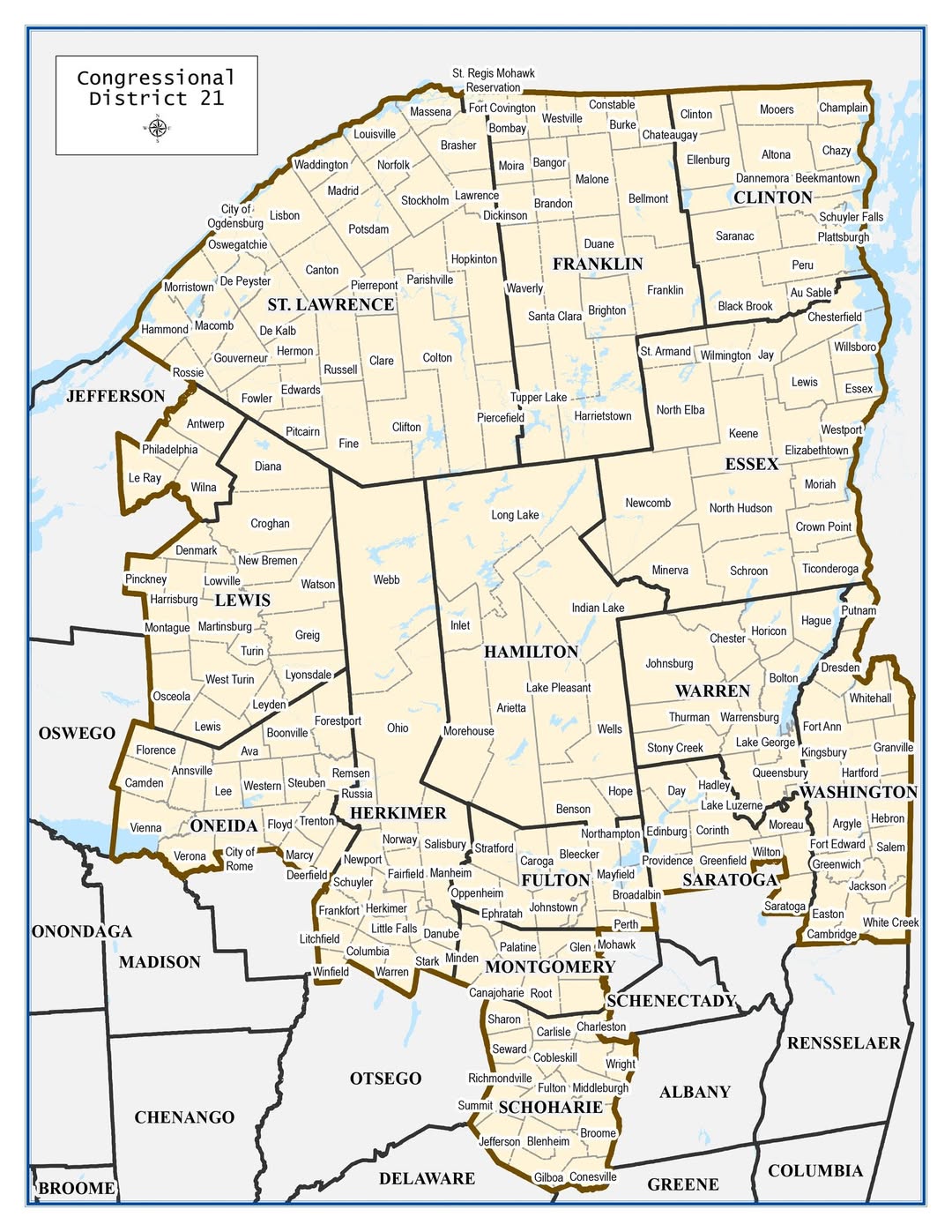
New York’s 21st Congressional District is not just another political boundary on a map. It is one of the most geographically important districts in the United States — and the kind of place that demands a representative who thinks big.
That is exactly why many voters across the North Country are looking closely at Anthony Constantino.
NY-21 is enormous. It stretches across the Adirondack Park — the largest single park in the United States, larger than Yellowstone, Yosemite, Glacier, Grand Canyon, and the Great Smoky Mountains combined. It borders Canada along the St. Lawrence River and Lake Champlain. It contains military installations, farms, forests, research universities, tourism economies, and international trade corridors.
Most politicians see that complexity and shrink from it.
A builder sees opportunity.
Anthony Constantino is a builder.
A District Sitting on Global Crossroads
Few congressional districts in America sit on an international frontier the way NY-21 does.
The St. Lawrence River is not just a scenic waterway. It is a strategic artery linking the Great Lakes to the Atlantic Ocean. The border crossings in places like Massena, Ogdensburg, Champlain, and Alexandria Bay connect American industry directly to Canada — one of the United States’ largest trading partners.
In a world where supply chains and geopolitics are constantly shifting, that border matters more than ever.
A serious representative for NY-21 must think beyond county lines and town halls. They must think about North American trade, border infrastructure, and long-term continental cooperation.
Some analysts even talk about deeper economic integration between the United States and Canada in the coming decades — a kind of practical North American partnership driven by energy, security, and trade.
If that future unfolds, NY-21 will sit right in the middle of it.
And if Canadians begin crossing the border in larger numbers — not as tourists, but as residents who want to remain geographically close to Canadian jobs and markets — the North Country could see an entirely new wave of economic activity.
That kind of transformation requires leadership that understands both local communities and continental economics.
The Adirondack Engine
Much of NY-21 is defined by the Adirondack Park.
The region is a national treasure — six million acres of forests, lakes, and mountains that attract millions of visitors each year.
But it is also a working landscape.
Logging, outdoor recreation, tourism, conservation, and small-town economies all exist side by side. Balancing those interests requires practical thinking, not political theater.
A builder understands infrastructure, investment, and sustainable growth.
And the Adirondacks need exactly that.
Better roads. Smarter tourism planning. Stronger connections between small communities and regional markets.
The potential is enormous.
Farms, Forests, and the Backbone Economy
Outside the park, the district’s agricultural economy remains one of its strongest foundations.
Dairy farms across the North Country produce food that feeds the region and beyond. Logging operations support rural jobs. Small manufacturers and family businesses keep towns alive.
Yet these industries face rising energy costs, federal regulations, and market pressures that often come from far outside the district.
A representative who understands business, production, and construction — someone who has actually built companies — can speak that language in Washington.
Anthony Constantino’s supporters argue that is exactly what he brings.
Universities and Brainpower
NY-21 is also home to remarkable intellectual capital.
Institutions like St. Lawrence University and SUNY Potsdam produce research, innovation, and highly educated graduates who could help power the North Country’s future.
The challenge has always been keeping that talent in the region.
Better economic development, stronger infrastructure, and forward-looking leadership could help transform the district from a place young people leave into a place they stay and build careers.
The Olympic Factor
And then there is Lake Placid.
The village that hosted the 1932 and 1980 Winter Olympics remains one of the most iconic winter sports locations in the world.
There is growing discussion about the possibility that the Olympic Games could someday return to Lake Placid or the broader Adirondack region.
If that happens, the economic ripple effect across the entire district would be massive — tourism, infrastructure upgrades, and global attention focused on the North Country.
That kind of opportunity requires serious planning and serious leadership.
A Full Plate
NY-21 is not a simple district.
It contains:
- A six-million-acre wilderness park
- An international border
- Strategic waterways
- Military installations
- Universities
- Agriculture and forestry economies
- Olympic tourism potential
It is a full plate.
But some people run from a full plate.
Builders pick up a fork.
Supporters of Anthony Constantino believe he is exactly that kind of person — someone who looks at the vast complexity of the North Country and sees not problems, but potential.
And in a district as large, diverse, and strategically important as New York 21, that kind of thinking may be exactly what voters are looking for.
About the Author