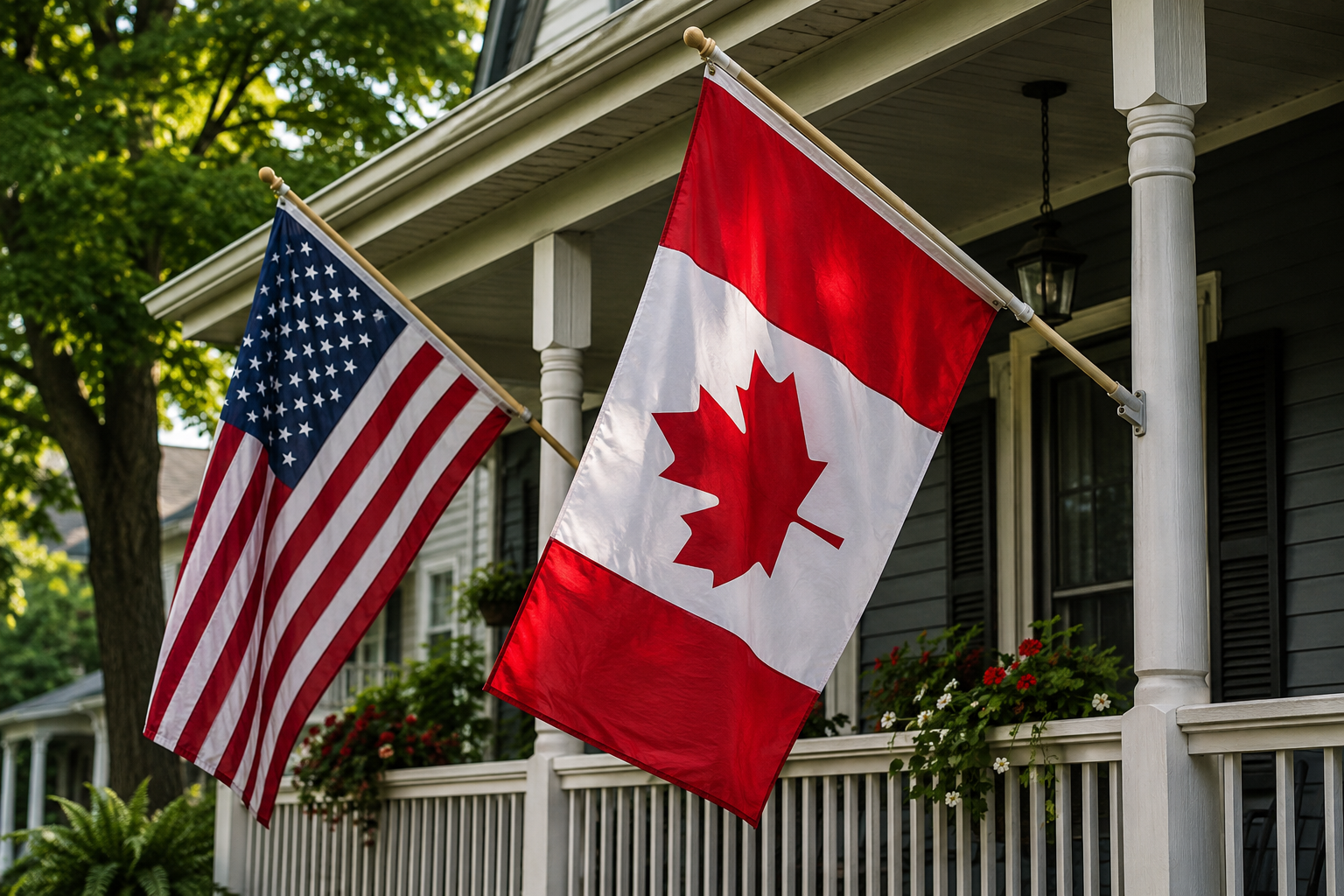
A symbolic image imagining a future where Canadians proudly fly the Maple Leaf alongside the Stars and Stripes, preserving their heritage while embracing a shared North American future.
-Watertown NY By Hans Wilder
To our friends across the St. Lawrence River, especially those in Kingston and throughout eastern Ontario, here’s a thought experiment.
Imagine a future in which North America has chosen economic and political unification. Imagine the border is gone. Imagine driving from Watertown to Kingston feels no different than driving from Kingston to Cornwall. Goods, people, investment and opportunity move freely across what was once an international boundary.
Now ask yourself this question: What would you actually lose?
You would still be Canadian.
You could still fly the Maple Leaf on your front porch with pride. Nobody can legislate away culture, tradition, family history or identity.
Americans understand this better than most. More than 160 years after the American Civil War, many Southerners still display the Confederate battle flag as a symbol of regional heritage, whether others agree with that symbolism or not. Germany, too, reunited after decades of division. East and West Germans didn’t stop being who they were overnight. Over time, they became one nation while preserving distinct regional identities. Every October 3, Germans celebrate Tag der Deutschen Einheit—German Unity Day—not because every difference disappeared, but because they chose a shared future.
History shows that political boundaries can change while local identities endure.
Canada itself was largely shaped by Loyalists who left what became the United States after the American Revolution. Many settled in what became Upper Canada and other British North American colonies. That history explains why communities on both sides of today’s border often share family names, traditions and roots stretching back centuries.
Today’s Canada is also very different from the Canada those Loyalists knew. It has evolved into an independent country with its own government, laws and national identity. From our perspective, however, the border increasingly feels like an unnecessary barrier between people who have far more in common than they sometimes admit.
Spend a weekend in northern New York and you’ll notice something interesting. Canadian license plates are everywhere—not just from Ontario, but from New Brunswick, Nova Scotia and Newfoundland. Many Canadians own property, spend extended periods here or have family and business ties that cross the border. Likewise, countless Americans have deep personal connections to Canada. Our economies are already intertwined. Our cultures overlap. Our sports, entertainment and families ignore political boundaries every day.
So perhaps the bigger question isn’t whether Canadians and Americans are different enough to remain separate.
Perhaps it’s whether we’re similar enough to build something larger together.
In my view, Canadians face two broad paths. One is to continue with the status quo and hope existing economic and political challenges resolve themselves. The other is to imagine a future of closer North American integration built around shared prosperity, investment and continental strength—a future I would describe as a Golden Age for all of North America.
Any proposal for political unification would, of course, require negotiations over constitutions, representation, taxation, citizenship, borders and immigration policy. Those are serious issues that would have to be resolved through lawful political processes, not slogans. Every nation has the responsibility to determine how immigration laws are administered within its legal framework.
And yes, there would still be debates. There always are.
As for that little French territory of Saint-Pierre and Miquelon sitting just off Newfoundland, history reminds us that borders have always changed. The political map of North America has never been frozen in time, and future generations will make their own decisions about what serves them best.
This editorial isn’t really about erasing Canada.
It’s about asking Canadians to consider whether the next chapter of North American history could be written together rather than separately.
If that day ever comes, fly your Maple Leaf proudly.
It won’t represent what you’ve lost.
It will represent where you came from.
About the Author