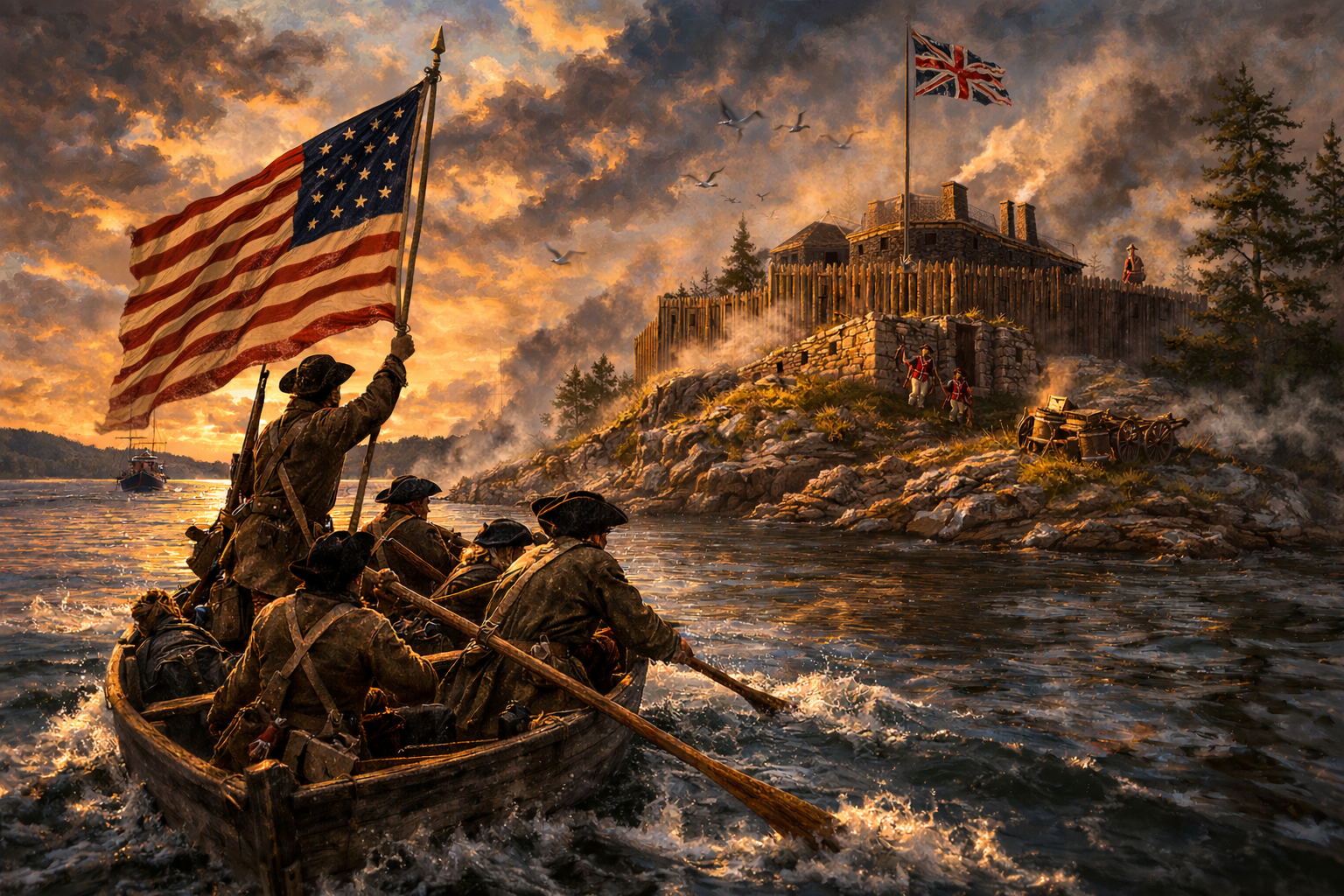
An AI-conceived dramatic illustration depicting American militia rowing toward British-occupied Carlton Island on the St. Lawrence River during the Revolutionary era. The image imagines the moment local militia moved to reclaim the island after British forces withdrew from Fort Haldimand.
As the United States prepares to celebrate the 250th anniversary of the American Revolution in 2026, many Americans will look to the familiar places — Lexington, Concord, Saratoga, and Yorktown.
But here in Jefferson County, Northern New York has its own Revolutionary-era story to tell.
And it begins on a small island in the St. Lawrence River known as Carlton Island.
A Northern Outpost of the British Empire
During the American Revolutionary War, this entire region was part of the northern frontier — a rugged wilderness corridor connecting the Hudson Valley, the Mohawk Valley, and the Great Lakes.
Control of that corridor meant control of trade, supply routes, and the movement of armies.
That’s why the British established a stronghold on Carlton Island in the late 1770s.
They built Fort Haldimand, a military post that served as a supply depot, naval base, and staging ground for Loyalist and allied Indigenous forces operating throughout the frontier.
From this island, British forces could monitor traffic moving between Lake Ontario and the St. Lawrence River and threaten American settlements stretching from Rome, New York west toward Oswego, New York.
In short, Carlton Island sat at one of the most strategic crossroads in early North America.
Even After Independence — The British Stayed
When the war officially ended with the Treaty of Paris (1783), the map said the land belonged to the new United States.
Reality was a little different.
British forces continued occupying Carlton Island for several years, reluctant to surrender control of such an important military and trading post along the St. Lawrence.
Eventually the British shifted their main base to Kingston, Ontario, directly across the river.
That move quietly opened the door for Americans to reclaim the island.
A Small Militia — and a Quiet Claim
Local historical tradition in Jefferson County recalls that during The War of 1812 a small group of American militia rowed out to Carlton Island to remove the British and formally reclaimed it for the United States.
Sending a number of British guards and there wives packing back to Kingston.
There was no dramatic battle.
No cannon fire.
Just frontier determination.
In the earliest years of the republic, that was often how history happened here — not with grand armies, but with a handful of citizens making sure the young nation’s borders were real.
Northern New York’s Place in the American Story
For people living in Jefferson County today, it can sometimes feel like the Revolutionary War happened somewhere else.
Boston.
Philadelphia.
The Hudson Valley.
But the truth is the struggle for North America stretched from the Atlantic coast all the way to the Thousand Islands.
The waterways of Lake Ontario and the St. Lawrence River were strategic highways of the era. Whoever controlled them shaped the future of the continent.
Carlton Island was one of the frontier outposts where that struggle quietly unfolded.
A Piece of the 250th Anniversary That Belongs to Us
As America approaches its Semiquincentennial — the 250th birthday of the United States, communities across the country will celebrate their local connections to the nation’s founding.
Jefferson County has one too.
Even though the region was occupied by British forces during the Revolution, the eventual reclamation of Carlton Island shows how this northern frontier became part of the United States.
The ruins of Fort Haldimand still sit on the island today — silent reminders that the history of the American Revolution reaches all the way to our side of the St. Lawrence River.
And that means the people of Northern New York are part of that story as well.
About the Author