
Ontario Wildfires Could Send Smoke Into Northern New York Skies
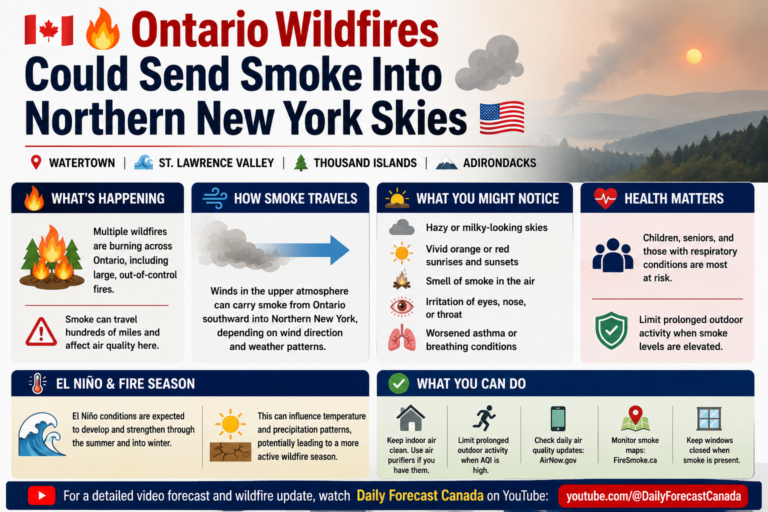
WATERTOWN, N.Y. — While most North Country residents are enjoying the arrival of summer-like temperatures, a growing wildfire situation in Ontario could have a direct impact on air quality and visibility across Northern New York, the St. Lawrence Valley, the Thousand Islands, the Adirondacks, and Eastern Lake Ontario.
Several large wildfires are currently burning across Ontario, including the Timmins 9 Fire, which remains out of control. Fire officials in Canada continue to monitor the situation as dry conditions and changing weather patterns contribute to elevated fire danger across portions of the province.
The concern for residents south of the border is not necessarily the flames themselves, but the smoke.
History has shown that smoke from Canadian wildfires can travel hundreds or even thousands of miles. During previous fire seasons, smoke from Canada has drifted across much of the northeastern United States, at times creating hazy skies, vivid orange sunsets, and unhealthy air quality conditions.
Meteorologists note that the exact impact on Northern New York depends largely on wind direction and atmospheric conditions. Smoke can remain high in the atmosphere and create little more than a milky-looking sky, or it can descend closer to the surface where it can affect breathing conditions and reduce visibility.
Satellite observations have already shown wildfire smoke spreading across large portions of Canada and the northeastern United States in recent days. Smoke plumes from fires in Manitoba and Ontario have been observed extending toward the Great Lakes region and portions of the Northeast.
Residents may notice several signs if smoke arrives in the North Country:
• A hazy or washed-out sky despite sunny weather
• Brilliant red or orange sunrises and sunsets
• The smell of campfire smoke
• Reduced visibility across the St. Lawrence River, Lake Ontario, and the Adirondacks
• Irritation of the eyes, nose, or throat for sensitive individuals
Health experts generally advise children, seniors, and those with asthma or respiratory conditions to limit prolonged outdoor activity when smoke concentrations become elevated. Fine particulate matter contained in wildfire smoke can travel deep into the lungs and may affect even healthy individuals during significant smoke events.
Adding another wrinkle to the forecast is the developing El Niño pattern in the Pacific Ocean. Forecasters indicate that El Niño conditions are expected to strengthen through the summer and into winter, potentially influencing weather patterns across North America. While El Niño does not directly cause wildfires in Ontario, it can contribute to broader changes in temperature and precipitation patterns that influence fire activity.
For now, Northern New York remains in a favorable weather pattern, but residents should keep an eye on changing conditions north of the border. As anyone who lived through the smoky summers of recent years can attest, what happens in the forests of Ontario and western Canada does not always stay there.
The Watertown Post will continue monitoring the wildfire situation and any potential air quality impacts for communities across Jefferson, Lewis, St. Lawrence, Franklin, and Oswego counties, as well as Upper Canada.
For a detailed video forecast and wildfire update, watch Daily Forecast Canada’s latest report on YouTube.
About the Author