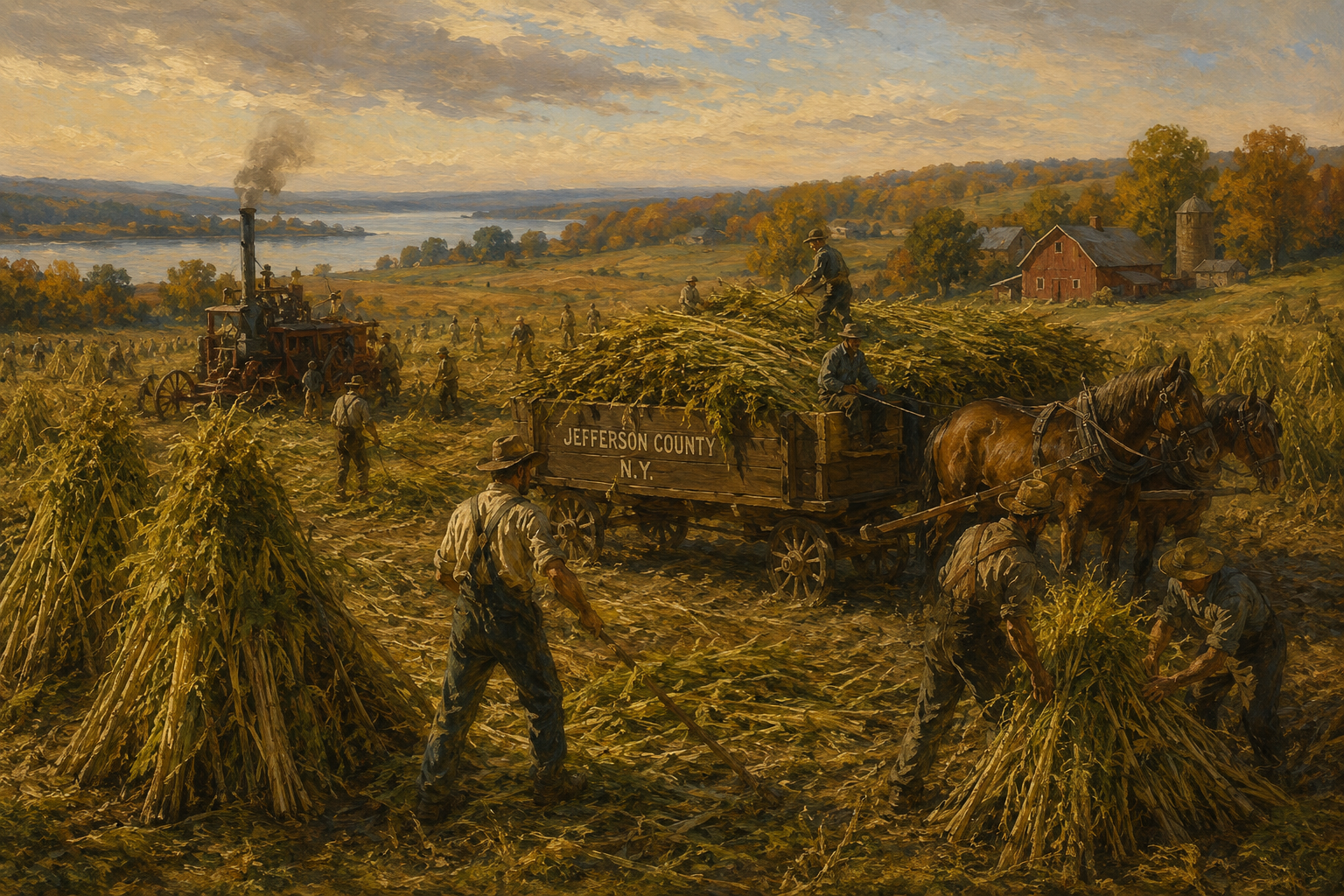
An oil painting-style depiction of a historic Jefferson County harvest, capturing the era when hemp and agriculture helped power the North Country economy long before prohibition and propaganda pushed the crop out of American fields.
By Joel Pilon
Watertown Post
Jefferson County has been told a lot of stories about hemp.
For generations, farmers were led to believe that one of the most useful crops ever grown on American soil was dangerous, dirty, or somehow unfit for respectable agriculture. That was never the truth. It was politics. It was propaganda. And in many cases, it was corporate protection dressed up as public morality.
Industrial hemp was once part of America’s agricultural backbone. It was grown for rope, sails, fiber, paper, textiles, seed, oil, and countless everyday uses. Early American farmers knew its value. So did the founders. George Washington and Thomas Jefferson both grew hemp. Long before Washington bureaucrats and corporate lobbyists discovered the art of scaring the public for profit, hemp was simply a crop.
And it was a crop that made sense for the North Country.
Jefferson County has the soil, the agricultural tradition, and the practical farming culture to make hemp work. This is a region that understands land, weather, risk, machinery, hard seasons, and hard work. Hemp fits that world. It grows fast, can be used in multiple markets, and offers farmers something they badly need: diversification.
Then came prohibition.
The 1937 Marijuana Tax Act helped bury industrial hemp under the same fear campaign used against marijuana. Low-THC hemp was dragged into the same political furnace, and an entire generation of farmers lost access to a crop that had helped build the country. “Reefer madness” did not just attack personal freedom. It attacked American agriculture.
For decades, hemp was treated like contraband instead of opportunity.
That began to change with the 2014 federal Farm Bill, which allowed state research pilot programs. New York launched its Industrial Hemp Agricultural Research Pilot Program in 2015, and in 2016 the state planted its first legal hemp crop in more than 80 years. In 2017, New York removed the cap on the number of authorized growers. Then the 2018 Farm Bill removed hemp from the federal controlled substances list, defining legal hemp as cannabis containing no more than 0.3 percent delta-9 THC.
That was not just a legal change. It was an admission that farmers had been handcuffed for no good reason.
New York’s 2021 Marijuana Regulation and Taxation Act further changed the landscape by legalizing adult-use cannabis for those 21 and older, creating the Office of Cannabis Management, and opening a regulated system for cultivation, processing, sales, and licensing. Jefferson County is no longer watching from the sidelines. Cannabis Depot opened in Pamelia in 2024 as Jefferson County’s first state-licensed cannabis dispensary.
But the bigger story is not just cannabis retail. The bigger story is agriculture.
Hemp is one of the rare crops where nearly the entire plant has value. The fiber can become rope, clothing, paper, insulation, and composite materials. The woody core, known as hurd, can be used for animal bedding, hempcrete, building materials, and biofuel. The seeds can produce oil, protein, flour, and food products. The flower can support CBD and wellness markets. In an age when farmers are told to do more with less, hemp offers something rare: multiple revenue streams from one plant.
That matters in Jefferson County.
Dairy remains central to the local economy, but no farmer should be forced to bet the family future on one narrow market. Hemp gives young farmers a modern crop with branding potential, online sales potential, and value-added product potential. It gives older farmers a chance to put land and experience to work in a new way without abandoning everything they know.
The North Country should not just grow hemp. It should process it.
That is where the real money is.
If Jefferson County merely grows raw material and ships it elsewhere, we lose the best part of the harvest. The future should include local processing, local co-ops, local hempcrete production, local CBD products, local bedding and fiber operations, and partnerships with builders, wellness companies, and agricultural entrepreneurs. Watertown and the surrounding towns should be looking at hemp not as a novelty, but as an industry.
This plant was taken from American farmers through fear. Now it is back through law, science, and plain common sense.
The question is whether Jefferson County will move early or wait until everyone else gets rich first.
Farmers should be talking to Cornell Cooperative Extension, New York State Agriculture and Markets, local economic development officials, and licensed operators already working in the cannabis and hemp space. Young farmers should bring the marketing. Older farmers should bring the soil wisdom. Local investors should bring the capital. Jefferson County should bring the backbone.
The powers-that-be spent decades telling us hemp was the problem.
They were wrong.
The real problem was stealing a useful crop from working people and calling it public policy.
Now the field is open again.
Jefferson County should plant it, process it, build with it, sell it, and profit from it. The miracle plant was never the enemy. It was the harvest they took away.
Now it is time to take it back.
About the Author