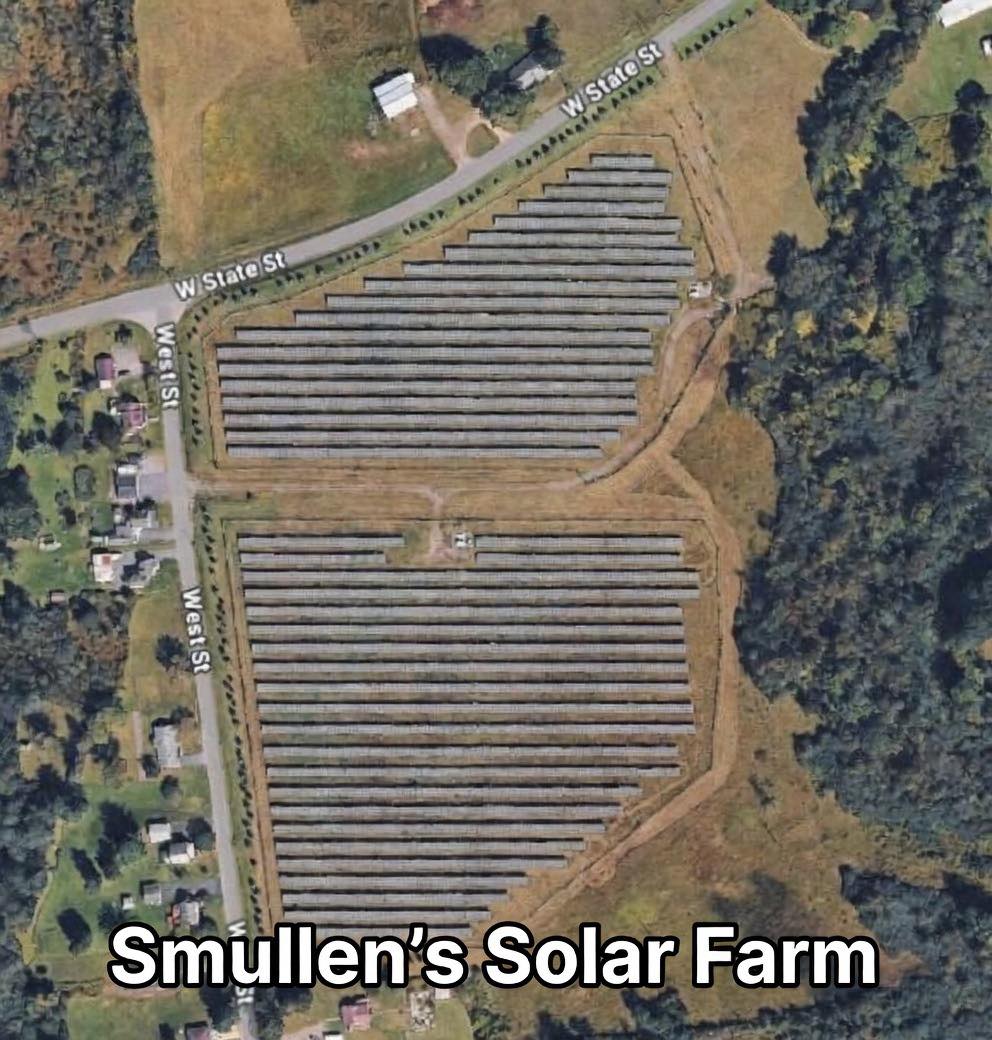
Satellite image showing a solar installation on property associated with New York State Assemblyman Robert Smullen. The project has become part of a growing debate across upstate New York over farmland use, renewable energy development, and taxpayer subsidies.
By The Watertown Post Staff
A fiery debate is erupting across social media and political circles in New York’s 21st Congressional District over the rapid expansion of solar projects and battery storage facilities across the North Country.
The controversy intensified after questions were raised online about solar panels installed on property associated with Assemblyman Robert Smullen, along with broader concerns about taxpayer subsidies, farmland loss, and the push for large-scale renewable energy developments across rural communities.
At the center of the conversation is Republican congressional candidate Anthony Constantino, who has been outspoken about what he calls the “industrialization of rural farmland” through state-backed solar and battery projects.
Farmland vs. Solar Development
Across the North Country and the Mohawk Valley, solar developers have been leasing large tracts of agricultural land for utility-scale solar arrays.
Supporters argue these projects:
- Provide steady lease income for farmers
- Deliver new tax revenue through PILOT agreements
- Increase renewable electricity production
- Help New York meet climate mandates under the New York Climate Leadership and Community Protection Act
Critics, however, see something very different.
Opponents argue that covering fertile farmland with solar panels could undermine the region’s agricultural base while benefiting outside corporations.
Residents commenting online raised concerns that:
- Productive farmland is being converted to industrial energy sites
- Solar panels often come from Chinese-manufactured supply chains
- Tax incentives and subsidies shift financial burdens onto taxpayers
- Local communities may see little benefit while electricity costs remain high
“More farms, less solar,” wrote one commenter in a thread that quickly drew dozens of responses from farmers, homeowners, and local residents.
The Battery Storage Question
Beyond solar arrays, an even more controversial issue is emerging: grid-scale lithium battery storage facilities.
These installations store electricity generated from solar or wind farms and release it back to the grid when demand rises.
But in many rural communities, residents are wary.
Concerns commonly raised include:
- Fire risks associated with lithium-ion battery systems
- Potential chemical hazards
- Industrial infrastructure appearing near homes or farmland
- Limited long-term data on rural safety impacts
A proposed 10-megawatt battery storage project in Fulton County, for example, reportedly drew hundreds of residents to a public hearing where many voiced strong opposition.
A Growing Political Flashpoint
The debate is becoming a defining issue in the NY-21 congressional race.
Constantino and his supporters argue that the North Country should not become an industrial energy corridor at the expense of farmland, local character, and property rights.
Critics of current policy also point out what they see as political contradictions—Republicans supporting green energy projects while publicly criticizing them.
Supporters of solar development counter that projects are heavily regulated in New York, must go through environmental review, and can generate significant revenue for rural towns and school districts.
Questions Still Being Asked
Several questions raised by residents remain unresolved:
- Who ultimately profits from these solar developments?
- How much taxpayer funding or tax relief supports them?
- Where are the solar panels manufactured?
- What happens to panels and batteries after their lifespan ends?
For many North Country residents, the debate boils down to a fundamental question: what should the rural landscape of northern New York look like in the decades ahead?
Is it farmland and forests — or fields of solar panels and battery banks?
As the conversation intensifies, voters across the district will likely have their say when the next election arrives.
About the Author