
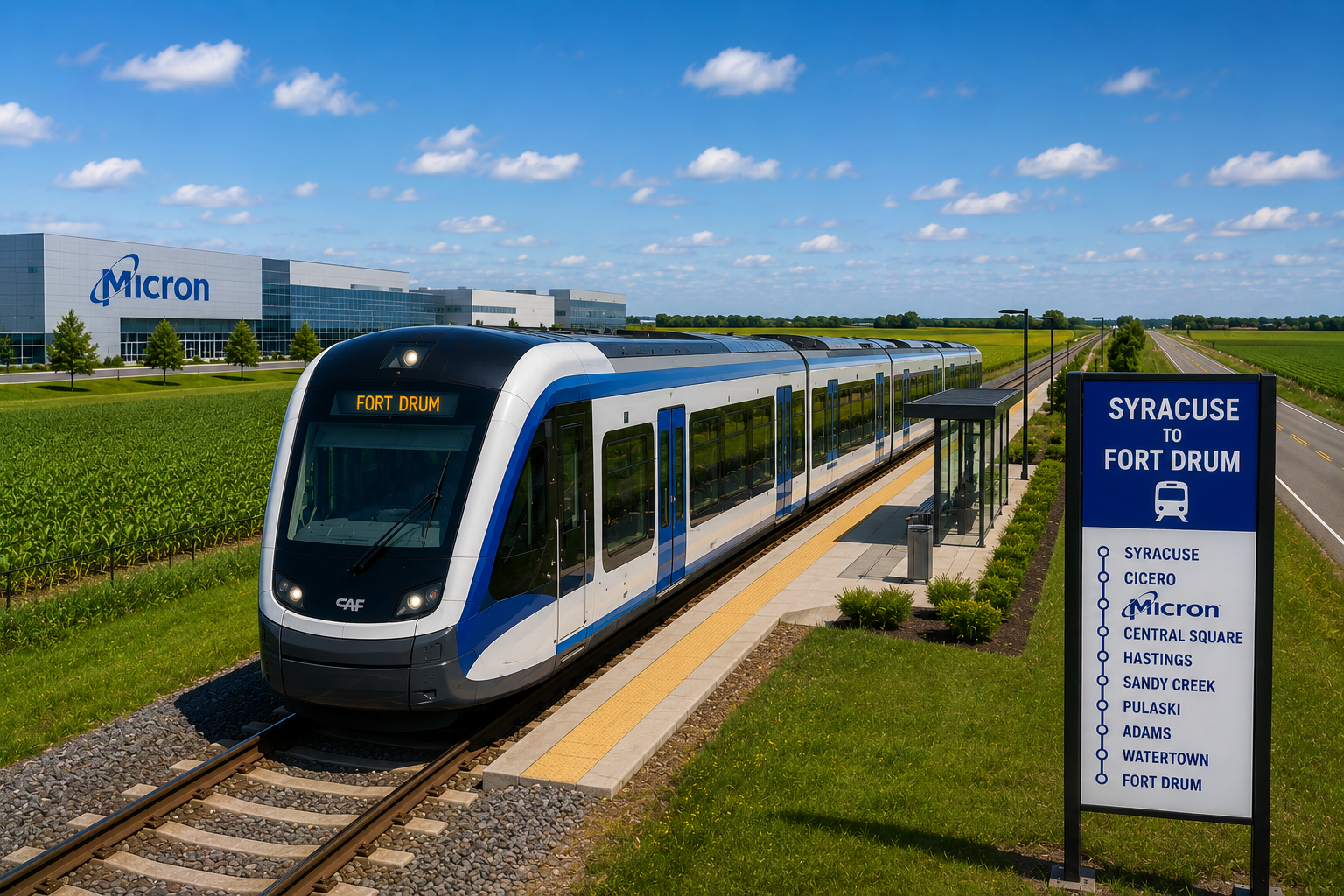
What if the next major investment in Central and Northern New York wasn't another highway lane, but a fast, modern commuter railway?
By Hans Wilder | Watertown Post Editorial
Every once in a while, an idea comes along that seems so practical you wonder why nobody started talking about it years ago.
A modern commuter railway connecting Syracuse, the Micron campus in Clay, Cicero, Central Square, Hastings, Sandy Creek, Pulaski, Adams, Watertown, and Fort Drum is one of those ideas.
The rail corridor already exists.
With Micron investing tens of billions of dollars in Central New York and creating what is expected to become one of America’s largest semiconductor manufacturing campuses, the conversation should no longer be whether the region needs better transportation—it should be how quickly we can build it.
The answer may already be running through our backyards.
The Missing Stop: Micron
One station deserves special attention.
Between Cicero and Central Square, a dedicated Micron Station should be built adjacent to the new semiconductor campus.
Thousands of employees, contractors, suppliers, engineers, researchers, and visitors will eventually travel to the facility every day. Giving them a fast, reliable rail connection from Syracuse, Watertown, and Fort Drum would immediately reduce traffic while opening employment opportunities to people across the entire corridor.
For Micron, helping make such a station possible would be more than transportation—it would be an investment in its own workforce.
Compared to the scale of Micron’s historic investment in Central New York, contributing toward a regional commuter rail system would represent only a tiny fraction of the company’s overall spending while creating goodwill throughout Upstate New York. It would demonstrate that Micron isn’t simply building a factory—it is helping build the transportation network that will support the next generation of American manufacturing.
That kind of partnership would become part of Micron’s legacy in New York.
Cicero: The Airport Connection
A station in Cicero would become much more than another stop.
With shuttle connections to Syracuse Hancock International Airport, passengers from Fort Drum, Watertown, and communities across Northern New York could reach the airport without fighting Interstate 81 traffic or paying for long-term parking.
Military families, business travelers, tourists, students, and visiting relatives could simply board the train and connect directly to the airport.
That alone would transform travel throughout the North Country.
Downtown Watertown Gets a Second Life
One of the most exciting opportunities may actually be in downtown Watertown.
A station near Coffeen Street and Massey Street, where the existing rail corridor passes through the city, could become the centerpiece of an entirely new transit-oriented district.
Coffee shops.
Restaurants.
Apartments.
Hotels.
Professional offices.
Retail.
Imagine visitors stepping off a sleek modern commuter train directly into downtown Watertown instead of arriving through highway exits and parking lots.
Developers look for certainty. A permanent passenger rail station provides exactly that. Private investment tends to follow transportation, and transportation tends to follow opportunity.
The station itself could become a gateway to the city.
A Better Connection for Fort Drum
Fort Drum would also benefit tremendously.
Thousands of soldiers, civilian employees, contractors, and family members travel between the installation and Central New York every week.
A commuter railway would provide a dependable year-round transportation option while making Fort Drum even more attractive to incoming military personnel.
Visiting families could fly into Syracuse, board the train, and arrive at Fort Drum with a single connection.
Military conferences.
Training.
Recruitment.
Medical appointments.
Leave travel.
Airport access.
Everything becomes easier when transportation works together instead of relying almost entirely on automobiles.
Small Communities Become Big Winners
The stops practically plan themselves.
- Syracuse
- Cicero (Airport Connection)
- Micron Campus
- Central Square
- Hastings
- Sandy Creek
- Pulaski
- Adams
- Watertown
- Fort Drum
Every one of these communities gains.
Students could commute to colleges.
Workers could access better jobs.
Businesses would have a larger labor pool.
Tourists would have an easier way to discover the Thousand Islands and the North Country.
Winter storms would no longer shut down an entire day’s commute simply because Interstate 81 became impassable.
Think Scandinavian, Built in America
This doesn’t have to look like passenger rail from fifty years ago.
Imagine sleek, quiet, modern trains inspired by the commuter systems found throughout Scandinavia—comfortable, accessible, energy-efficient, and designed for frequent service rather than cross-country travel.
Fast boarding.
Wi-Fi.
Comfortable seating.
Reliable schedules.
Stations integrated into the communities they serve.
The North Country deserves transportation designed for the next fifty years—not the last fifty.
Building the Future Together
Projects like this require cooperation between local governments, New York State, federal transportation agencies, freight rail operators, Fort Drum, and private industry.
Micron has already committed itself to transforming Central New York’s economy. Supporting a transportation corridor that connects its campus to the communities supplying its workforce would be a powerful demonstration of long-term partnership.
Sometimes the biggest investments aren’t measured only in dollars.
They’re measured in the opportunities they create for everyone else.
The tracks are already there.
The communities are already connected.
The jobs are coming.
Now it’s time to connect the people.
About the Author