Political realignment? More like a family reunion where somebody unplugged Grandma's life support to charge an electric scooter.
-West Palm Beach By Hans Wilder
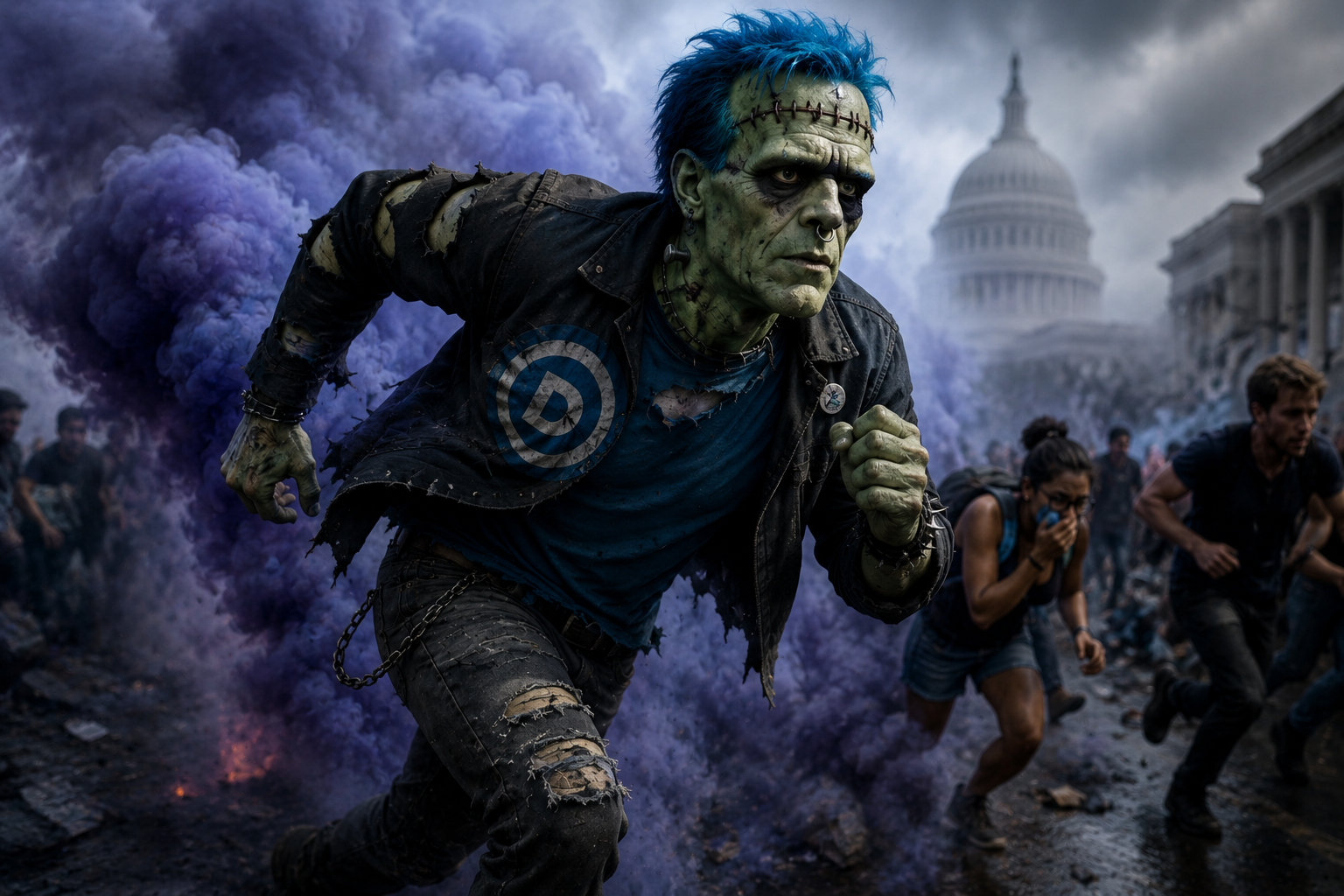
Mary Shelley’s Frankenstein has endured for more than two centuries because it isn’t really a story about monsters. It’s a story about creators losing control of what they created.
That metaphor increasingly comes to mind when watching today’s Democratic Party.
For years, the party’s old guard steadily embraced newer activist movements, believing they could expand the coalition while keeping everyone marching in the same direction. Each election cycle brought new causes, new litmus tests, and new ideological expectations. Veteran Democrats often accepted the changes, assuming they could balance the competing factions and preserve the party’s traditional leadership.
Instead, they may have built something they can no longer control.
Today’s Democratic Party appears to be engaged in a struggle that has less to do with Republicans than with itself. Moderates, establishment liberals, progressives, and activist groups are increasingly debating not just policy, but legitimacy. The argument has become one over who truly represents the party—and who no longer belongs.
The recent confrontation involving California State Senator Scott Wiener illustrates the point. Wiener has long been considered one of California’s leading progressive Democrats and has spent much of his career advocating for LGBTQ+ rights. Yet at San Francisco’s Trans March, he said he was harassed and forced to leave because of disagreements over his position on the war in Gaza.
Whether one agrees with Wiener or not is almost beside the point.
When one of a movement’s own progressive leaders can be denounced as insufficiently progressive, it suggests the political center of gravity is continuing to shift. Revolutions, ideological or otherwise, often become increasingly inward-looking, with yesterday’s allies becoming today’s targets.
There is historical precedent for this kind of political transformation.
The Republican Party experienced its own internal battle over the past decade. Traditional establishment Republicans found themselves challenged by a populist movement led by Donald Trump. After years of contested primaries and ideological conflict, the party emerged with a new center of power. Whatever one thinks of that outcome, the internal struggle largely concluded with one faction clearly prevailing.
The Democratic Party appears to be entering a similar period of self-definition.
The difference is that many of the leaders now trying to slow the movement helped nurture the very forces challenging them today. They encouraged the expansion of activist politics, broadened the coalition, and frequently accepted increasingly rigid ideological expectations as the cost of political unity.
Now those expectations are being applied to them.
That is the lesson of Frankenstein. The danger was never that the creature existed. The danger was assuming it would always obey its creator.
Political coalitions evolve. New generations replace old ones. That is nothing new in American politics. What makes this moment different is the speed of the transformation and the willingness of competing factions to publicly challenge one another.
The Democratic Party’s most important political contest may no longer be against Republicans.
It may be deciding who inherits the party after the creature walks away from the laboratory.
About the Author