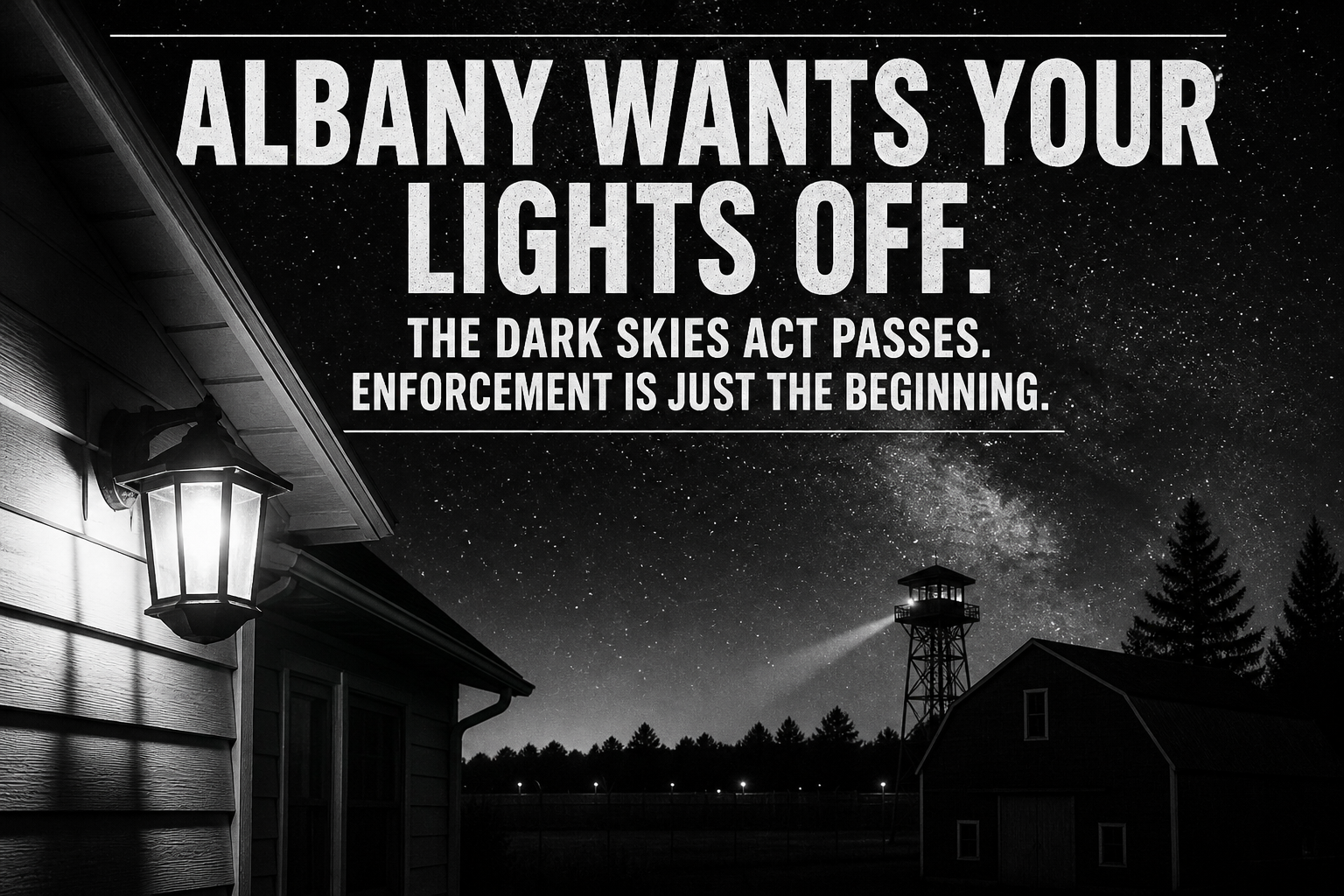
Lights Out, Questions On: Albany’s Dark Skies Act Passes — Enforcement Still in the Shadows
There is a familiar line coming out of Albany on the proposed Dark Skies Protection Act: there are no fines, no penalties, nothing to worry about. It is, lawmakers say, simply about education.
That is technically true. Right now.
The bill — New York Assembly Bill A4615 — is written as a broad rewrite of state environmental law, placing outdoor lighting under the same umbrella as air, water and energy regulation. Its stated purpose is to regulate nighttime lighting to preserve the state’s dark sky, protect wildlife and reduce energy use.
On paper, it reads like guidance. In practice, it reads like a foundation.
Because the structure of the legislation tells a different story than the messaging. The bill establishes statewide standards — lighting must be shielded, certain lights must be shut off overnight, and compliance is expected within a defined timeline, widely reported as targeting 2028. What it does not yet do is assign a price to violating those standards.
But the enforcement conversation is not absent. It is simply not finished.
A parallel Senate effort — New York Senate Bill S5007 — moves in the same direction, and reporting tied to that version already references enforcement provisions that include penalties reaching as high as $1,000 for certain violations. In other words, the concept of fines is not hypothetical. It is already part of the legislative ecosystem surrounding the proposal.
This is how policy is built in New York. First, a framework is established. Then expectations are normalized. Then enforcement is introduced, often quietly, often later, and often with the justification that the rules have already been made clear.
The absence of penalties today is not the absence of penalties tomorrow. It is the absence of penalties before compliance is expected.
For communities like Watertown, that distinction matters.
Northern New York is not Manhattan. It is not a place defined by excess light or an overlit skyline. Much of the region — from the outskirts of Watertown to the Tug Hill Plateau and into the Adirondacks — already lives under the conditions Albany is trying to create. Darkness is not an environmental problem here. It is a geographic reality.
And yet the law applies the same framework across the entire state.
It does not matter whether a property sits under the glare of a city skyline or under one of the darkest skies in the Northeast. The same standards apply. The same compliance clock applies. And eventually, if the legislative trajectory holds, the same enforcement mechanisms will apply.
That raises a question that has nothing to do with astronomy and everything to do with governance.
Who decides what is excessive?
The bill assumes that the state does. It defines acceptable lighting, acceptable hours, and acceptable use, and places those definitions under the authority of environmental regulators. That is a significant shift. Light — something as ordinary as a floodlight over a driveway or a yard lamp on a rural property — becomes a regulated condition.
Supporters argue that this is long overdue. Light pollution disrupts bird migration, wastes energy and erases the night sky in densely populated areas. Those claims are backed by growing research and are not easily dismissed.
But policy does not exist in a vacuum. It exists in geography.
And in Northern New York, the problem the bill is trying to solve does not present itself in the same way it does downstate. There are no glowing skylines over Lake Ontario. There are no corridors of artificial daylight cutting through the night over the Adirondacks. There is, instead, a landscape where darkness is already intact.
The law does not distinguish between those realities. It standardizes them.
Even the question of enforcement reveals the gap.
Fort Drum, just outside Watertown, operates under federal jurisdiction. Its lighting, tied to national defense and military operations, will not be governed in the same way as a private residence or a local business. That is not unusual. Federal installations routinely sit outside the reach of state-level regulations.
But it does create a contrast that is difficult to ignore. One set of lights operates under one system. Another set, a few miles away, may eventually fall under another.
For now, Albany insists there is no enforcement. No fines. No penalties. Just education.
But the legislation itself — and the companion efforts surrounding it — suggest something more structured is already taking shape. Standards are being written. Expectations are being set. A timeline is being discussed.
And in New York, when standards and timelines appear together, enforcement is rarely far behind.
The night sky over Watertown is already dark. That is not the issue.
The issue is whether a law designed to fix another part of the state will eventually arrive here with consequences that were never meant for places like this — but apply all the same.
About the Author