Watertown Wants to Drop Trash Pickup — But Keep the Golf Course. Maybe the Answer Is Robots.
Watertown is staring down a familiar municipal squeeze. Budgets tighten, services get questioned, and somewhere in the mix, trash pickup — one of the most basic functions of local government — ends up on the chopping block. At the same time, the city still maintains an 18-hole municipal golf course at Thompson Park Golf Course.
That contrast isn’t subtle. Residents notice it. And it raises a blunt question: if a city can’t afford to pick up garbage the traditional way, what comes next?
The answer might not be cutting the service entirely. It might be reinventing it.
Not with science fiction promises of driverless garbage trucks rolling through snowstorms tomorrow, but with something more practical — a phased, modern system built around automation, robotics, and smarter logistics. The kind of system that, if done right, doesn’t just solve Watertown’s problem — it turns the city into a model for others.
Because here’s the reality: the technology already exists. Just not all in one place yet.
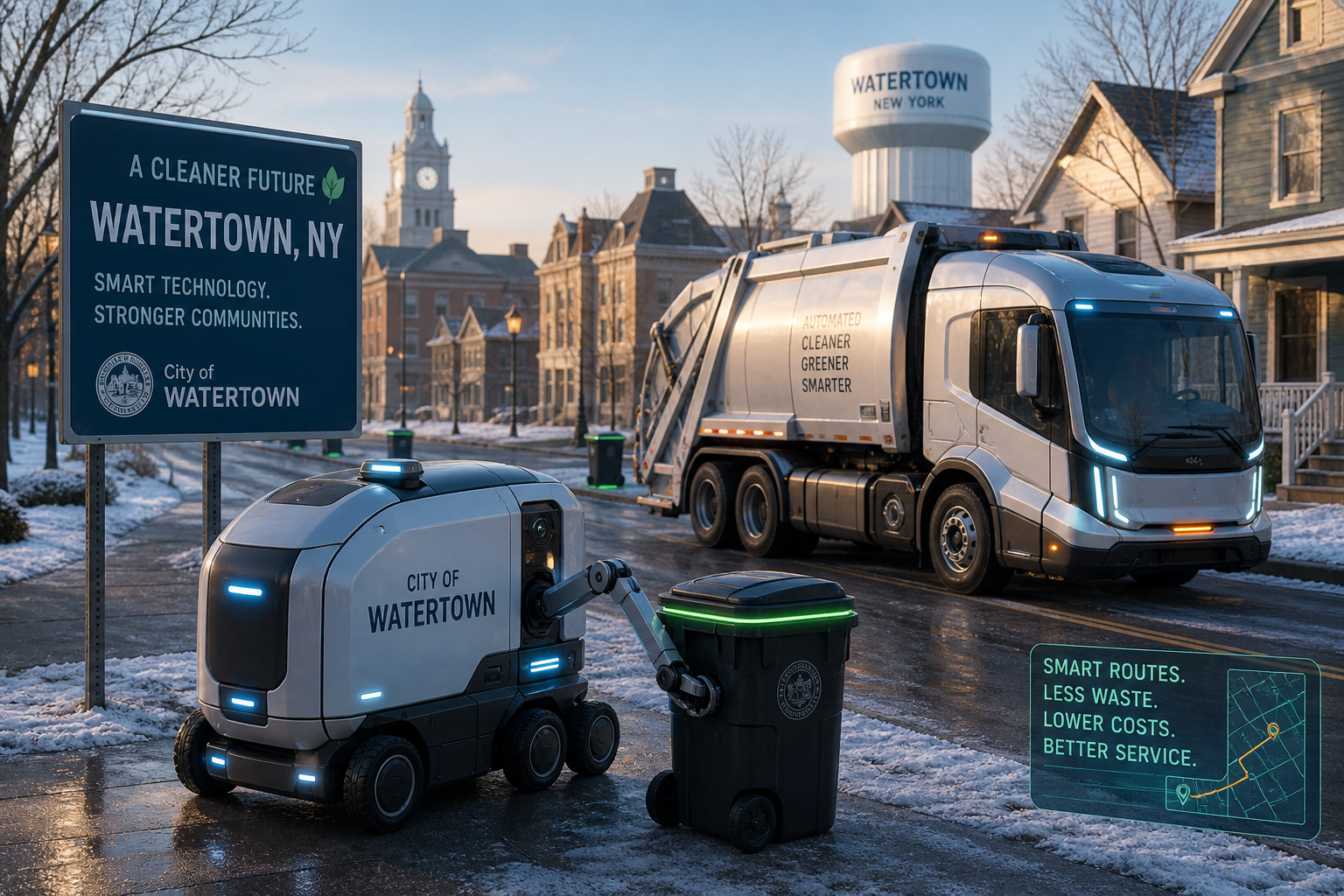
Across the country, municipalities are already using automated side-loader garbage trucks that reduce the number of workers needed per route. One operator, one mechanical arm, standardized bins — faster, cheaper, more efficient. In some cases, these systems can service close to a thousand households a day with significantly lower labor costs.
That’s not futuristic. That’s now.
Then there’s the next layer — small-scale robotic collection. Think less “Terminator” and more “electric trash mule.” Compact, battery-powered units designed to move waste from homes, apartment buildings, or dense downtown blocks to centralized pickup points. These aren’t replacing trucks — they’re feeding them.
In a city like Watertown, that matters.
You don’t need robots navigating every snow-covered side street. You deploy them where they make sense: senior housing, tight neighborhoods, downtown corridors, city-owned properties, parks. Places where consolidation saves time, fuel, and manpower.
The model builds from there.
Standardized city-issued totes with RFID or QR tracking. Smart routing software that knows exactly where pickups are needed. Neighborhood transfer points where waste is staged for larger trucks. Fewer miles driven. Fewer workers per route. More predictable costs.
And importantly — scalability.
Because if Watertown figures this out, it won’t be alone for long.
Cities across New York — places like Rome, Oswego, Massena, Plattsburgh — are facing the same pressures. Rising labor costs, aging infrastructure, and taxpayers who are done paying more for less. If one municipality cracks the code on modernized sanitation, it doesn’t just fix its own budget — it creates a template others will want.
That’s where the real opportunity is.
Watertown could go beyond simply adopting technology. It could build a system — operational standards, software integration, cold-weather performance data, labor transition models — and own it. Package it. License it. Partner with vendors. Attract state and federal innovation funding.
In other words, instead of being the city that “gave up trash pickup,” Watertown becomes the city that reinvented it.
There are hurdles, of course.
New York State regulations still require tight oversight on autonomous systems operating on public roads. Insurance requirements are steep. Testing isn’t a free-for-all. And no one’s handing over full control to robots without human supervision anytime soon.
Then there’s the local reality: winter. Snowbanks. Ice. Narrow streets. Real-world conditions that don’t care how slick a tech demo looks in California.
Which is exactly why Watertown is the perfect place to try.
If it works here, it works anywhere.
And if it doesn’t? Then at least the city tried something forward-looking instead of quietly cutting a core service while hoping no one notices.
Because people do notice.
They notice when garbage pickup disappears. They notice when costs go up. And yes — they notice when the golf course stays open.
The question isn’t whether Watertown can afford to collect trash anymore.
It’s whether it’s willing to rethink how it does it — and maybe, just maybe, turn a budget problem into something a lot bigger.
About the Author