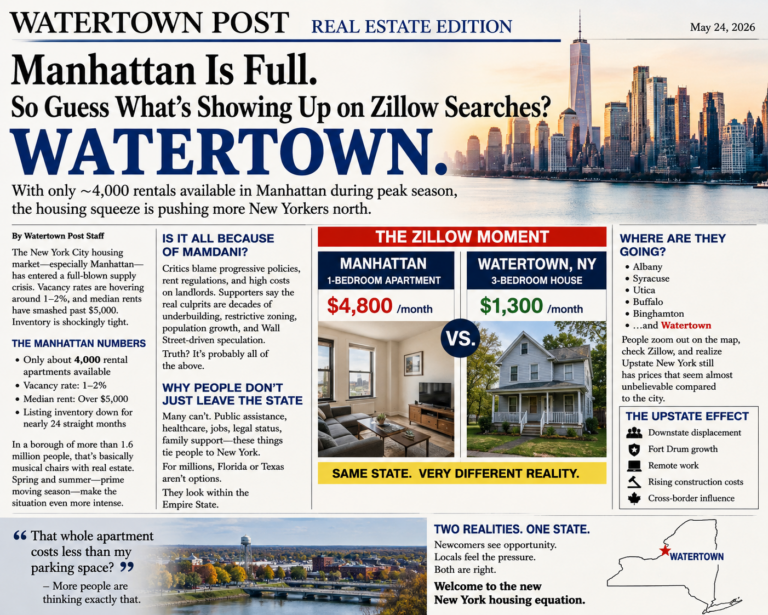

Fort Drum Can’t Save Metro Watertown Housing Forever
The interesting thing about the Watertown / Fort Drum metro is that it’s not behaving exactly like the disaster zones you’re seeing in places like Atlanta, Phoenix, or parts of Florida and Texas. The national housing market is clearly flashing warning signs — collapsing pending home sales, rising inventory, price cuts, and what is basically a nationwide buyer rebellion against 7% mortgages and absurd monthly payments. But the Watertown–Fort Drum metro sits in a weird little economic bunker compared to much of America.
The broader Watertown-Fort Drum Metropolitan Statistical Area has a population around 115,000–116,000 people, with a median household income between roughly $66,000 and $70,000 depending on the dataset. Median home values are still dramatically lower than much of New York State, generally ranging from about $188,000 to $220,000. That’s one reason the market here hasn’t completely imploded yet. Compared to places where starter homes somehow became $700,000 shoeboxes with HOA fees and insurance bills from hell, Northern New York still looks “cheap” on paper.
But here’s the catch nobody wants to talk about: “cheap” does not mean affordable anymore.
A household making $66,000 a year trying to buy a $240,000 home at today’s rates is still getting punched in the face by mortgage payments, taxes, insurance, utilities, and grocery inflation. And in the Watertown area, inventory remains weirdly constrained because many homeowners locked themselves into ultra-low 2–3% mortgages during the pandemic and now refuse to move unless absolutely necessary. So instead of a dramatic crash, you get a frozen market.
Fort Drum changes the equation even more. The base injects a constant stream of military personnel, contractors, renters, and rotating families into the region. That stabilizes demand in a way most upstate metros do not have. Even during national slowdowns, Fort Drum acts like an economic shock absorber. The military presence keeps rental demand alive and prevents total housing collapse.
But even the Fort Drum shield has limits.
Deployment cycles, inflation, higher rates, and affordability problems are starting to weigh heavily on the metro. Many military families arriving from lower-cost states are now looking at monthly payments and saying, “Yeah… no thanks.” At the same time, local civilian wages have not remotely kept pace with the price increases seen since 2020.
The data also suggests something very important: homes are increasingly selling below asking price in the Watertown-Fort Drum market. Zillow shows roughly 65% of homes selling under list price now, with homes taking over a month to go pending. That is not a roaring hot market anymore. That’s a market slowly losing leverage.
At the city level, Watertown itself remains heavily renter-based, with roughly 59% of occupied housing units renter occupied. That means a lot of people are stuck renting while watching mortgage rates and prices keep ownership just out of reach. Meanwhile, landlords who bought properties years ago at much lower prices are sitting pretty compared to first-time buyers trying to enter the market today.
And unlike giant Sun Belt boomtowns, Northern New York doesn’t have endless waves of high-income migration pouring in to permanently prop prices up. The metro depends heavily on Fort Drum, healthcare, government employment, education, and regional service jobs. If the national economy weakens hard enough, this area absolutely feels it.
So the real story in Metro Watertown–Fort Drum is not a 2008-style collapse. It’s something slower and stranger:
- Buyers pulling back
- Sellers reluctant to cut prices
- Inventory slowly rising
- Homes sitting longer
- Military demand preventing total freefall
- Local wages failing to keep pace with housing costs
- Younger buyers increasingly locked out
In other words, the market here may not crash dramatically like overheated metros, but it could grind sideways painfully for years unless rates fall or incomes rise substantially.
And that’s the dirty little secret of the modern “affordable” housing market in America: even places once considered cheap are no longer easy for normal people to buy into.
About the Author