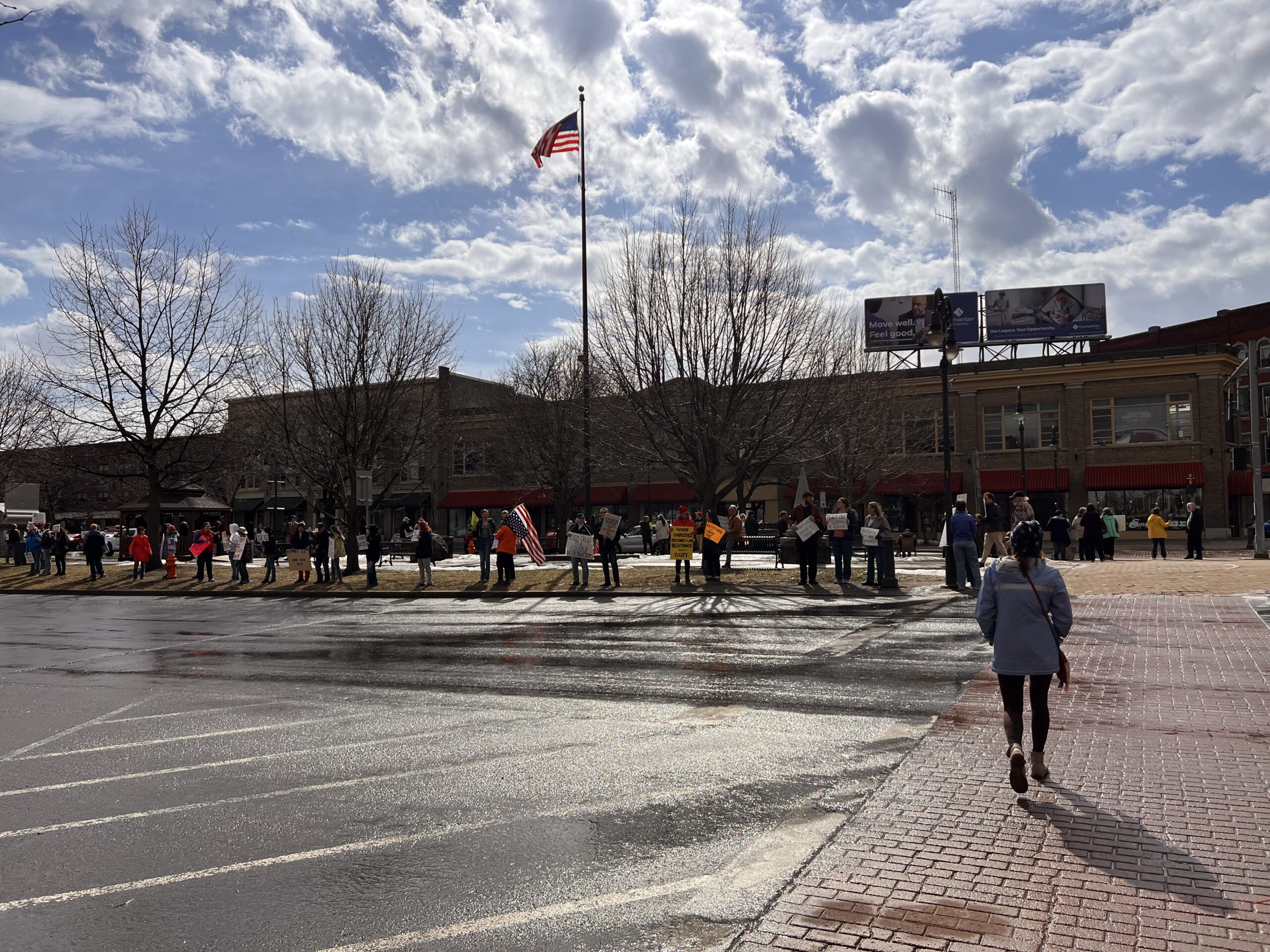
photo of Public Square protest scene with American flag visible above the crowd.
-Watertown NY By Hans Wilder
On Saturday I wandered down to Public Square in Watertown, not because I intended to write about the latest “No Kings” protest, but because curiosity still gets the better of me sometimes. I figured I’d walk around, say hello to a few familiar faces, and see what the mood of the moment looked like.
Predictably, the square was populated mostly by the same crowd we’ve come to expect — progressive activists holding signs warning that America is descending into fascism under President Donald Trump.
Now normally I wouldn’t even bother mentioning it. These demonstrations have become about as surprising as winter in the North Country.
But something interesting happened.
A couple of people I’ve known for years approached me looking genuinely stunned — not angry, not hostile — just baffled.
“How can you, of all people, not see it?” one of them asked.
You see, my name is Hans. I lived in Germany for years. I grew up around people who had actually experienced the aftermath of the Second World War. In fact, when I was a kid in the 1960s, there were still bombed-out buildings standing in some places.
Real war leaves marks.
My mother lived through the Nazi era as a child. My grandmother hid her in forests and haystacks to keep her from being captured by the regime. They were not considered the “correct” German lineage, and that meant danger — real danger.
Those stories were not political talking points.
They were survival stories.
So when someone asks me how I could possibly fail to recognize “Nazism” in modern America, I have a simple response.
“What exactly do you mean when you say fascist or Nazi?”
That’s when things get interesting.
The answer wasn’t a definition.
It wasn’t history.
It wasn’t even a coherent explanation.
Instead I got the modern political equivalent of a shrug:
“Don’t you watch the news?”
I couldn’t help but laugh a little.
Because as this conversation was happening, the protesters were standing there — peacefully, freely — holding signs under a massive American flag waving high above Public Square against a bright blue sky.
So I said something simple.
“If what you’re saying were actually true — if this country were really under fascism — you wouldn’t be standing here protesting right now.”
There was a pause.
Then came the reply, delivered with a dramatic flair that sounded uncannily like Katharine Hepburn herself:
“Well, that’s for now. Next week they probably won’t let us.”
Ah yes. The future fascism theory.
The dictatorship that always begins… next week.
The irony is almost poetic.
In actual fascist regimes, protests are not scheduled on Facebook.
In actual fascist regimes, dissent doesn’t end with everyone going home afterward for coffee.
And the American flag certainly isn’t flying proudly above the whole thing.
Then the conversation took an even stranger turn.
A mutual acquaintance happened to drive through the square. I pointed him out casually.
Before I could finish the sentence, the woman I was speaking with launched into a rant about “you men,” claiming we were all in on some kind of conspiracy together.
Apparently all men are secretly part of the same club.
I calmly pointed out that the very person she was referring to is no fan of Trump whatsoever.
That fact didn’t slow the rant down much.
But it did prove something.
The modern progressive protest movement often isn’t about definitions, history, or even policy anymore. It’s about emotion, slogans, and cable-news vocabulary that gets repeated until it loses all connection to meaning.
Words matter.
“Fascist” means something.
“Nazi” means something.
And people who grew up around the real aftermath of those regimes know the difference.
The irony of the whole afternoon was impossible to miss.
There they were warning of dictatorship — while freely protesting in the middle of an American city square under the protection of the very system they claim has already collapsed.
If that’s fascism, it’s the most relaxed dictatorship in human history.
Meanwhile the rest of the country seems to be moving forward — jobs growing, the economy stabilizing, and the political establishment finally being challenged by an outsider president who was elected to shake things up.
Call it the Golden Age, call it political disruption, call it whatever you want.
But one thing is clear.
If your argument begins and ends with “Don’t you watch the news?” — it might be time to step away from the television and read a little history instead.
About the Author