
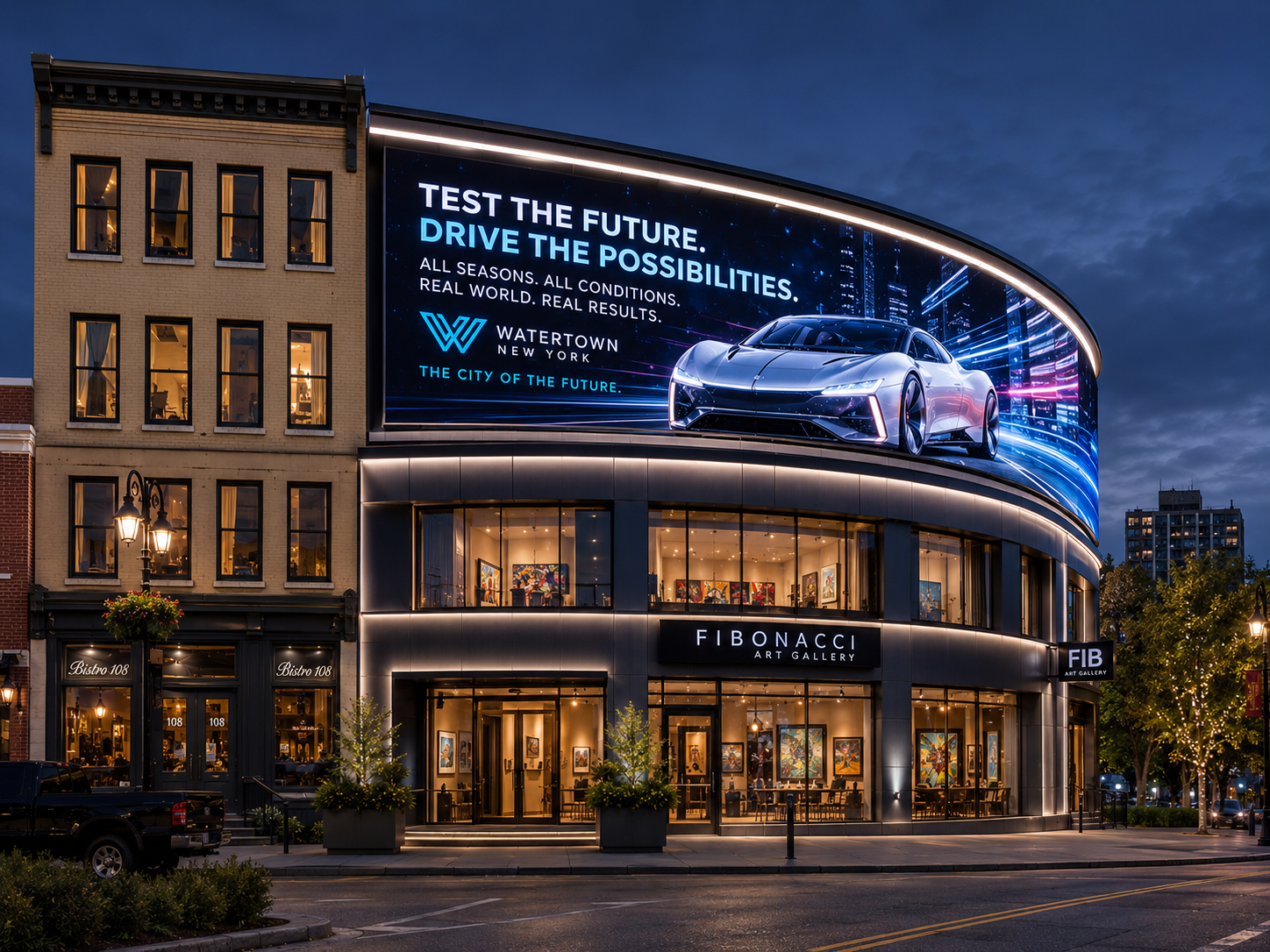
A concept visualization showing how modern curved digital billboards, underground utilities, and updated architecture could transform downtown Watertown into a visually striking “City of the Future.”
The City of the Future Must Think Like the Future Again
By Hans Wilder
Watertown, NY
For decades, the city of Watertown proudly carried the nickname “The City of the Future.” Looking around parts of the city today, that title can feel almost ironic. But beneath the empty lots, collapsing garages, abandoned buildings, tangled utility wires, and overgrown corridors, there is still something incredibly valuable here — a city with extraordinary geography, historic architecture, strategic location, and the kind of untapped potential most regions in America would love to have.
The problem is not that Watertown lacks opportunity. The problem is that Upstate New York stopped thinking boldly somewhere along the line.
A lot of people passing through Watertown probably don’t immediately notice the blight because Public Square still looks relatively good thanks to the major renovation project completed years ago. The Square remains one of the more attractive downtown centers in Northern New York. But even that can lose its flare quickly if the rest of the city continues deteriorating around it. Drive through many neighborhoods and you’ll find forgotten industrial sites, empty parcels, run-down barns, collapsing garages, houses hidden behind overgrown vegetation, and streets lined with utility wires hanging in every possible direction.
And yet, strangely enough, Watertown may actually be sitting on one of the most unique opportunities in the Northeast.
Look at the map of the city. Watertown spreads outward almost like a flower blossom from a central core. That layout matters in the modern era. Imagine a major technology company searching for a place to test autonomous vehicles or cold-weather robotics systems. Watertown and the surrounding metro region could become one of the premier real-world testing environments in the country. Here, companies would get four true seasons — snow, ice, freezing rain, dense fog, rural roads, urban intersections, hills, highways, and dramatic temperature swings. Most places in America simply do not offer that variety of conditions within one compact region.
That is not science fiction. That is geography.
And geography matters.
When people discuss Watertown, they also need to understand that the real conversation involves the greater Watertown-Fort Drum region, including Fort Drum, the town of LeRay, the Thousand Islands region, and the broader North Country economy. The area sits within striking distance of New York City, Toronto, and Montreal — a geographic trifecta that many cities would envy. Add in a manageable airport, rail infrastructure, one of the most important military installations in America, and access to some of the largest freshwater systems on Earth, and suddenly Watertown starts looking less like a forgotten upstate city and more like an underutilized strategic asset.
But first, the city needs to start looking like it believes in itself again.
One of the biggest visual problems in Watertown is impossible to ignore: the utility wires. They hang across nearly every major corridor, dangle in front of historic homes, slice through skyline photography, and visually overwhelm many of the city’s best architectural features. And that is particularly tragic because Watertown still possesses an extraordinary collection of homes and buildings from the late 1800s and early 1900s — architecture that has already disappeared in many other American cities.
Watertown still has much of it.
It is simply buried beneath clutter.
If utility lines were gradually moved underground over time, the transformation of the city would be dramatic. Imagine Arsenal Street without overhead wires. Imagine historic neighborhoods fully visible. Imagine clean sightlines, illuminated storefronts, modern signage, and winter photography without cables hanging through every frame. In the social media era, cities that look unique attract attention. People increasingly travel to places that are visually distinctive. Watertown has the raw ingredients to become one of the most photogenic small cities in the Northeast if it chose to prioritize aesthetics and presentation.
The city also desperately needs stronger zoning enforcement and better maintenance standards. Some of the overgrowth throughout Watertown has reached the point where it actively harms the appearance of entire corridors. Drive down sections of City Center Drive and you’ll immediately notice how trees and vegetation often overwhelm the streetscape itself. Trees are important, but so is visibility. If those corridors were selectively thinned and landscaped properly, many of them would become attractive urban drives instead of looking neglected and visually crowded.
These details matter more than people realize.
A city’s atmosphere is built from thousands of little impressions.
Right now, too many parts of Watertown project exhaustion instead of momentum.
Arsenal Street alone could become one of the most visually impressive commercial corridors in Upstate New York. Imagine coordinated architectural lighting, modern boutique signage, underground utilities, landscaped medians, cleaner sidewalks, and consistent development standards. Instead, portions of it often feel visually trapped between different decades all fighting each other at once. Even some of the signage still feels stuck in the 1970s. Meanwhile, modern sign technology has become far more elegant and visually appealing.
Even the giant billboard on Court Street overlooking Public Square could become something iconic if upgraded into a modern curved high-definition display integrated properly into the downtown aesthetic. Why not think bigger? Why does every conversation about development in Upstate New York immediately collapse into bureaucracy, hesitation, and red tape?
And yes, Albany deserves some blame.
Many communities across Upstate New York feel trapped under layers of regulation and political paralysis that make large-scale transformation feel almost impossible. But if Watertown ever wants to truly reinvent itself, it cannot continue operating with a survival mentality.
Meanwhile, across the river in Kingston, construction cranes are swinging through the skyline. New buildings are rising. Streets are manicured. Corridors are maintained. The city presents itself professionally. Canada has major economic problems right now too, but visually, Kingston understands something that many Upstate cities forgot long ago: presentation matters.
Perception drives investment.
And investment drives momentum.
Even something as simple as grocery stores contributes to the atmosphere of a city. Some of the stores around Watertown honestly feel frozen in another era. Walking into one off Eastern Boulevard recently felt eerily similar to walking through Soviet-era grocery stores in the 1980s — fluorescent lighting, aging interiors, and an overall feeling of economic fatigue hanging in the air. And yes, some people around here actually remember seeing the USSR firsthand back then. To be fair, the beef prices were pretty good. But the larger point remains the same.
Cities communicate with people psychologically whether they realize it or not.
Every abandoned building communicates something.
Every overgrown lot communicates something.
Every dangling utility wire communicates something.
The good news is that Watertown’s problems are still fixable. The bones of the city remain strong. The river is still here. The architecture is still here. The geography is still here. Fort Drum is still here. The seasons are still here. The location between major North American population centers is still here.
The potential absolutely still exists.
But if Watertown truly wants to become “The City of the Future” again, then it has to stop thinking like a city trying to merely survive and start thinking like a city preparing to matter again.
About the Author