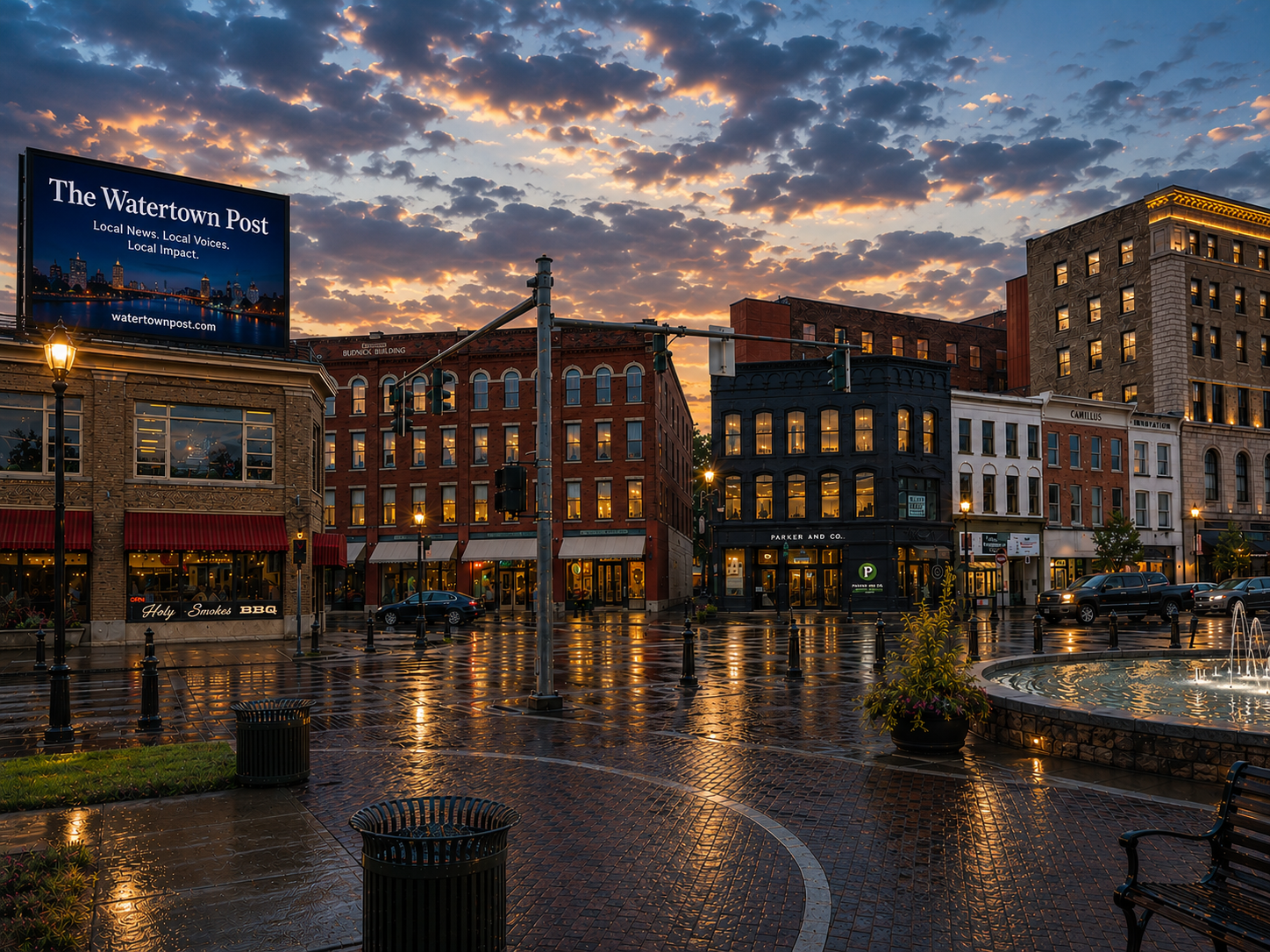
A conceptual rendering of Watertown's Public Square shows how the city's historic architecture could be preserved while introducing modern digital infrastructure, enhanced lighting, improved streetscapes, and strategic technology-focused investment. The vision emphasizes economic growth, business attraction, and downtown revitalization while maintaining the character that makes Watertown unique.
-Watertown NY By Hans Wilder
Stand in Public Square for a few minutes and really look around.
Ignore the traffic. Ignore the politics. Ignore the endless debates that seem to consume every local government meeting. Just look at the city itself.
What you’ll see is something most communities would love to have.
You’ll see historic buildings that still have good bones. You’ll see a downtown that remains intact when many cities lost theirs decades ago. You’ll see streets that radiate outward from a central core in a pattern that is surprisingly rare in America. From the air, Watertown looks almost like a flower, with downtown at its center and neighborhoods spreading outward in every direction.
In other words, the foundation is already here.
The problem is that for years we have been having the wrong conversation.
Every few years somebody proposes another project that is supposed to save the city. A water park. A swimming complex. A Mega-Zoo. Some new attraction that sounds great during a press conference and produces impressive renderings for social media.
But attractions don’t create wealth.
They consume wealth.
That doesn’t mean they are bad ideas. It simply means they come later.
Before you build amenities, you need a strong tax base. Before you build attractions, you need businesses. Before you build recreation projects, you need investment.
A city cannot spend its way into prosperity.
It has to grow its way there.
The question Watertown should be asking is not what attraction should be built next. The question should be how to become the technology and innovation capital of Northern New York and then be able to afford those things.
Fort Drum already brings some of the most highly trained people in the country into our backyard. Communications specialists, cybersecurity experts, engineers, logistics professionals, drone operators and technology experts cycle through this region every year. Many leave because there are limited opportunities waiting for them downtown.
Why?
Why are we not converting historic buildings into startup offices, technology incubators and engineering firms? Why are we not filling vacant upper floors with modern apartments designed for young professionals? Why are we not actively recruiting software companies, artificial intelligence firms, defense contractors and advanced manufacturing businesses?
These are the industries that create jobs.
These are the industries that expand tax bases.
These are the industries that create the wealth necessary to support everything else.
At the same time, Watertown needs to start taking appearance more seriously.
People often dismiss beautification as something cosmetic. It isn’t.
It is economic development.
Investors notice things. Business owners notice things. Families considering a move notice things.
They notice weeds growing through sidewalks. They notice neglected properties. They notice corridors that appear forgotten. They notice when public spaces look maintained and when they don’t.
The Black River Parkway should be one of the crown jewels of Northern New York. Instead of allowing it to become overgrown and forgotten in places, the city should be treating it like a front yard. Improved landscaping, better sightlines, decorative lighting and consistent maintenance would dramatically change the way people experience one of Watertown’s coolest roads.
The same principle applies to our utility infrastructure.
Look up.
In many parts of the city, the sky is hidden behind a maze of poles, cables and wires accumulated over decades. Some of those lines are active. Many are not.
If Watertown is serious about attracting technology companies and modern investment, then it needs to begin conversations with National Grid about a long-term strategy to move utilities underground in key redevelopment corridors. Cities across America have done it. It isn’t cheap, but there are ways to structure partnerships and long-term plans that do not simply dump the entire burden onto local taxpayers.
Likewise, cable and telecommunications companies should be required to remove abandoned infrastructure that no longer serves customers. There is no reason disconnected lines should remain hanging from poles and homes year after year. If a wire isn’t being used, it should come down. If equipment has been abandoned, it should be removed.
That isn’t anti-business.
It’s common sense.
A city trying to attract twenty-first century industries should not look like a museum of twentieth century utility practices.
These may sound like small things, but small things are often what separate successful cities from struggling ones.
People invest where they see momentum.
People invest where they see confidence.
People invest where they believe local leaders have a vision for the future.
And that’s where both political parties have fallen short.
Too often Democrats focus on projects that spend money before the economic foundation exists to support them. Too often Republicans settle for managing the city’s decline rather than pursuing transformative growth.
Neither approach leads to a Golden Age.
A Golden Age begins with investment. It begins with rebuilding downtown. It begins with modern infrastructure. It begins with attracting businesses, restoring buildings and growing the tax base.
The amenities come later.
The attractions come later.
The rewards come later.
First you create wealth.
Then you enjoy the benefits that wealth creates.
The encouraging part is that Watertown already possesses nearly everything it needs. It has a strategic location. It has Fort Drum. It has historic architecture. It has a hardworking population. It has available real estate. It has a downtown that most cities would envy.
What it lacks is not potential.
What it lacks is the confidence to think bigger.
The future of Watertown will not be determined by the next attraction.
It will be determined by whether city leaders are willing to build a city where innovators, entrepreneurs, investors and businesses want to be.
If they do that, the rest will take care of itself.
That’s how cities grow.
That’s how cities prosper.
And that’s how Watertown enters its Golden Age.
About the Author