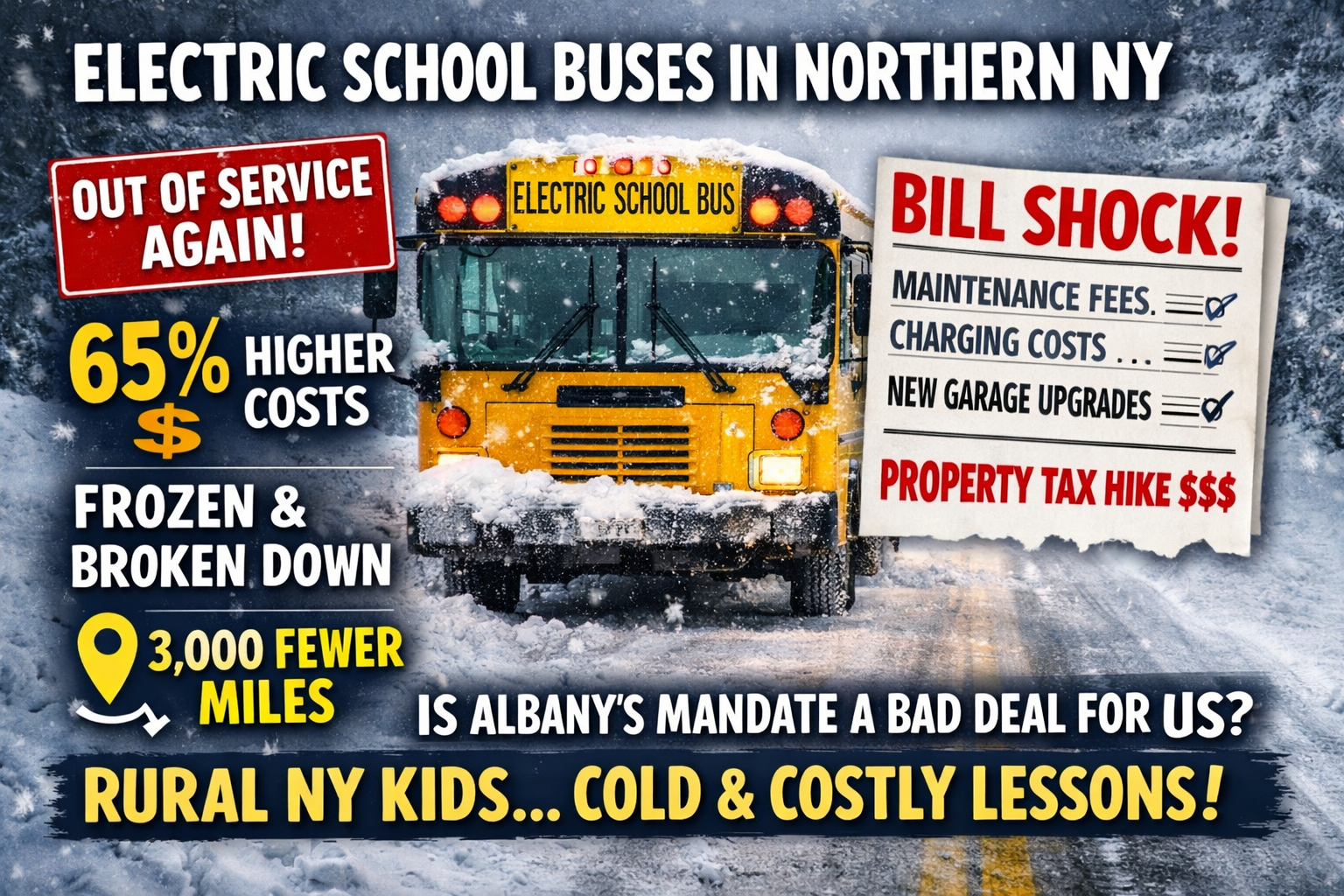
A snow-covered school bus highlights concerns about rising costs, cold-weather reliability, and rural impact under New York’s electric bus mandate.
By Watertown Post Staff
In a development that should get the attention of every taxpayer, parent, and candidate running in Northern New York, the superintendent of the Alexandria Central School District is urging New York State to reconsider its aggressive electric school bus mandate.
And this isn’t theoretical. It’s happening in our backyard.
According to reporting from WWNY-TV, Alexandria Bay school officials say their experience with electric buses has been costly, unreliable, and operationally difficult — particularly in a rural district where long routes, cold winters, and tight budgets are simply part of life.
The Local Reality
New York State’s mandate requires:
- All new school bus purchases to be zero-emission by 2027
- All school bus fleets to be fully electric by 2035
On paper, it’s a climate-forward initiative.
On the ground in Jefferson County? It’s a logistical and financial stress test.
The superintendent reports:
- Electric buses costing significantly more per mile to operate than diesel
- Reduced mileage performance
- Extended downtime due to mechanical and electrical issues
- Infrastructure upgrades still needed for charging and maintenance
This isn’t Manhattan. This isn’t Yonkers. This is the North Country — where sub-zero mornings, 40-mile rural routes, and limited tax bases define reality.
When half a fleet is sidelined for weeks at a time, that’s not an environmental debate. That’s a transportation reliability issue.
Why This Matters Politically in NY-21
The 21st Congressional District — currently represented by Elise Stefanik — stretches across vast rural territory: farms, small towns, military communities, and school districts that operate on thin margins.
If you’re the Republican candidate for NY-21 this cycle, this issue is tailor-made for engagement:
- It’s rural.
- It’s about mandates from Albany.
- It affects property taxes.
- It impacts Fort Drum families.
- It touches infrastructure, energy policy, and fiscal responsibility.
- It resonates across Jefferson, St. Lawrence, Lewis, Franklin, and Clinton counties.
Northern New York voters are not anti-innovation. But they are practical.
A serious candidate could frame this as:
- A call for flexibility for rural districts
- A push for realistic timelines
- A demand for full infrastructure funding before mandates
- A defense of local decision-making
That’s not culture war rhetoric. That’s governance.
The Broader Question
Can a one-size-fits-all climate mandate work equally in:
- Brooklyn?
- Buffalo?
- Alexandria Bay?
The North Country has unique geographic, economic, and climate realities. Policies designed for dense urban corridors don’t always scale well to sparsely populated rural districts where bus routes can exceed 100 miles per day in winter conditions.
This isn’t about rejecting cleaner technology outright. It’s about sequencing. Funding. Infrastructure. And timing.
If electric buses are the future, then rural districts need:
- Proven cold-weather performance
- Reliable maintenance pipelines
- Financial guarantees that local taxpayers won’t absorb overruns
- Charging infrastructure grants that fully cover upgrades
Otherwise, this becomes another case of Albany policy colliding with North Country reality.
The Political Opening
NY-21 candidates who ignore this do so at their own risk.
School buses are not abstract policy vehicles. They carry kids. They reflect budgets. They hit property tax bills directly.
In a district where margins are often razor thin, practical concerns win elections.
The Republican candidate who walks into town halls across the district and says:
“We support innovation — but we will not let rural districts be testing grounds for policies that aren’t ready.”
…will find an audience.
This is one of those issues that crosses party lines among parents and taxpayers.
The North Country doesn’t need slogans. It needs workable solutions.
And this one is sitting in plain sight.
About the Author