Why Local Independent News Sites Are About to Matter More Than Ever
For more than two decades, the internet worked like this: you typed a few words into Google, clicked through ten blue links, ignored the first three because they were ads pretending not to be ads, and eventually found what you were looking for—usually after being ambushed by cookie popups and a request to subscribe for $1 a week “for quality journalism.”
That era is ending.
Artificial intelligence has changed search so dramatically that the old model is beginning to look like a fax machine in a smartphone store.
People are no longer just “searching.” They are asking. They are having conversations with systems like OpenAI’s ChatGPT, Anthropic’s Claude, xAI’s Grok, and whatever Silicon Valley names next after a Norse god or science-fiction villain.
Instead of typing “best Italian restaurant Watertown NY,” people now ask, “Where should I take my wife for dinner tonight if I want something quiet and good pasta?”
That is not search.
That is information retrieval with context.
And it changes everything.
The biggest shift may not be national politics or celebrity gossip. It may be local news.
For decades, local information was controlled by legacy media outlets—newspapers with shrinking staffs, rising subscription costs, and websites often designed like they were built during the George W. Bush administration. Much of that information now sits behind paywalls, inaccessible not only to readers who refuse to pay $14.99 a month to learn why a squirrel delayed a zoning board meeting, but also inaccessible to AI systems.
Artificial intelligence does not casually stroll past paywalls like it owns the place. If the information is locked up, it often stays locked up.
That creates a massive opening.
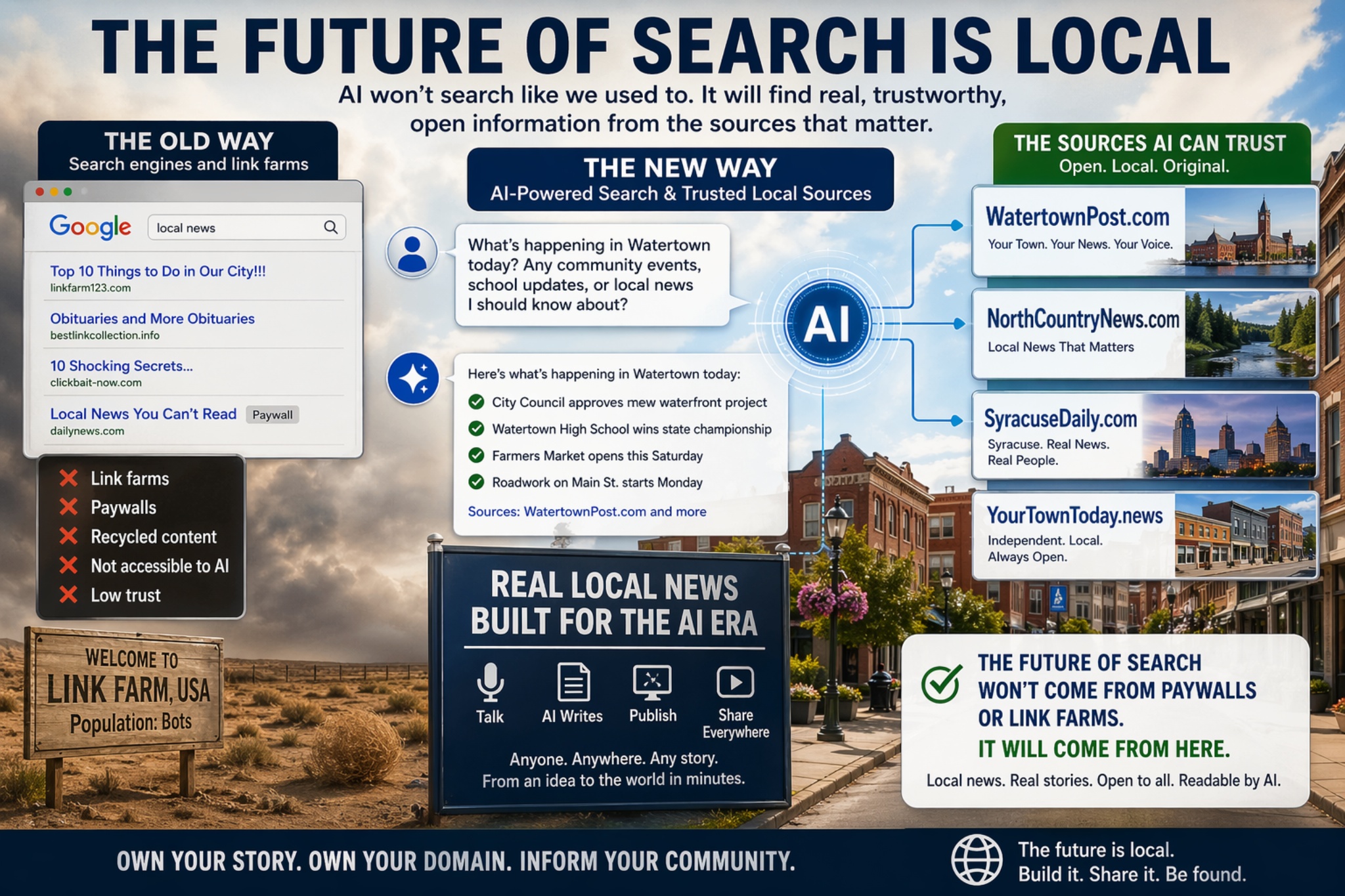
Across the country, independent publishers are quietly buying up strong local domain names—clean, memorable, authoritative names like WatertownPost.com, SyracuseDaily.com, NorthCountryNews.com, and thousands more. They are building modern local media platforms without the baggage of old corporate newsrooms.
These sites are fast, searchable, open, and built for the AI era.
They are not waiting for permission.
Since the invention of the printing press, publishing required gatekeepers—editors, presses, delivery trucks, and enough coffee to kill a horse. Today, someone can stand on a sidewalk, speak a news story into their phone, and an AI system can turn it into a readable article, a short-form social media post, a radio-style audio segment, a video script, or even a fully AI-generated news anchor presentation.
That is not science fiction. That is Tuesday.
The barrier to entry for publishing has collapsed.
And because these new independent local sites are open-access, AI systems can actually read them, understand them, summarize them, and use them as part of future search results.
That matters.
Because the future of search will not be built on link farms—the digital junkyards full of obituaries, scraped headlines, and fifty links to stories written by someone else. Every town has one. You know the one. It exists primarily to harvest clicks like a raccoon digging through garbage.
Those sites are not information sources. They are traffic traps.
AI does not need link farms. It needs original reporting, direct information, local context, and actual human observation.
It needs someone who knows why that road project matters, who was really at that city council meeting, why the school board argument exploded, and why everyone on one particular street is suddenly furious about geese.
That information comes from local publishers who live there.
The future search engine is not a search engine at all.
It is a conversation.
And the sources feeding that conversation will increasingly be the independent local news sites being built right now by people who understand their communities better than any corporate newsroom two states away.
Legacy media may still have the printing presses.
But the future belongs to whoever owns the facts—and the domain name.
In the age of AI, visibility is everything.
And if your town’s story is going to be told, it better not be hiding behind a paywall while some link farm in another county farms your obituary traffic like it’s 2009.
The next generation of search is already here.
It is local.
It is direct.
And it probably has a better domain name.
About the Author