
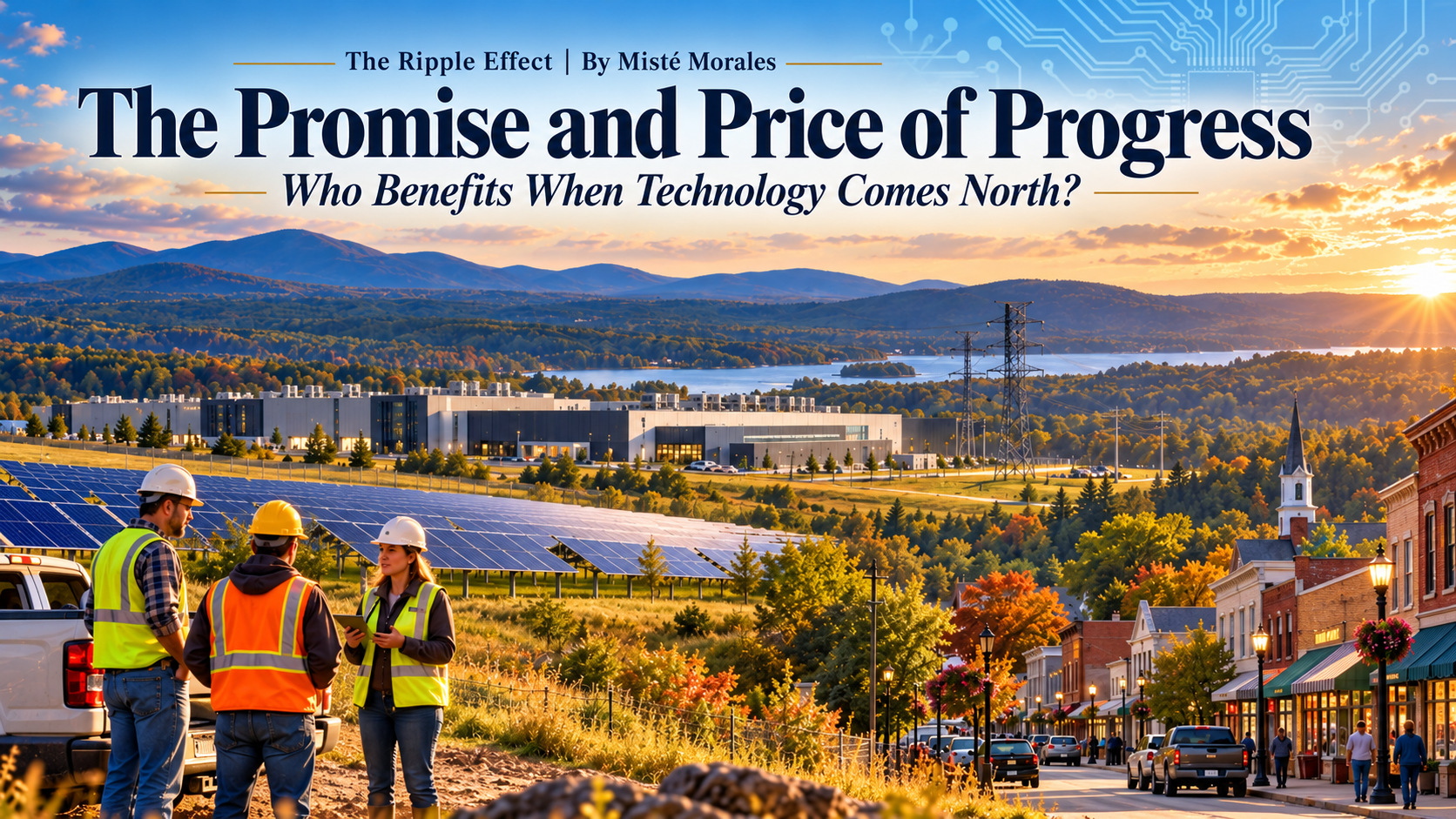
AI-generated editorial illustration by Misté Morales.
The Ripple Effect | By Misté Morales
For a homeowner in Jefferson County, technological progress may mean the prospect of solar panels changing a familiar landscape. For a construction worker in Massena, it may mean an opportunity to work closer to home.
Both are looking at the same wave of technological development reaching Northern New York, yet they see different possibilities for the region's future.
From solar farms and data centers to semiconductor manufacturing and artificial intelligence, investments across upstate New York are generating excitement, concern and questions about what these developments will mean for the people already living here.
Will they create lasting jobs and strengthen existing businesses? Or could the environmental and financial costs outweigh the promised benefits?
The answers may be more complicated than either side expects.
A Region on the Edge of Change
In Jefferson County, the proposed 140-megawatt Greens Corners Solar project would bring large-scale solar development to agricultural land in the towns of Hounsfield and Watertown.
According to AES, a company associated with the project, construction could create more than 100 jobs at peak activity, although only two or three permanent positions are anticipated once the facility is operating.
In neighboring St. Lawrence County, the New York Power Authority has announced its involvement in the 240-megawatt Rich Road Solar project in Canton. The authority projects more than 250 union construction jobs, along with future electricity-bill credits for eligible low-income customers.
Meanwhile, North Country Colocation Services is proposing a major expansion of its existing computing operations in Massena. The approximately 635-megawatt data center proposal could bring an estimated 2,000 construction jobs over a phased buildout and approximately 200 full-time positions, including employment associated with its existing operations.
Residents in LeRay have also debated potential data center development, raising questions about electricity, water resources and local zoning, according to WWNY.
Beyond the North Country, Micron Technology's semiconductor manufacturing project in Clay, Onondaga County, is moving through construction. Reports have also described preliminary discussions involving another potential chipmaking facility near Utica, although no finalized agreement has been announced.
These developments represent different industries, but their potential effects extend beyond the facilities themselves.
What Do Residents Stand to Lose?
For some Northern New Yorkers, economic opportunity does not erase concerns about the environment, neighboring properties or the character of their communities.
One example comes from Trisha Wattie Lapell, a Jefferson County resident who shared her concerns during a discussion in the Facebook group North Country Speaks Out.
"We are going to lose this beautiful area we have called home," Lapell wrote.
Her comments addressed the potential cumulative effects of solar farms, wind turbines and data centers, including concerns about soil disturbance, wildlife habitat and neighboring property values.
Lapell's perspective is one example of the concerns being expressed by residents who fear that development could permanently change the places they call home.
Those concerns are not without scientific context.
A 2025 study published in the Proceedings of the National Academy of Sciences found that residential properties within three miles of large solar facilities experienced an average estimated decline in value of 4.8% relative to comparison properties farther away. The study also found increased values for nearby agricultural and vacant land.
Those findings do not mean every home near a solar farm will lose value, nor do they establish what will happen around Greens Corners. They do, however, demonstrate why property-value questions deserve examination.
Environmental concerns extend to data centers.
In October, the Saint Regis Mohawk Tribal Council formally opposed hyperscale data center development on or near the southern portion of Akwesasne. Its concerns included electricity consumption, water resources, air quality, noise and potential effects on cultural resources.
A national report published in June by Lawrence Berkeley National Laboratory estimated that data centers accounted for 4.7% of U.S. electricity consumption in 2024. Its reference-case projection suggests that figure could reach 11.8% by 2030.
That growth is substantial, although national projections do not tell us precisely how individual North Country projects would affect local electricity bills.
The Massena developer says its revised plan includes a sealed, closed-loop cooling system designed to avoid withdrawals from nearby rivers. It has also pledged to fund roughly $75 million in electrical infrastructure improvements and address attributable increases in local power costs.
Those commitments provide a response to community concerns. Whether they adequately address the potential impacts must be established through environmental review, engineering assessments and enforceable agreements.
The question is not simply whether a company promises to minimize harm, but whether the evidence supports those promises.
Others See an Opportunity Worth Considering
Not everyone views technological development primarily through its environmental consequences.
Others see the possibility of revitalizing communities that have experienced industrial decline, limited employment opportunities and the departure of younger workers seeking careers elsewhere.
During a September discussion about the proposed Massena data center, electrical workers' union member Travis Flint told North Country Public Radio that construction workers often travel between projects to earn a living.
"It would be nice if we could do it in our own town for once," Flint said.
His statement reflects another important issue facing the region: the desire for meaningful employment without having to leave Northern New York.
Large development projects can create work for electricians, equipment operators, engineers, technicians and construction crews. However, the economic impact does not necessarily end with the workers hired directly.
Consider what happens when a regional construction contractor receives a major project.
That company may purchase materials from nearby suppliers, hire additional workers, contract with transportation businesses and use local equipment services. Workers may spend money at restaurants, hotels, grocery stores and other establishments.
In economic terms, these are direct, indirect and induced effects. For existing businesses, they can represent opportunities to gain customers and expand operations.
And we already have evidence of this occurring in upstate New York.
In July, Micron reported directing approximately $675 million to New York-based contractors, suppliers and subcontractors during the early construction stages of its semiconductor project.
Those businesses included companies from Syracuse, Rome, Rochester, Watertown, Buffalo, Binghamton and other communities.
Although the figures come from Micron itself, they describe work already awarded rather than employment projections alone.
The example illustrates how a major investment in one region can create opportunities for businesses elsewhere in the state.
Northern New York also has an existing industrial foundation upon which to build.
In Plattsburgh, the North American Center of Excellence for Transportation Equipment supports a regional network of more than 50 transportation and aerospace manufacturers.
Those companies represent established manufacturing expertise that could potentially connect with additional technology-related supply chains.
New development does not necessarily require creating an entirely new business community. It may also provide opportunities for industries already here.
Turning Investments Into Lasting Careers
There is, however, a difference between temporary economic activity and lasting prosperity.
Construction projects eventually end.
That distinction is particularly visible at Greens Corners Solar, where more than 100 construction jobs are projected but only two or three permanent operating positions are anticipated.
A data center may offer additional permanent technical careers, but the number of jobs created should still be examined rather than assumed.
An August analysis by the Brookings Institution found that counties receiving their first large data center typically gained approximately 100 to 200 jobs, depending on facility type. Researchers did not find an overall increase in wages.
The findings support the possibility of local employment growth while challenging the assumption that a large technology investment necessarily transforms an entire labor market.
For Northern New York, this raises another question: How can residents prepare for the jobs that do become available?
One development is already underway.
Jefferson Community College received $750,000 from Micron to develop semiconductor and advanced-manufacturing education. The college has also introduced a semiconductor boot camp designed to build practical technical skills.
These programs represent connections between education and regional economic development.
But workforce preparation must extend beyond a single institution or county.
Opportunities involving manufacturing, energy, computing and automation could benefit residents throughout Northern New York if training, recruitment and business partnerships reach the communities positioned to participate.
What About the Businesses Already Here?
Technology's economic impact is not limited to constructing industrial facilities.
It can also change how existing businesses operate.
A dairy producer might use automated monitoring systems to manage equipment and production. A small retailer could expand through online sales. A tourism business could use digital reservation systems, while a local contractor might use software to manage scheduling, expenses and customer communications.
Artificial intelligence introduces additional possibilities, although its long-term employment effects remain uncertain.
An October analysis from the Federal Reserve Bank of New York found that small businesses using AI were more optimistic about future employment and revenue growth than those not using it.
The findings reflect expectations, not guaranteed job creation. Nevertheless, they suggest that the economic discussion should include technology adoption by businesses already operating in our communities.
The benefits are not automatic.
Training costs, access to reliable internet, cybersecurity risks and changing workforce requirements can all present obstacles.
The question becomes whether Northern New York businesses will have the resources and knowledge to take advantage of these changes.
My Perspective: Progress Should Benefit the People Already Here
I see considerable potential in technological advancement, particularly in its ability to generate employment, strengthen existing businesses and create opportunities for people who want to build their futures in Northern New York.
But recognizing that potential does not mean every proposed development deserves unquestioned support.
The concerns residents raise about water, farmland, electricity costs, wildlife and property values are important. They should be examined seriously, not dismissed as resistance to progress.
At the same time, concerns about development should not prevent us from investigating what new industries might offer workers, students, entrepreneurs and small businesses.
I believe the discussion becomes more productive when we move beyond automatically supporting or opposing a project and begin asking what it will actually deliver.
Will regional workers have access to the jobs being promised? Will existing businesses have opportunities to compete for contracts? Will local educational institutions receive support to prepare the workforce?
And just as importantly, who will bear the infrastructure costs? How will natural resources be protected? What guarantees will communities receive if a company's projections do not materialize?
These are not questions that stand in opposition to technological advancement. They are questions that help determine whether its benefits are real, measurable and sustainable.
I am interested in a future where Northern New York can participate in emerging industries while continuing to value the agricultural communities, natural resources, local businesses and traditions that make the region distinctive.
The two possibilities do not have to be treated as mutually exclusive. But achieving both requires more than promises.
The Ripple Effect
Technological change rarely stops at the boundaries of the facility where it begins.
Its effects can extend into classrooms preparing the next generation of workers, farms adopting new equipment, businesses competing for contracts and homes where residents are watching their communities change.
Some effects may bring welcome opportunities. Others may introduce costs or consequences that deserve closer scrutiny.
The challenge for Northern New York is not simply deciding whether technological advancement should occur.
It is understanding what that advancement means, demanding credible answers and ensuring that the communities affected have a meaningful place in the conversation.
Because progress should not be measured solely by the size of an investment or the sophistication of the technology being introduced.
It should also be measured by what that investment leaves behind for the people who call this region home.
That is the ripple effect worth examining.
About the Author