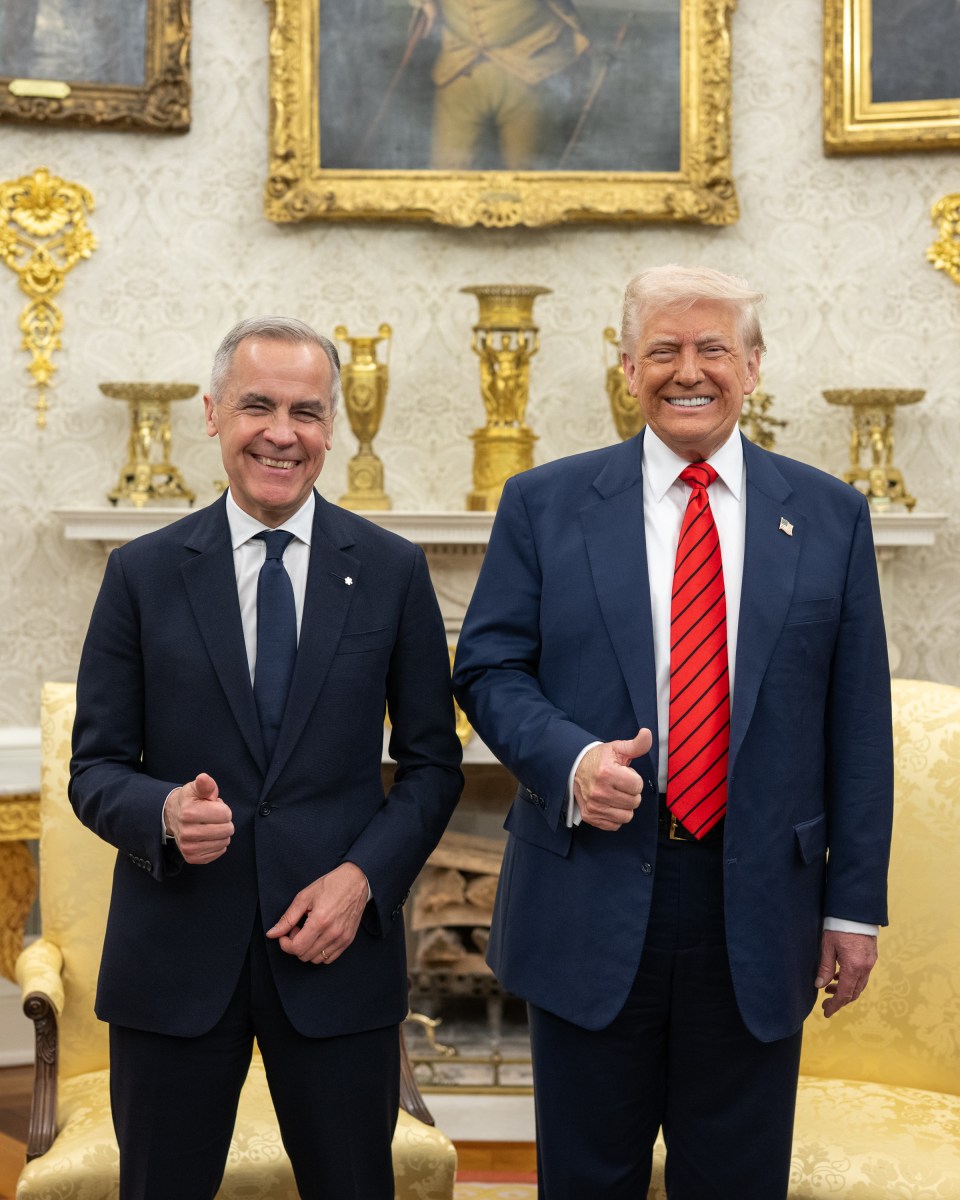
Canadian Prime Minister Mark Carney and U.S. President Donald Trump in the Oval Office on May 6, 2025. Official White House photo by Daniel Torok.
By Hans Wilder | Watertown Post
Opinion | Sackets Harbor, New York | October 16, 2026
What if Mark Carney has been playing the straight man in Donald Trump’s greatest continental production? Before anybody summons the Royal Canadian Mounted Fact-Checkers, this is a political thought experiment. I have no evidence of a secret arrangement between the two men. But watching their performance, one begins to wonder whether the apparent antagonists might ultimately accomplish something neither could have sold to the public by simply announcing it: a much more united North America.
Writing from Sackets Harbor, where the War of 1812 left this continent’s quarrels etched into the local landscape, I find the spectacle especially rich: the frontier has traded its cannon for tariff schedules, but it has lost none of its theatrical possibilities.
Trump supplies the pressure. Carney supplies the patriotic palaver. The audience boos the American, applauds the Canadian, and meanwhile the old assumptions about how this continent operates are being hauled out of the drawing room like furniture nobody wants to admit has woodworm. If the eventual destination is greater continental integration, this would be one devilishly elaborate way of getting there. Diabolically brilliant, even.
Carney provided another scene at Calgary’s Forever Canadian rally on October 15. Discussing reduced dependence on the United States, he joked about Americans being “a little touchy down there at the moment.” The crowd had its laugh. Fair enough. Political theatre requires an audience, and nothing warms a Canadian gathering quite like discovering that the Americans might be annoyed. The rally and remarks were real. What those performances ultimately accomplish is the more interesting question.
Here is where the casting becomes delicious. Carney is hardly some bewildered woodsman encountering American capitalism for the first time. He was chair of Brookfield Asset Management when the company announced its head-office change to New York in October 2024. The stated rationale involved broader equity-index inclusion. He resigned in January 2025, and the separate Brookfield Corporation remains headquartered in Toronto. Nevertheless, the New York decision makes a useful point: the financial world Carney inhabited understood America’s attractions perfectly well before patriotic speeches required a more complicated explanation.
Money, unlike a rally crowd, seldom applauds an expensive inconvenience merely because somebody wraps it in a flag. Capital studies access, scale, opportunity and returns. Carney knows that language. Trump knows it too, although he tends to deliver the translation through a bullhorn. Perhaps their public quarrel conceals no cooperation whatsoever. Perhaps the more amusing possibility is that their competing manoeuvres could drive the continent toward the same destination without either man sharing a single secret handshake.
Then comes Europe, entering from stage left with a communiqué and excellent table manners. Carney has proposed deeper Canadian-European ties. My objection is not that trade across the Atlantic is imaginary. It is that an additional customer is being asked to perform the role of a replacement neighbourhood. Brussels cannot move itself beside Alberta. A European handshake does not shorten a shipping route. The Atlantic remains a magnificent ocean and a thoroughly inconvenient driveway.
That is why I see Trump’s pressure as more than another passing tariff squabble. In my view, it forces a reckoning with realities that comfortable political arrangements have allowed people to postpone. Canada has alternatives, but alternatives have costs. The question is whether those costs eventually make a larger continental bargain look less like surrender and more like common sense. A banker might understand that reckoning long before he can persuade a cheering crowd to welcome it.
Imagine, then, the stratagem in our little frontier comedy: Carney gives Canadians the defiant speeches, explores the distant exits, and gradually discovers that the most consequential door remains the enormous one immediately to the south. He could then present closer integration as a hard-won bargain rather than an American demand. Trump would declare victory. Carney would declare that he had secured better terms. Every statesman would locate a suitable balcony. The accountants might finally get some peace.
The Watertown Post’s position is straightforward. I believe North American unification offers a greater future for the continent: stronger common defence, fewer barriers to enterprise, and more opportunity to build rather than endlessly administer our differences. That is the Golden Age proposition. It does not require Canadians to forget who they are. A Maple Leaf on the front porch could remain a declaration of heritage. Flags can outlive political arrangements, as Confederate flags in parts of the American South demonstrate, although the histories and meanings are plainly different. Nostalgia does not disappear because a constitutional map changes.
So, has Carney been working for Trump all along? There is no evidence establishing that. But as a mischievous explanation for a continental drama full of bluster, calculation and wounded pride, it has a certain magnificent audacity. If the outcome eventually brings Canadians and Americans into a stronger political and economic union, history may have difficulty distinguishing an accidental convergence from an elaborate masterstroke. Trump will say he planned it. Carney will say he negotiated it. And I will be standing here asking whether we have just witnessed the longest merger presentation in human history.
About the Author