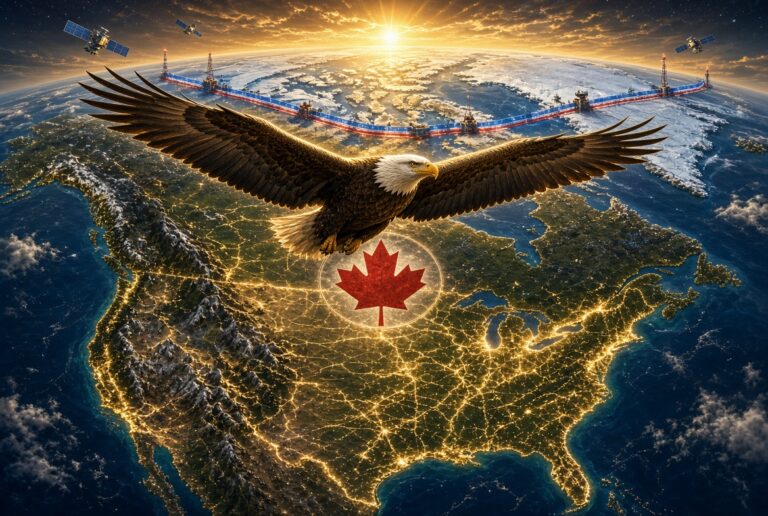

There was a time when Canada was simply Canada.
Ceuta’s border crisis is a warning that weak enforcement, mass migration and foreign influence can transform a friendly neighbor into a continental vulnerability.
By Hans Wilder | The Watertown Post | Opinion
There was a time when Canada was simply Canada.
For those of us who grew up in Northern New York, crossing the border was hardly an international expedition. We visited Upper Canada Village, toured Fort Henry in Kingston, attended concerts in Toronto, Ottawa and Montreal, and zipped across the St. Lawrence River to Gananoque or Brockville by speedboat. At 18, some young Americans even crossed over to buy beer legally—a proud regional tradition of questionable judgment and excellent international relations.
The border was real, but culturally it often felt like little more than a tollbooth between neighbors. Canadians had their own traditions, temperament and national identity, but they were unmistakably part of the same North American civilization.
How times have changed.
Canada today is increasingly difficult to recognize. Its familiar civic identity has been weakened by years of rapid population growth, mass immigration, economic dependence and political leadership that often appears more interested in global approval than continental security. Immigration itself is not the enemy; America and Canada were both built by immigrants. The danger begins when immigration exceeds a nation’s ability to screen, absorb, house and integrate newcomers while maintaining public order and a shared national identity.
The world received a brutal lesson in that distinction on July 30, 2026, when an extraordinary mass crossing overwhelmed the Spanish territory of Ceuta on the North African coast.
Spain’s Interior Ministry estimated that roughly 50,000 people crossed from Morocco into Ceuta by land and sea in approximately one day. Around half reportedly returned to Morocco, while Spanish officials reported numerous deaths and deployed military forces along the border. Prime Minister Pedro Sánchez described the crossing as a violation of Spain’s territorial sovereignty.
Ceuta is small, but the lesson is enormous: migration can become more than a humanitarian or economic issue. Under the wrong conditions, it can become an instrument of pressure capable of overwhelming local authorities, destabilizing communities and forcing national governments into emergency action.
That does not mean the people involved were soldiers or that every migrant represented a security threat. It means the movement of tens of thousands of people across a poorly controlled frontier can produce the strategic effect of an invasion even when the individuals crossing are unarmed. Once the border collapses, authorities lose the ability to determine who entered, why they came or whether hostile actors have hidden themselves within the larger population.
Spain and Canada do not have identical immigration systems. However, both governments have embraced unusually high immigration levels, humanitarian admissions and pathways allowing some people already inside the country to regularize their status. Spain recently processed a large legalization initiative involving hundreds of thousands of unauthorized migrants.
Canada’s current plan calls for 380,000 permanent-resident admissions annually from 2026 through 2028, plus a target of 385,000 new temporary workers and international students in 2026. Ottawa has acknowledged that previous levels became unsustainable and says it intends to reduce temporary residents to less than 5 percent of the population by the end of 2027. It is also accelerating permanent status for approximately 115,000 protected persons and as many as 33,000 temporary workers through additional initiatives.
That is not evidence of an imminent Ceuta-style crossing into Canada. It is evidence that Ottawa itself recognizes that its immigration system grew beyond comfortable limits and now requires a substantial recalibration.
For the United States, this is not somebody else’s social experiment. It is happening immediately north of the American heartland.
Statistics Canada reported that 66 percent of Canadians lived within 100 kilometers—about 62 miles—of the United States border. Toronto, Montreal and Vancouver are all located within this southern population belt. Canada’s largest concentrations of people, infrastructure, transportation and economic activity therefore sit directly beside the United States.
A failure of Canadian immigration enforcement, internal security or political stability would not remain neatly contained behind a maple-leaf curtain. It would immediately affect New York, Michigan, Minnesota, Washington state, Vermont, Maine and every American community connected to Canadian transportation and trade.
Washington does not need unnamed sources to demonstrate that it recognizes the issue. U.S. Customs and Border Protection separately tracks encounters along the northern land border, while Canada has enacted new immigration and border-security legislation, expanded intelligence sharing and allocated additional resources to combat organized crime, fentanyl trafficking and illicit financing. Ottawa says plainly that border security is essential to both national security and its relationship with the United States.
That is encouraging—but it is also an admission that the northern border can no longer be managed on nostalgia and polite assumptions.
China adds another dimension. Canada’s government says it intends to expand trade and investment ties with Beijing while maintaining economic and national-security “guardrails.” At the same time, Canadian security agencies describe foreign interference as one of the country’s greatest national-security threats.
Americans must separate ethnicity from state power. Chinese immigrants are not the Chinese Communist Party, just as immigrants from any country should not be collectively blamed for the actions of a foreign government. The legitimate concern is whether Ottawa can adequately screen foreign investment, political influence, research partnerships, technology transfers and individuals acting on behalf of hostile states.
Canada cannot expect the United States to remain indifferent while Ottawa pursues deeper economic relations with China, expands its population rapidly and leaves Washington responsible for much of the continent’s ultimate defense.
Canada has recently increased military spending and says it reached NATO’s 2-percent-of-GDP benchmark during the 2025–26 fiscal year—the first time it had done so since the fall of the Berlin Wall. That is progress, but the timing reveals how long the imbalance was permitted to continue. A sovereign nation cannot spend decades outsourcing the hard parts of sovereignty and then become offended when its principal protector starts asking difficult questions.
The Trump administration’s latest Canadian tariffs were officially imposed in response to what the White House describes as discriminatory treatment of American automobiles, alcohol, dairy products and other exports. The administration announced additional 50-percent duties on certain Canadian goods and explicitly placed those actions within its broader economic and national-security strategy.
The tariffs were not officially announced as punishment for Canadian immigration policy. Nevertheless, they represent something larger: Washington is no longer willing to treat Canada as an untouchable little sibling that can benefit from the American economy and security umbrella while resisting American strategic priorities.
The era of automatic accommodation is ending.
That does not mean America should invade or occupy Canada. Such talk distracts from the real objective. The United States needs a stable, prosperous and defensible Canada that understands it is part of the North American security system—not an offshore European social project conveniently parked above New York and Michigan.
Ottawa must reduce immigration to levels its housing, healthcare, law enforcement and infrastructure can realistically absorb. It must strengthen vetting and removals, intensify intelligence sharing with Washington, protect critical industries from hostile foreign influence and build armed forces capable of defending Canadian territory and the Arctic.
Ceuta demonstrated how quickly political assumptions can be swept aside when a border is tested at scale. Yesterday it was a small piece of Spanish territory beside Morocco. Tomorrow’s crisis could emerge somewhere entirely different, using different people, different methods and different political grievances.
America’s Golden Age cannot be constructed beside a security vacuum.
Canada still has time to restore control, rebuild its national confidence and return fully to the North American fold as a serious sovereign partner. But it does not have unlimited time. Geography has given Canada extraordinary protection and prosperity. Geography has also placed it directly against the United States.
That position carries responsibilities—and Washington is finally beginning to insist that Canada meet them.
About the Author