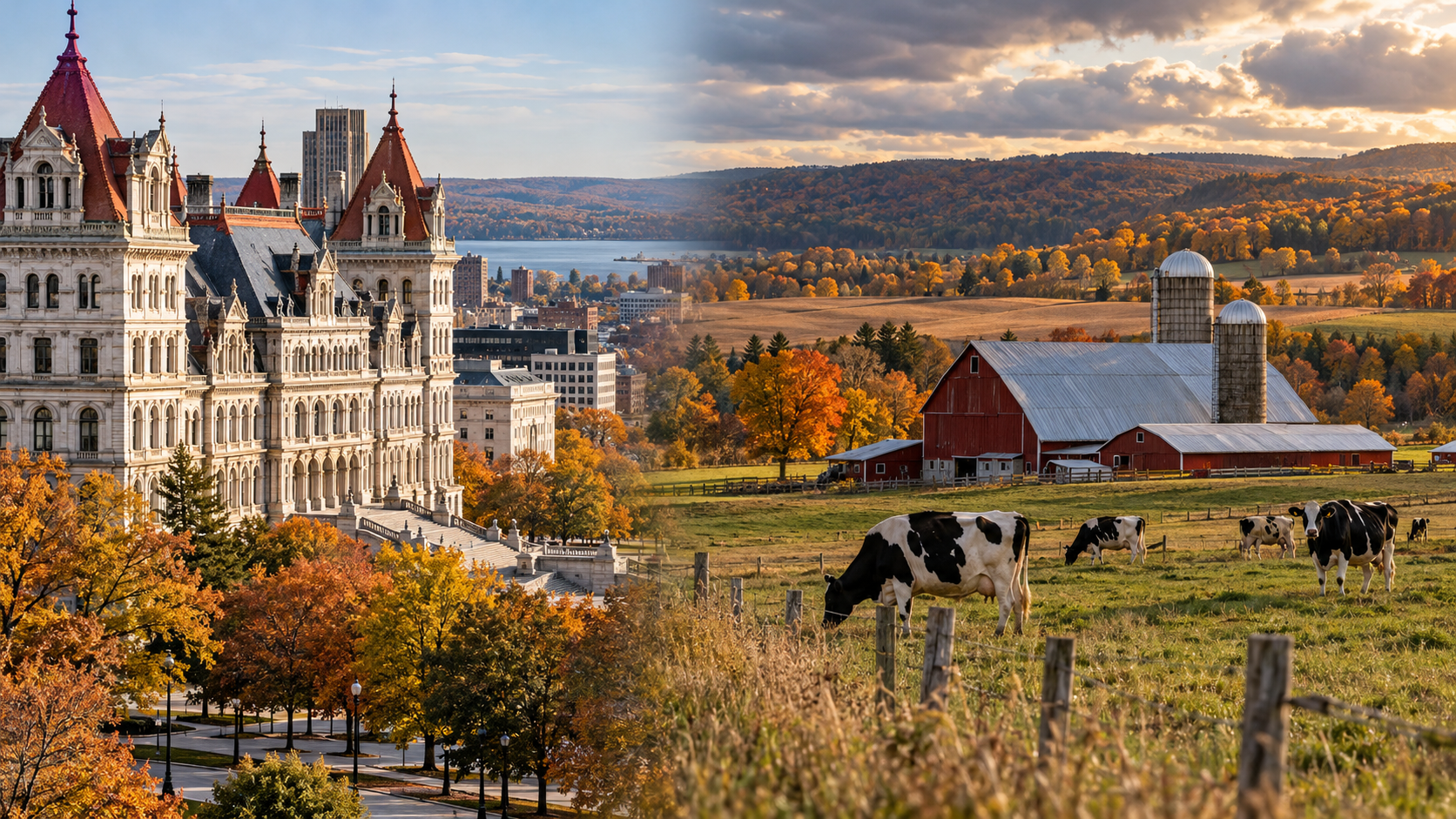
Albany policy and North Country agriculture. Generated editorial composite; not an actual shared location.
Ripple in Five | Watertown Post
Tuesday, October 27, 2026
A provocative headline published Monday by the New York Post has placed Gov. Kathy Hochul's record under renewed scrutiny.
The newspaper highlighted a sharply critical national assessment from the libertarian Cato Institute, which examined how governors' policies affected economic and personal freedom.
With New York's gubernatorial election approaching Nov. 3, the report adds another point of contention to an already heated political debate.
But what does the assessment actually mean for New Yorkers, particularly those living in the state's agricultural and rural communities?
The answer depends partly on how freedom is defined.
A debate over the meaning of freedom
The Cato Institute's 2026 report examines 97 policy measures across 10 categories, including taxation, housing, occupational regulations, education, firearms and individual rights.
The organization evaluates government policies according to a philosophy that generally favors greater individual choice and fewer restrictions on economic activity.
Hochul's administration disputes that approach, arguing that regulations protecting wages, public safety, children and consumers serve important public interests.
Both positions raise questions worth considering.
Can excessive regulation make it harder for families and businesses to prosper? Regulations can create costs and restrict choices.
But can the absence of regulation expose workers, consumers and communities to harm? That possibility also deserves consideration.
The more difficult question is where government should draw the line.
When protecting workers increases the cost of farming
Consider Northern New York's agricultural industry.
Farms already contend with fluctuating commodity prices, expensive equipment, utility bills and labor shortages.
New York's farmworker overtime requirements have added another consideration.
Beginning in January 2026, farm employees became entitled to overtime after 52 hours of work per week. That threshold will gradually decline to 40 hours by 2032.
The original farm labor legislation was signed under former Gov. Andrew Cuomo in 2019. The additional reductions were adopted by the state Labor Department during Hochul's administration.
Farm owners have warned that additional payroll expenses could make it harder to remain competitive. Some fear having to reduce employees' hours or limit operations.
Labor advocates counter that farmworkers deserve compensation for long hours, just as employees in other industries do.
New York provides a refundable farm employer overtime tax credit to help qualifying agricultural businesses offset eligible additional overtime expenses.
Separately, Hochul announced the launch of a $30 million state agricultural assistance program in June 2026 to address costs and market losses associated with federal tariffs imposed under President Donald Trump. The tariffs were a federal policy; the assistance program was a state response.
But do these measures adequately offset the financial pressures farmers face? That remains an important question for agricultural businesses.
A separate controversy illustrates how quickly proposed regulations can generate opposition.
In 2025, two New York City Democratic legislators introduced a bill preventing new or expanding large concentrated animal feeding operations from receiving certain permits. The legislation would affect dairy operations reaching the regulatory threshold of approximately 700 cows.
Jefferson County agricultural coordinator Jay Matteson strongly criticized the proposal, explaining that many North Country dairy operations exceeding that size are family-owned businesses.
Supporters of the proposal argue that large operations can create environmental problems and place pressure on smaller farms.
However, the legislation remains in committee. Hochul did not introduce it, and WWNY reported that sources in Albany said she would not sign it.
The controversy nevertheless demonstrates the competing priorities surrounding agriculture: environmental protection, economic survival and the independence of family farms.
Whose rights come first when farmland becomes solar development?
Another dispute is unfolding much closer to Watertown.
In October, North Country Public Radio reported that state regulators had approved the proposed Greens Corners Solar Project, covering approximately 800 acres in Watertown and Hounsfield.
Nearby residents have questioned the project's effect on agricultural land, property values and the rural landscape.
Some also object to the state's authority to approve large energy developments despite local concerns.
Developer AES argues that the project will generate tax revenue, construction employment and renewable electricity.
There is another perspective worth considering: The property belongs to a local dairy farmer, and private landowners have an interest in deciding how their property is used.
Should a farmer be free to lease land for additional income?
Should neighboring property owners have greater influence when that decision changes the surrounding landscape?
And how much authority should Albany have over development decisions affecting rural municipalities?
These competing interests make the issue more complicated than a simple disagreement over renewable energy.
Hochul's administration has supported renewable development while also making affordability-related revisions to New York's climate law. Agricultural organizations welcomed some of those adjustments, while environmental advocates criticized them for weakening the state's original commitments.
Hunting and fishing: Another definition of freedom
For many Northern New Yorkers, outdoor recreation is not merely entertainment. It is a tradition tied to family, conservation and local economies.
The Department of Environmental Conservation recently adopted an Earn-a-2nd-Buck deer management system intended to encourage hunters to harvest antlerless deer.
DEC argues that managing deer populations can protect habitat and reduce ecological damage.
Hunters may welcome the additional opportunities while still questioning whether the new requirements fit their preferred hunting practices.
Meanwhile, DEC has proposed reducing the daily walleye harvest limit in Jefferson County's Lake Ontario waters to two fish, with no more than one exceeding 24 inches.
The department cites concerns about declining fish populations and protecting reproduction.
Some anglers may question additional limits, while others see conservation measures as essential to preserving future fishing opportunities.
The proposal has not been confirmed as adopted.
These examples demonstrate how policies intended to protect natural resources can simultaneously affect the freedom of people who use them.
Did national politics influence the conversation?
The discussion is occurring against an increasingly contentious political backdrop.
On Oct. 9, President Donald Trump visited Syracuse to campaign for Republican gubernatorial candidate Bruce Blakeman.
Trump criticized Hochul's record on energy prices, crime, immigration and economic policy.
The event drew enthusiastic supporters and protesters.
Could Trump's appearance influence public perceptions of Hochul? Possibly. Political campaigning can reinforce existing opinions or introduce new arguments.
However, available evidence does not establish that the visit changed voter preferences.
An October 21 Quinnipiac survey found different political preferences among Upstate respondents compared with statewide voters.
The statewide figures also demonstrate why a think tank's evaluation cannot be treated as a substitute for public opinion.
Cato's policy assessment, Trump's campaign statements and New Yorkers' voting intentions measure three different things.
The questions beyond the headline
Whether discussing farm regulations, solar development, hunting or fishing, a recurring disagreement emerges.
One side emphasizes government's responsibility to protect workers, communities and natural resources.
The other questions whether those protections impose excessive costs, restrict individual choices or diminish local authority.
Neither perspective should escape scrutiny.
A regulation's stated purpose does not guarantee that it works as intended. Likewise, opposition to a regulation does not automatically mean its underlying problem should be ignored.
For North Country residents, these debates have practical consequences for their livelihoods, traditions and communities.
When the government promises protection or progress, who receives the benefits? Who bears the costs? And who ultimately gets to decide whether the tradeoff is worthwhile?
About the Author