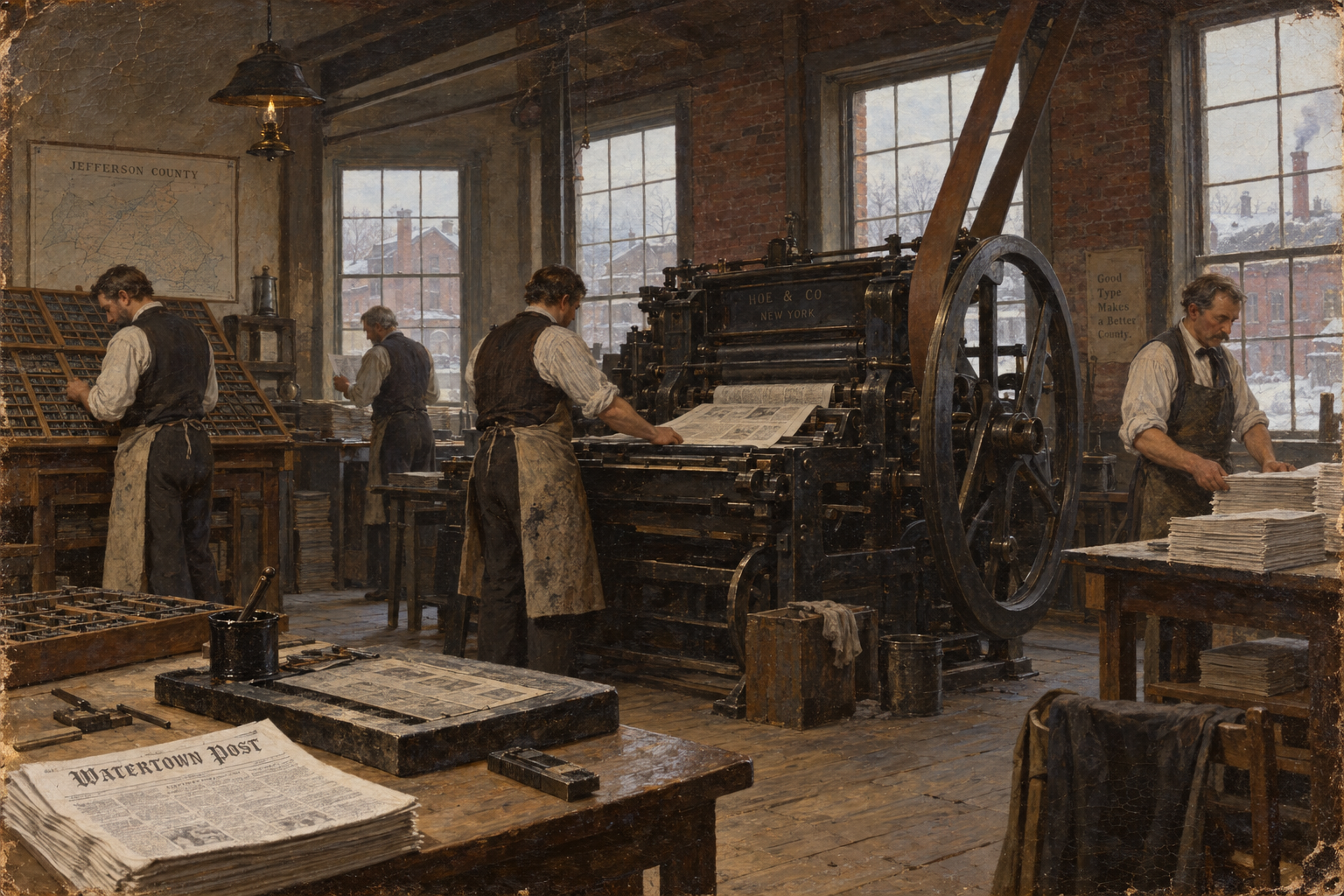
An imagined view of the Watertown Post’s printing room in the 1870s, with printers setting type and operating a belt-driven press. AI-generated artwork styled as an aged oil painting.
By Hans Wilder
I collect historical newspapers, antique firearms, and domain names.
That combination probably tells you something about me. I’m interested in things with a story, things that survived, and names that might still have a future.
An old newspaper lets you read history before anyone knew how it would turn out. The advertisements, arguments, local notices, and headlines capture what people thought mattered that week. An antique firearm is another kind of historical object, carrying evidence of the craftsmanship and circumstances of its time. A domain name offers a different possibility: somewhere to build something new.
For me, the Watertown Post brings those interests together.
Today, I own and operate WatertownPost.com through Digital Media USA. But a newspaper called the Watertown Post was serving this city long before websites, smartphones, or anyone arguing in a Facebook comment section.
Its story reaches back to 1870.
The name on the old paper
A Jefferson County history dates the original Watertown Post to July 16, 1870, identifying George C. Bragdon & Co. as its founders and Bragdon as editor. Other historical accounts connect the operation to Hanford & Wood, a local printing and bookbinding business. Jefferson County gazetteer
The Post began as an independent literary and family newspaper. Its early editions included a literary supplement printed in New York City and folded into the paper in Watertown.
That detail appeals to the newspaper collector in me. We often preserve the big headlines—the wars, elections, assassinations, and disasters. But a newspaper also belongs to ordinary life. Somebody paid for it, brought it home, read its stories, checked the advertisements, and perhaps saved a piece of it.
In 1872, a newspaper directory listed the Post at $2 a year, with a claimed circulation of 2,500. It was competing for readers and advertisers just as publications do today, although its publishers had considerably more machinery to maintain. 1872 newspaper directory
A Republican chapter in Watertown’s publishing history
The paper changed under Lotus Ingalls, who acquired the establishment in 1874. A historical account describes his transformation of the Post into an independent Republican newspaper, giving political and public affairs greater attention while retaining its literary and family material. History of Jefferson County newspapers
That is a part of the history I find especially interesting given my own Republican and conservative outlook and my interest in the idea of an American Golden Age.
I see a connection in the willingness to publish with an identifiable editorial perspective. At the same time, Ingalls belonged to his century, and I belong to mine. Understanding his newspaper means taking its own circumstances seriously.
The operation itself was substantial. A contemporary Watertown history described the Post’s brick premises on Arsenal Street, steam-powered printing, and associated job-printing and bookbinding work. It reported approximately 20 employees and a claimed newspaper circulation exceeding 5,000. Contemporary account
Those are the kinds of details that make the past tangible to me: a building, equipment, employees, customers, and thousands of pages going out into the community.
The long rest
In 1884, the newspaper appeared under the expanded title The Watertown Post, and Northern New York Republican. The Library of Congress records that title and a later return to the shorter Watertown Post name. Library of Congress record
After that, the trail becomes less complete.
The New York State Library’s holdings directory lists surviving Post issues from 1888. The records examined so far do not establish its exact final publication date, so I cannot honestly tell you the precise number of years it rested before the modern revival. Surviving newspaper holdings
And if I’m going to write about history, I want to get that right. An unanswered question is a reason to keep looking.
“Resting” is how I think about the long interval between the old paper and the name’s return. The present publication is a new operation reviving a historical name. Its connection to the original is something to explore and document, rather than assume.
A collector’s interest becomes part of the story
My interest in old newspapers extends beyond researching this particular title. I collect them.
One example is an original August 4, 1812 edition of the Utica Patriot in our collection. WatertownPost.com has already examined that issue, using photographs of the actual paper to explore the news and arguments Americans were reading during the opening months of the War of 1812. The Utica Patriot feature
That is the kind of history I enjoy: opening something that survived for generations and paying attention to what is actually on the page.
My collection of antique firearms reflects a related interest in material history. Domain names take that curiosity in another direction. A name can carry associations, identify a place, and become the starting point for a project.
With WatertownPost.com, there is now an opportunity to investigate an old publishing history while adding a modern chapter.
The Post is publishing again
On May 26, 2025, the modern Watertown Post published its introductory article. It announced a local publication covering Watertown and the surrounding region, with news, commentary, and community life among its subjects. Our introductory article
The tools have changed considerably since the Arsenal Street printing operation. Readers now reach the Post through a screen, and a domain name does some of the work once performed by a sign over a newspaper office.
The historical questions remain open. I still want to see an original Watertown Post issue, examine its masthead, read its editorials, and discover the businesses that advertised in its pages. Institutions list surviving copies, but locating a usable scan has proved more difficult than locating references to the paper.
If you have an issue, photograph, clipping, subscription receipt, or another artifact connected to the original Watertown Post, I would like to hear from you.
I’m the guy publishing under the name today. I’m also the collector who wants to know what came before—and who would be very happy to spend an afternoon reading a newspaper from 1870.