Nearly 9,000 unserved North Country locations may receive Starlink satellite internet instead of fiber-optic connections under the federal broadband deployment program.
Satellite internet could finally connect remote households—but critics warn the North Country may be receiving a cheaper substitute instead of permanent broadband infrastructure
For thousands of households across Northern New York, the long wait for high-speed internet may finally be ending.
The connection, however, may arrive from hundreds of miles above the Earth rather than through a fiber-optic cable running past the front door.
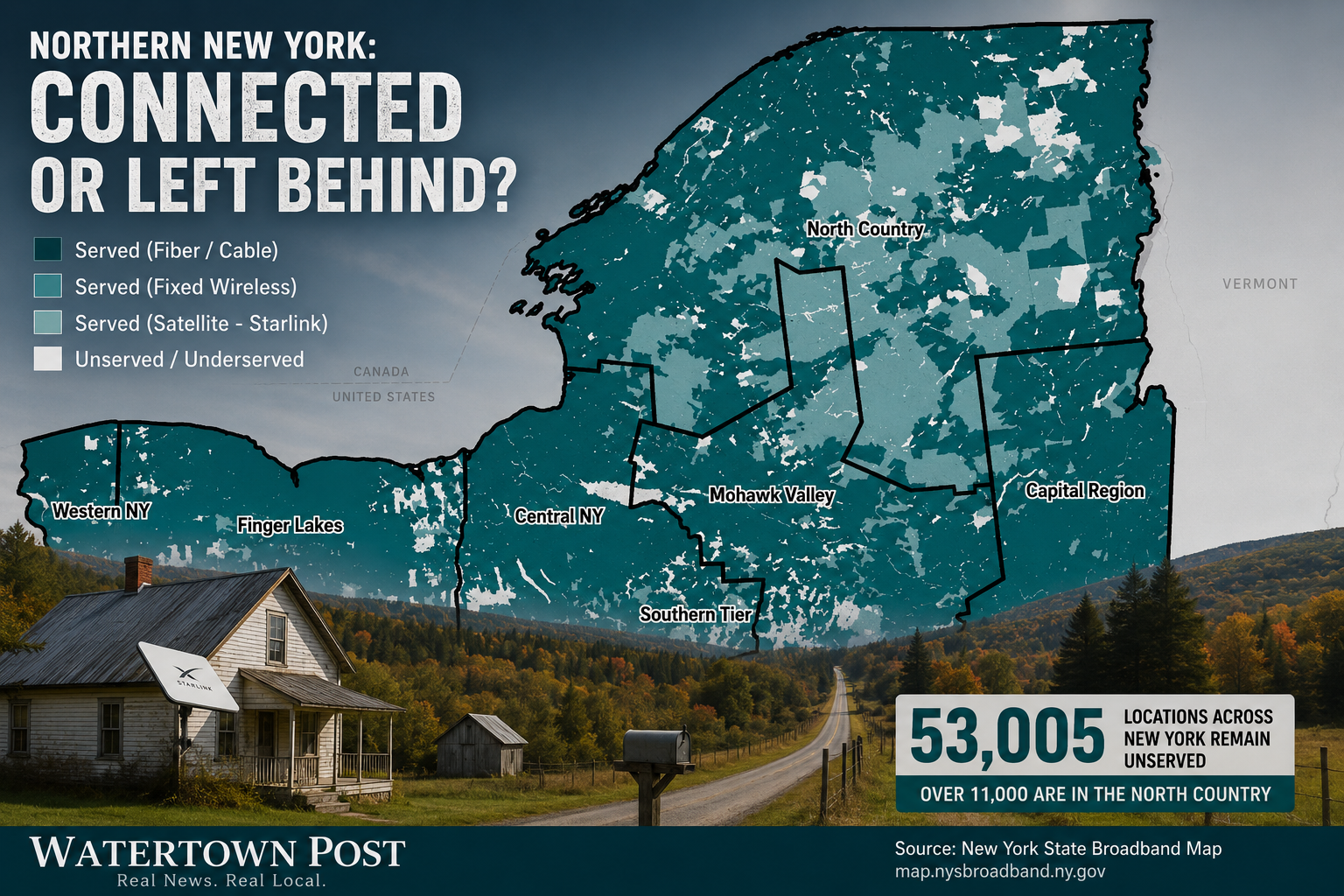
Final contracts awarded through the federal Broadband Equity, Access and Deployment program indicate that Elon Musk’s Starlink satellite network will serve nearly 9,000 of the approximately 11,430 still-unserved locations across the North Country.
That means families in rural portions of Jefferson, Lewis, St. Lawrence, Franklin, Essex, Clinton and surrounding counties could finally receive broadband service after years of watching cable and fiber construction stop several miles—or sometimes several hundred feet—short of their homes.
For genuinely isolated properties, Starlink could be transformative. A farmhouse on a remote road outside Harrisville, a camp deep in the Adirondacks or a residence miles from the nearest utility connection may never be economically practical to reach with fiber.
For those customers, a satellite dish may be considerably better than waiting another decade for a cable crew that is never coming.
But broadband advocates are questioning whether satellite service is being used only where necessary—or whether Northern New York is being handed the least expensive solution because Washington decided that building permanent rural infrastructure cost too much.
From Fiber to Satellites
The BEAD program was established through the 2021 Bipartisan Infrastructure Law as a $42.45 billion national effort to connect homes and businesses that still lacked dependable broadband. New York was originally allocated more than $664 million under the program.
Under the original approach, fiber-optic construction was generally treated as the preferred solution. Fixed wireless and satellite service were supposed to be used primarily where fiber would be extraordinarily expensive or impractical.
Federal policy changes in 2025 placed greater emphasis on technological neutrality and lowering the immediate cost of broadband projects. That allowed satellite providers to compete more directly against companies proposing fiber and terrestrial wireless networks.
The resulting North Country awards are heavily weighted toward Starlink.
According to the project figures, Starlink is expected to receive approximately $13 million to connect 8,687 North Country locations. Verizon fiber would reach another 925 locations, primarily in the eastern Adirondacks, through projects costing approximately $17 million. Fixed-wireless providers would serve roughly 1,800 additional locations at a cost of about $5 million.
The contrast is difficult to miss.
The government can connect thousands of homes through satellite for considerably less money than it would cost to extend fiber through mountains, forests, farmland and sparsely populated back roads.
That may be efficient accounting. Whether it represents good long-term infrastructure policy is another matter.
A Lifeline—But Not Necessarily Fiber’s Equal
Starlink uses a constellation of low-Earth-orbit satellites rather than the traditional geostationary satellites associated with older rural internet services.
The system can deliver broadband-level speeds and has already become a lifeline for homes, farms and businesses without practical access to cable or fiber. Starlink currently advertises residential service beginning at $55 per month, although prices, speeds and equipment costs vary by location and plan.
Many Northern New Yorkers who have used the service describe it as a dramatic improvement over dial-up, cellular hotspots or older satellite systems.
But Starlink is still a shared wireless network.
Its performance can be influenced by congestion, tree cover, equipment placement, weather and the number of customers using capacity within a particular area. Academic research has also found that Starlink performance can vary depending on network infrastructure and the location of terrestrial connection points.
Fiber, by comparison, provides enormous capacity through a physical connection and can be upgraded repeatedly without rebuilding the entire route.
That distinction matters in Northern New York, where communities are attempting to attract remote workers, technology companies, advanced manufacturing, data centers and younger families who expect reliable internet as a basic utility.
A connection that works well for streaming television today may not necessarily provide the same economic foundation as fiber 10 or 20 years from now.
Jefferson, Lewis and St. Lawrence Counties Have Plenty at Stake
The broadband problem is not limited to isolated Adirondack camps.
Large sections of Jefferson, Lewis and St. Lawrence counties remain rural enough that traditional providers have little financial incentive to extend their networks. A road may have only a few houses spread across several miles, making every new connection expensive.
The result is a familiar Northern New York problem: residents pay taxes, run businesses, raise families and contribute to the economy, but are told that providing modern infrastructure to their neighborhood does not make financial sense.
That affects far more than Netflix.
Reliable broadband now supports telemedicine, education, agricultural technology, emergency communications, banking, employment, tourism reservations and the daily operation of small businesses.
A farmer outside Adams, a contractor near Gouverneur, a remote employee in Lewis County and a family living beyond the cable lines in Theresa all need dependable internet for different reasons.
Broadband is no longer a luxury service. It is the digital equivalent of the rural telephone and electric lines previous generations built into the countryside.
The Rural Electrification Comparison
Broadband advocates frequently compare today’s internet expansion to rural electrification during the 1930s.
Electric companies initially found many rural customers too expensive to serve. The cost of running poles and wires over long distances could not be justified by the revenue from a handful of farms.
America ultimately decided that electricity was too important to leave entirely to short-term market calculations.
Supporters of fiber expansion argue that broadband should be treated similarly. More profitable connections in villages and suburban areas help make it possible to reach expensive rural locations, creating one interconnected network rather than dividing customers into first-class and second-class service areas.
Under the satellite-heavy approach, critics fear that rural residents will technically be classified as “served,” ending their eligibility for future government-funded fiber construction even though no permanent terrestrial network was built.
The map may show the digital divide as closed.
The cable, however, will still end several miles down the road.
Affordability Could Become the Next Problem
The initial installation is only part of the equation.
Fiber and cable networks may eventually support competing providers or publicly negotiated service requirements. A household assigned to Starlink may have fewer realistic alternatives, particularly after government maps officially classify that address as having broadband access.
That raises concerns about future prices.
Starlink has adjusted residential pricing and introduced different service tiers as demand and network conditions have changed. New York also requires qualifying providers to offer reduced-price broadband plans for eligible low-income customers, and Starlink has created a New York plan intended to comply with the state’s Affordable Broadband Act.
Still, rural customers could become dependent on a single provider whose equipment, monthly rates and service policies are controlled by one private company.
Building a fiber line requires a large public investment upfront. Satellite service can shift more of the continuing expense onto individual households through monthly subscriptions, equipment charges and future price increases.
Government saves money today.
The customer may keep paying the difference indefinitely.
Better Than Nothing Is Not the Same as Best
There is no serious argument that residents should remain disconnected while waiting for a perfect solution that may never arrive.
Starlink can provide fast, usable internet in places where almost nothing else works. For an isolated household, it may be not merely acceptable but life-changing.
The larger question is whether nearly 9,000 of the North Country’s roughly 11,000 remaining locations are truly so remote that satellite is the only reasonable solution.
That is a remarkably large percentage of the region’s unfinished broadband map.
Northern New York should not reject satellite technology simply because fiber is technically superior. Nor should government pretend that installing a dish is always equivalent to constructing permanent broadband infrastructure.
The region needs an address-by-address explanation of why fiber, cable or fixed wireless was rejected for each community assigned to satellite service.
Residents should also know whether receiving federally subsidized Starlink will prevent their properties from qualifying for fiber construction under future state or federal programs.
Northern New Yorkers have waited long enough for dependable internet. They deserve more than a box checked on a government spreadsheet.
For some households, Starlink will finally open the door to the modern world.
For others, it may become another example of the North Country being told to accept the cheaper version because building the real thing north of Syracuse was considered just a little too expensive.
About the Author