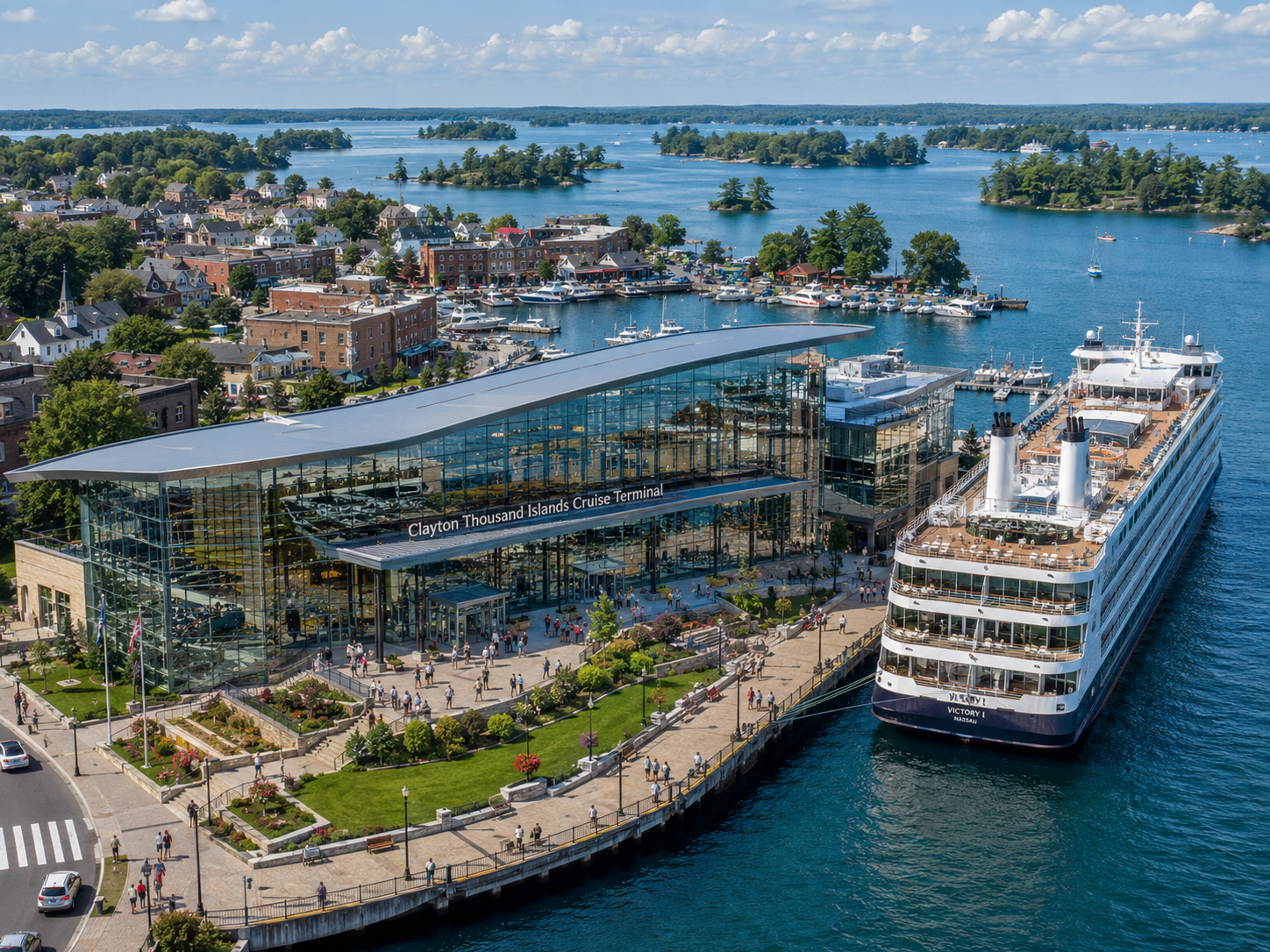
A conceptual rendering shows a modern glass-and-steel cruise terminal on the Clayton, New York waterfront, designed as a potential Thousand Islands departure point for Great Lakes and St. Lawrence cruise tourism.
Clayton, N.Y. — By Hans Wilder
There are moments when a community can either recognize the future coming over the horizon or stand on shore waving politely as it sails past.
Great Lakes cruise tourism is growing, new ships are entering the market, existing ports are expanding, and cities across the region are spending real money to position themselves for the next generation of freshwater travel.
It may be time for Jefferson County to think, in the immortal words of Billy Fuccillo, huge.
Jefferson County should begin studying the development of a full-service Great Lakes cruise facility—either along the Thousand Islands section of the St. Lawrence River or within one of the protected bays along the eastern shore of Lake Ontario.
Not merely a place where a ship might occasionally drop anchor and unload a few passengers into tender boats. Jefferson County should explore becoming both a destination and an embarkation port: a place where passengers arrive, stay in hotels, eat in restaurants, board a ship and begin their Great Lakes adventure.
That is where the bigger money is.
Milwaukee clearly understands what is happening. The city is completing a roughly $17 million South Shore Cruise Dock project that includes a 50,000-square-foot platform designed to serve Seawaymax vessels—the largest ships capable of navigating the St. Lawrence Seaway and Great Lakes system. Milwaukee expects approximately 64 cruise-ship calls and more than 20,000 cruise visitors during 2026.
Milwaukee is not doing this because city leaders suddenly developed a strange emotional attachment to gangways and luggage carts. They see an industry growing around them, and they want their city positioned to collect the economic benefits.
Jefferson County should be looking at the same opportunity.
The Great Lakes Cruise Industry Is Growing
Cruise the Great Lakes projects that more than 23,000 individual passengers will take Great Lakes cruises during 2026, an increase of approximately 5 percent from 2025. The industry expects more than 800 port visits during the season, nearly 15 percent more than the previous year.
Because each passenger may visit several ports during one trip, total cruise-passenger visits throughout the region are expected to approach 175,000 in 2026—also an increase of nearly 15 percent. The projected regional economic impact is expected to exceed $300 million, approximately 25 percent higher than in 2025.
The longer-term trend is equally important. Great Lakes cruise-passenger traffic has increased roughly 60 percent since 2018, when seven ships operated in the region and generated approximately 100,000 total passenger visits.
There is no responsible public forecast available that tells us precisely how many Great Lakes cruise passengers there will be in 2035 or 2045. Anyone tossing out an exact number that far into the future is probably consulting the respected maritime research institution known as “I Made It Up.”
But the measurable direction is clear: more ships, more itineraries, more port visits, more passenger traffic and more public investment in cruise infrastructure.
Seven cruise lines are offering Great Lakes sailings in 2026, using approximately 10 ships and operating nearly 150 itineraries. American Cruise Lines has entered the market, adding new routes and creating more opportunities for domestic, passport-free cruises.
Jefferson County does not need to predict the exact number of passengers in 2040 to understand the opportunity. It needs to recognize that cities already investing in docks, customs facilities, transportation links and passenger services will have an enormous advantage when cruise lines decide where to expand next.
Jefferson County Has the Geography
Jefferson County occupies one of the most strategically interesting locations in the entire Great Lakes–St. Lawrence system.
To the west is the vast open water of Lake Ontario and, beyond it, the other Great Lakes. To the north and east are the Thousand Islands, the St. Lawrence River and the route toward Montreal, Quebec City and the Atlantic Ocean.
This is not some artificial tourist attraction that would need to be invented by consultants using foam-board renderings and words like “synergy.” The scenery already exists.
The Thousand Islands are internationally recognized. Sackets Harbor offers War of 1812 history, a naturally protected harbor and a walkable waterfront village. Alexandria Bay and Clayton already possess established tourism identities. Cape Vincent sits where Lake Ontario meets the St. Lawrence River. Henderson Harbor, Chaumont Bay and Black River Bay offer additional possibilities along the eastern Lake Ontario shoreline.
A properly selected location could place passengers within reach of:
- The Thousand Islands and Boldt Castle
- Sackets Harbor Battlefield and Madison Barracks
- Clayton’s waterfront and Antique Boat Museum
- Cape Vincent and the lake-river transition
- Fort Drum and military-history attractions
- Watertown’s hotels, restaurants and retail businesses
- Regional wineries, farms, fishing destinations and historic communities
- Cross-border excursions involving Kingston and eastern Ontario
Jefferson County is also positioned within a large North American customer market. Potential passengers could be drawn from across New York State, eastern Ontario, southern Quebec, New England, Pennsylvania and the northeastern United States.
Toronto, Ottawa and Montreal all represent major metropolitan markets within the broader regional travel shed. Syracuse provides commercial-air access, while Interstate 81 connects Jefferson County directly with central New York and Canada.
For travelers coming from the Northeast, a Jefferson County embarkation point could eliminate the need to travel all the way to Chicago, Milwaukee, Duluth or another western Great Lakes port before beginning a cruise.
The sales pitch practically writes itself: arrive in the Thousand Islands, spend a night or two in Jefferson County, then sail west across the Great Lakes—or east toward Montreal and the Atlantic.
Being a Starting Port Is More Valuable Than Being a Stop
There is an important economic difference between being a port of call and being a port where cruises begin or end.
A port-of-call passenger might step off the ship for several hours, take a bus tour, buy lunch and return before departure.
An embarking passenger may arrive a day early, book a hotel room, eat dinner, buy supplies, pay for parking, use local transportation and possibly remain after the cruise. Cruise crews must also obtain food, fuel, equipment, waste services, maintenance and other supplies.
That creates business beyond the waterfront.
A Jefferson County cruise terminal could support jobs involving:
- Construction and marine engineering
- Longshore and docking operations
- Passenger processing and security
- Customs and border services
- Ground transportation and tour buses
- Hotels and short-term lodging
- Restaurants, catering and food suppliers
- Ship provisioning and maintenance
- Travel agencies and tour operators
- Retail, entertainment and cultural attractions
- Marketing, administration and terminal management
The terminal itself would not be the entire economic-development project. It would be the front door through which thousands of higher-spending visitors enter the county.
Tourism Is Already Big Business Here
Jefferson County is not starting from zero.
Visitors spent approximately $348.3 million at local businesses in Jefferson County during 2024, including about $105.8 million on food and beverages, $64.4 million on lodging, $47.4 million on retail goods and services and $19.2 million on recreation and entertainment.
The county has also begun reinvesting visitor-generated occupancy-tax revenue through its Visitors Investment Fund. In 2026, Jefferson County committed approximately $300,000 toward tourism-related capital improvements, attractions and amenities supporting overnight stays.
That is a good beginning.
But $25,000 grants for individual tourism projects and a $300,000 investment fund are not the same thing as developing transformative regional infrastructure.
A cruise terminal would require county, state, federal and private participation. It could involve Empire State Development, maritime-development funding, federal transportation grants, port-security programs, private cruise operators and possibly a public authority or development corporation.
Jefferson County would not necessarily have to write one enormous check and become the proud owner of three miles of concrete and a gift shop selling captain hats.
The county’s first investment should be a serious feasibility study.
What the County Should Examine
A feasibility study should identify several possible sites and compare them according to water depth, harbor protection, Seaway access, road connections, environmental conditions, available land and proximity to existing tourism businesses.
It should determine whether the better opportunity lies along the St. Lawrence River, where ships are already passing through the Thousand Islands, or along eastern Lake Ontario, where a protected harbor could potentially become a cruise origin and destination.
The study should also examine:
- Required channel and dock depth
- Vessel length and Seawaymax requirements
- Customs and immigration facilities
- Passenger-terminal needs
- Parking and bus access
- Shore power, water and waste services
- Security and emergency-response requirements
- Winter weather and seasonal operations
- Environmental permitting
- Connections to Watertown and Syracuse
- Agreements with cruise lines before construction
- Opportunities for mixed cargo, ferry or excursion-boat use
The county should talk directly with Viking, American Cruise Lines, Pearl Seas, Ponant and other operators already sailing the Great Lakes. The most important question is not simply, “Can we build a dock?”
It is: What would make cruise lines use it?
Build the Market Around the Terminal
A terminal alone will not guarantee success.
Jefferson County would need coordinated shore excursions and passenger experiences ready before the first ship arrives. Cruise lines sell complete itineraries, not random bus rides through a county while everyone argues about where to eat lunch.
The region could package excursions around War of 1812 history, Thousand Islands mansions, shipwreck diving, lighthouses, military history, local agriculture, fishing, boating, wineries and cross-border culture.
Sackets Harbor could become the historical stop. Clayton could be the maritime and boating stop. Alexandria Bay could offer the classic Thousand Islands experience. Watertown could function as the lodging, transportation and service center.
The county should also explore partnerships with Kingston and eastern Ontario rather than treating Canadian communities only as competition. A binational cruise corridor involving Jefferson County, Kingston and the Thousand Islands could be marketed as one of the most historically and geographically distinctive cruise regions in North America.
The Risk Is Not Thinking Big Enough
Naturally, there would be objections.
Someone will say it costs too much. Someone will say the ships are too large. Someone will say tourists will never come. Someone will demand that every dollar instead be spent filling the same pothole for the ninth time.
Those concerns deserve serious examination. A cruise facility should not be built without commitments from operators, a realistic financing plan and a site capable of supporting the ships.
But refusing to study the idea because it sounds ambitious would be the greater mistake.
Great Lakes cruising is expanding. Ports are investing. New itineraries are being introduced. Communities that once viewed cruise ships as occasional curiosities are now treating them as economic infrastructure.
Jefferson County possesses something many places would spend billions trying to manufacture: extraordinary waterfront, international geography, maritime history and access to one of the largest freshwater systems on Earth.
We should not settle for watching the ships pass through the region on their way to someplace that had the nerve to build a dock.
Jefferson County should conduct the study, approach the cruise lines, identify the right location and determine what it would take to become a true Great Lakes cruise gateway.
Eastern Lake Ontario should not merely appear in the brochure.
It should be where the journey begins.
About the Author